Blog Reset (Part 2)
Posted by Mark on February 26, 2013 at 05:24 | Last modified: July 25, 2013 11:40As mentioned here, I was 29 posts behind my twice-weekly goal on September 8 of last year. With the exception of a couple weeks at the beginning of January, I have pretty much posted every trading day since. As of today, I am roughly 14 posts ahead of schedule.
With a target length of 300 words per post, I will aim to post twice weekly going forward. This blog keeps me on track with my goals and is a way to keep me accountable in lieu of a manager or supervisor that I used to have in my corporate days as a pharmacist.
Categories: Accountability | Comments (0) | Permalink2012 Performance Evaluation (Part 10)
Posted by Mark on February 25, 2013 at 06:01 | Last modified: February 13, 2013 05:19In http://www.optionfanatic.com/2013/02/21/2012-performance-evaluation-part-9/, I disclosed a third flaw in my preceding analysis showing potential utility for a LF.
The corrected equity curves and performance results are shown below:
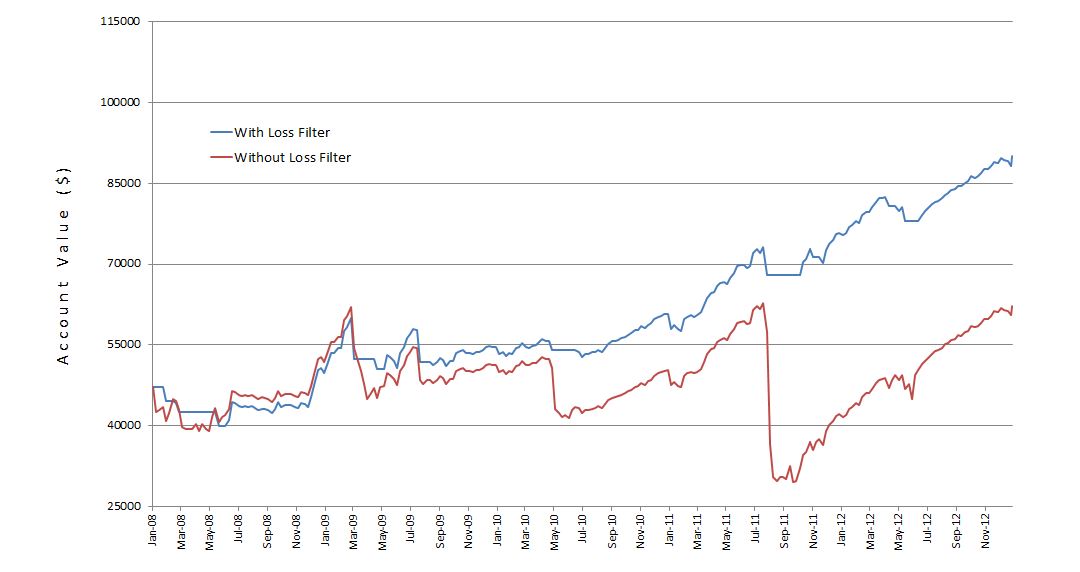
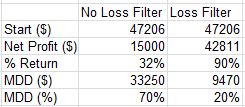
The methodology is still worth researching but a 90% profit is nowhere close to 143%.
I am categorizing this post as optionScam.com (http://www.optionfanatic.com/2012/04/21/optionscam-com/) because I have found deception to be commonplace among newsletter and trader education/mentorship offerings. You should understand the theory behind a proposed system and review the results to see if they are consistent with general tenets of the theory. Furthermore, you should not fall for the “one good example” that might be cherry picked from a population of losers. You should always be thinking about other possible combinations, market environments, and trade situations to evaluate whether an exemplar successful in one situation is likely to be successful in others.
I outperformed with this analysis by going beyond human nature to detect an honest mistake and I believe this is exactly what we need to do as traders to be successful. I really cannot emphasize that enough. Human nature is falling prey to the confirmation bias, as written here:
> The reason confirmation bias can be so deadly to a human is because… we tend to look only
> for information that supports our pre-held beliefs… not only could we be biased about the
> information we do get a hold of, we may completely sidestep vital information in the first
> place, just because we are subconsciously ignoring everything that doesn’t fit in with our
> beliefs.
For the most part, traders maintain hope that a “Holy Grail” exists. Once we get wind of a potential contender, we become captivated. We confirm evidence in support and discard, overlook, or refuse to scrutinize evidence to the contrary. Confirmation bias must be one of the biggest culprits of flawed system development methodology. If left undetected then traders will fall victim (i.e. lose money) to the “scam” perpetrated by another or, even worse, inadvertently by themselves.
Categories: Accountability, optionScam.com, System Development | Comments (0) | Permalink2012 Performance Evaluation (Part 9)
Posted by Mark on February 22, 2013 at 05:29 | Last modified: February 13, 2013 05:20In http://www.optionfanatic.com/2013/02/20/2012-performance-evaluation-part-8/, I detailed the loss filter (LF) concept and showed performance results with and without the LF. I then went on to describe two potential flaws with the analysis.
As mentioned previously, when I see shockingly impressive results I tend to scrutinize closely to see if mistakes, either deliberate or inadvertent, have been made. Did you look closely at the graph in the previous post? If so then you might have seen what I did:
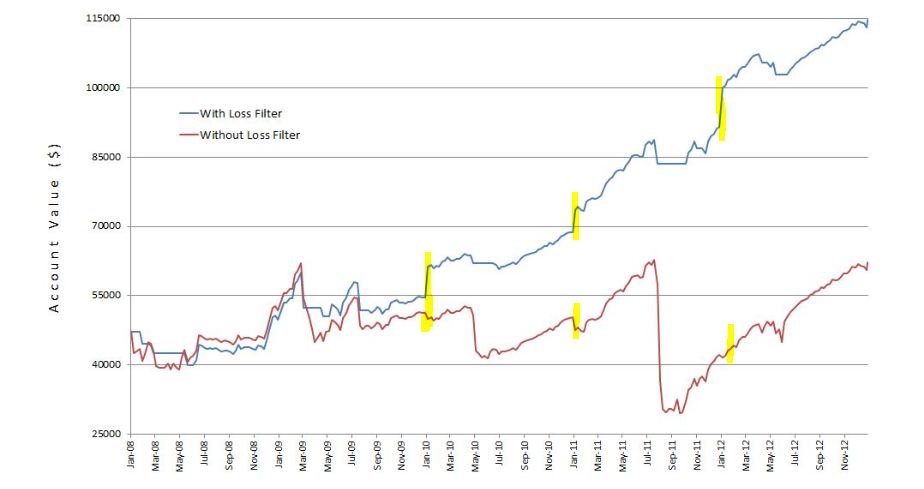
When activated, the LF keeps me out of the market, which results in a flat equity curve. The red line should always be gaining when the blue line is gaining because the red line is always in the market (no LF). Highlighted in yellow above are three occurrences where the blue line was gaining and the red line either gained much less or lost.
As it turns out, I made a mistake in the spreadsheet at year-end 2009, 2010, and 2011!
I will continue this analysis in my next post.
Categories: Accountability | Comments (1) | Permalink2012 Performance Evaluation (Part 8)
Posted by Mark on February 21, 2013 at 06:41 | Last modified: February 13, 2013 05:21In http://www.optionfanatic.com/2013/02/19/2012-performance-evaluation-part-7/, I discussed using the equity curve as a signal to stop trading when it crosses below its own moving average. Another concept I have been considering is to exit the market in favor of paper trading when I have an unusually large weekly drawdown and to resume live trading once consecutive weekly paper gains are posted.
Here is a graph of account value weekly change:
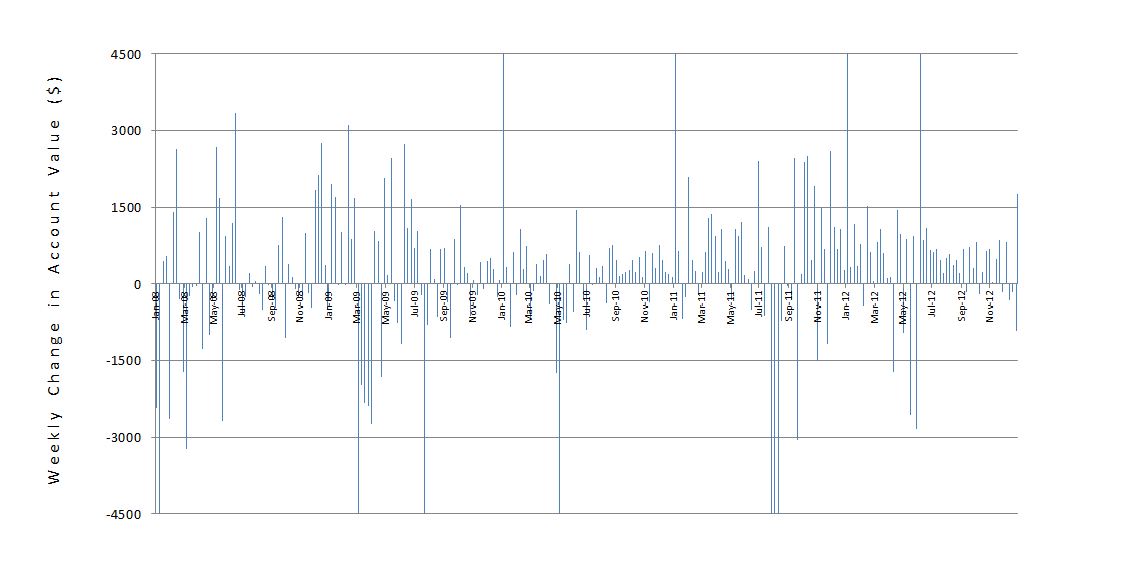
Since 2008, I have made money in about 64% of all weeks. The largest losses seem to be somewhat clustered, though. Suppose I switch to paper after a weekly loss over $3,000 and resume live trading after back-to-back weeks of paper profit The following graph shows the equity curves with and without this “loss filter” (LF):
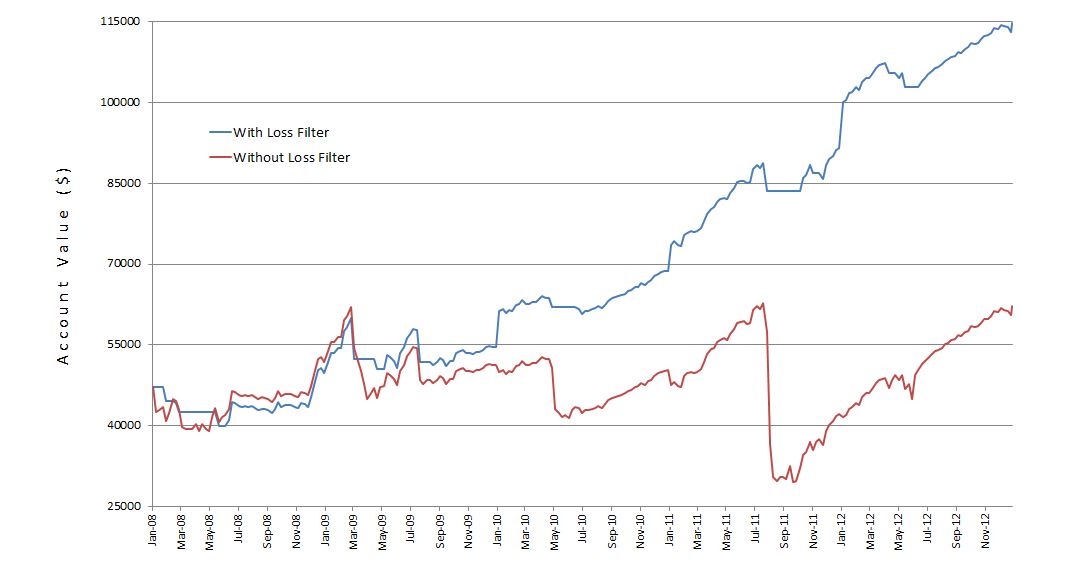
Note the significantly reduced drawdowns–especially March 2009, the Flash Crash, and August 2011. With that ball and chain cut, the profits were really able to run:
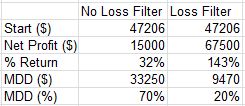
Whenever I see shockingly impressive results like these, I want to scrutinize the methodology for potential flaws. I see two such flaws with this analysis. First, I am analyzing a sample of discretionary rather than systematic trading. Position size has varied in an unpredictable fashion and the bigger weekly changes may have occurred when position size was extremely large. With a systematic approach where position size is more controlled, this may not have occurred and the LF may not have been triggered. On the flip side, the hypothetical account did not outperform in all instances where the LF was triggered. I should backtest the strategy in a more systematic fashion and then assess the impact of the LF.
A second potential flaw is arbitrary selection (-$3000 for the LF and two consecutive weeks of profitability) per my post http://www.optionfanatic.com/2012/12/12/flushing-out-the-arbitrary/. I should study the parameter space for plateaus rather than spikes by backtesting different values of the LF and number of consecutive profitable weeks required to resume live trading.
Categories: Accountability | Comments (0) | Permalink2012 Performance Evaluation (Part 7)
Posted by Mark on February 20, 2013 at 06:57 | Last modified: February 13, 2013 05:22As discussed in my last post (http://www.optionfanatic.com/2013/02/18/2012-performance-evaluation-part-6/), 2012 was calm for stocks as compared to any of the preceding four years. Give me any tame market and my account should flourish. Indeed, last year I returned over 53% when the best-performing index returned under 16%. What a windfall! Don’t you just wish I managed your money? Do you want to be like me?
Not just yet.
As for the other two questions, no and no.
I cannot depend on quiescence in order to succeed. I will only be a good trader when I can make money in calm markets and avoid losing big in violent ones. With the exception of 2008, I have yet to demonstrate success with the latter.
I now want to adjust my focus from monthly to weekly performance numbers. The basis for this discussion involves tracking account value alongside its moving average (MA). The MA serves as a “loss filter” by signaling to stop trading real money in favor of paper trading when the equity curve crosses below the MA. When the hypothetical account value crosses above the MA then trading may resume with real money.
While I think this concept has merit, I worry about the potential for curve fitting. I would not want to optimize and pick the best MA period without surveying the parameter space to make sure good results are seen with neighboring values. I also worry about sample size. I have less than five years of weekly account values available and in that time, I may only have a handful of instances where account value has crossed its MA. If I don’t have enough cases to form a valid sample then the door is left open to curve-fit results and decreased probability of future profit with real trading.
In the next post I will discuss a variation on this theme.
Categories: Accountability | Comments (0) | Permalink2012 Performance Evaluation (Part 6)
Posted by Mark on February 19, 2013 at 06:38 | Last modified: February 13, 2013 05:23For the first time in this blog, I am reviewing my performance from 2001 to the present. In http://www.optionfanatic.com/2013/02/15/2012-performance-evaluation-part-5/, I reviewed 2011 and began discussion of two changes made in my trading following the summer market crash.
Aside from not trading until after 3:30 PM, the second change I have adopted is a stricter limit on position sizing. Although it is difficult to nail this down with certainty, the largest long position size (by number of contracts) I would carry today is about 40% of that carried in 2010 and about 70% (about 60% in dollar terms) of that carried in 2011. I have a maximum monthly long contract limit in mind and I prefer to start out trading 33-67% of that limit. In most months I do not even reach the limit.
Position sizing has been restricted on the short side as well. I would estimate my acceptable short contract limit to be 60% or less than what I carried in 2010-11.
One thing that still concerns me is a tendency to see position size creep higher from one month to the next. This reflects difficulty accepting loss. Rather than close out positions and realize loss, I look to roll positions for equal or greater credit. This will boost profitability in a tame market but lead to suffering when the bull or bear really gets angry.
In 2012, the Russell 2000 experienced two corrections over 10% but still moved higher by year-end. For the first year in four, I outperformed:
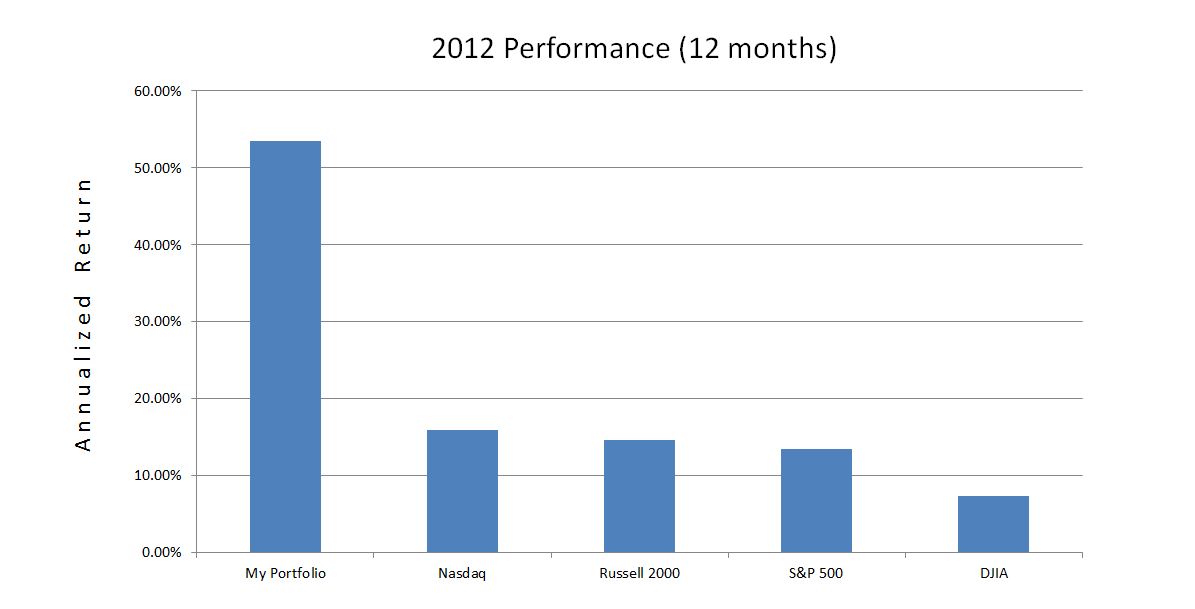
With a 53% return and MDD of only 3.6%, this was a dream year for my portfolio. This was a relatively tame year for the markets, however, as the largest MDD of any major index was only 8.2% (Nasdaq). I give much more credit to the tame market than to my own skill for the exhilarating performance. While I feel the updated trade guidelines have helped to stabilize my portfolio, it will take the next significant market correction to truly make an apples-to-apples comparison with what happened in 2010 and 2011.
Categories: Accountability | Comments (0) | Permalink