2021 Performance Review (Part 7)
Posted by Mark on April 14, 2022 at 07:22 | Last modified: February 10, 2022 17:45Last time, I decided to exclude results from my 2001 – 2007 stock trading years. I also settled upon a custom benchmark combination of RUT/SPX to more closely parallel my trading vehicles. I am finally ready to delve into the numbers.
Here is my performance record as a full-time option trader since 2008:
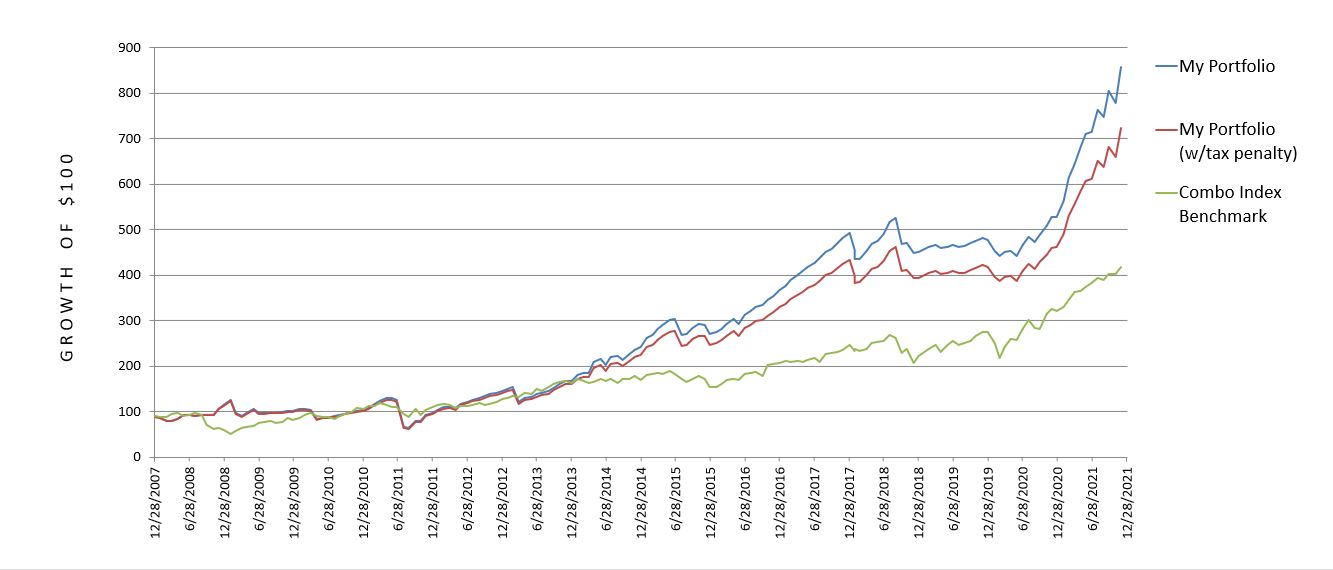
Since 2008, I have posted an average annual return of 15.17% vs. 10.75% for the combo index benchmark: outperformance of at least (see fifth-to-last paragraph here) 4.42% per year. A Motley Fool article from 2/1/22 writes:
> The S&P 500 gained value in 40 of the past 50 years, generating an average annualized return of 9.4%.
If sold, taxes are still due on these funds in the form of LTCG. The same is true for the combo index benchmark (green) and my red (penalized for active trading) equity curve.
My non-penalized (blue) equity curve simply shows taxes do matter (my annualized return would be 16.59% sans penalty). I think inquiring about tax implications and trading frequency is an integral part of due diligence on potential investment advisors (IA), money managers, or strategy vendors.
Pop quiz: does the blue curve apply if done in a Roth IRA?
Answer: please consult a tax professional for specifics about your individual situation. From my understanding, though, no tax liability remains on after-tax funds, which means the blue curve underestimates equity. The combo index benchmark still owes taxes in the form of LTCG (unless eligible for step-up at death, perhaps).
I would be elated to maintain benchmark outperformance of 4.42% p.a. if claims that most IAs underperform are true.
Total return does not tell the whole story, however. I believe drawdown (DD) is equally important for performance evaluation (see last paragraph here):
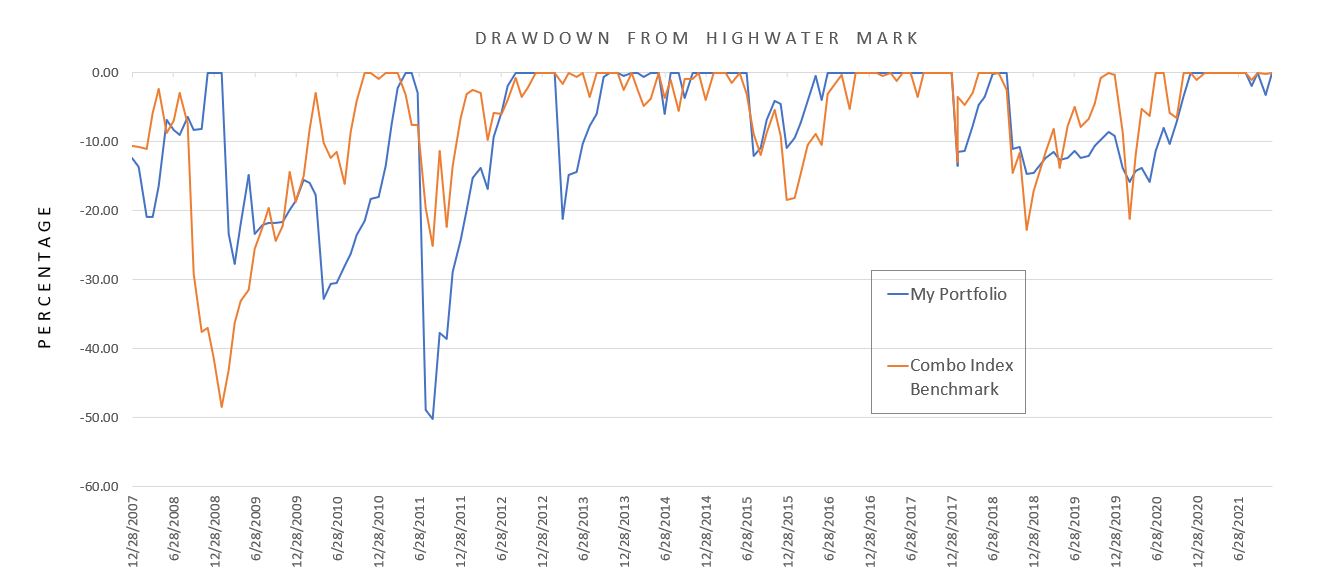
My maximum drawdown (MDD) is -50.10%, which is slightly worse than the benchmark’s -48.39%. That does not take place during the financial crisis, which I manage well. My MDD occurs in Aug – Sep of 2011 with the benchmark only down 25%. My average DD across all months is -8.86%, which is a bit worse than the benchmark’s -7.17%.
I am happy with my total return, but not so much with my DD statistics (risk management). Unfortunately, as part of the historical record I cannot improve on MDD. Going forward, I can work to exit sooner if I see signs of market turmoil. If the market falls more than 50.1% at some point and my portfolio falls less (or gains), then I can jump ahead on a relative basis in terms of MDD. These efforts may or may not succeed, though. There are no guarantees.
I will continue next time.
Categories: Accountability | Comments (0) | Permalink2021 Performance Review (Part 6)
Posted by Mark on April 12, 2022 at 06:38 | Last modified: February 9, 2022 15:12I left off last time with a big question: should I include my pre-2008 [mostly stock] trading as part of the long-term performance record? After sleeping on it, I’ve decided this question has no right answer.
A case can certainly be made to leave it in. It was me who researched and traded [stocks] back then. It’s still me who researches strategies and trades [options] now. I’ve learned things over the years: some for better, maybe some for worse—and who knows which of those things will be helpful or harmful going forward. It’s all the same person, though. It’s me.
As a candidate to manage money in an investment adviser capacity, one would have every right (and perhaps duty!) to look at my entire performance record. I am very proud of my time spent trading equities. That is what grew my account to a size sufficient for launching a full-time trading business.
Having said all this, I need to make a command decision.
Just because so many things are different from my option trading, I am leaving my pre-2008 trading performance out for the rest of this analysis. It was once presented here. I did not normalize for short-term trading (tax penalty), and I did not include benchmark dividends. At some future time, I may revisit and study the entire record again.
Going back to the third paragraph of Part 4, one question not addressed is whether 7% is a sufficient tax penalty in the first place. I definitely erred to the side of conservatism by charging the penalty on too much (see table), but is the penalty itself big enough? Look back at this table. Column 5 shows surplus tax for short-term trading. The actual tax incurred will move through various brackets up to that containing the actual AGI. 7% is higher than most values and sometimes significantly higher. It’s 1.8% lower than the third bracket, which only covers a range of $1,150 (column 6). It’s 1% lower than the seventh bracket, which is the second largest of all (~$250K range).
I think the best way to evaluate the penalty is to calculate a weighted average tax premium for short-term trading. This will be highest at $460,000 AGI where the [column 5] weighted average is 6.33%.
Once again, the penalty is more than sufficient.
The last consideration I want to make before delving deeper into the numbers is determination of the proper benchmark. From 2008 through Dec 2018, the bulk of my trading was done in RUT. I switched to SPX in Dec 2018. I will therefore construct one index benchmark, which will be a combination of these two. As I assume this to be a buy-and-hold benchmark, all considerations regarding the tax penalty remain the same.
I will continue next time.
Categories: Accountability | Comments (0) | Permalink2021 Performance Review (Part 5)
Posted by Mark on April 7, 2022 at 06:48 | Last modified: February 9, 2022 15:17I left off suggesting a revision to my global tax penalty for short-term trading, which will hopefully allow me to err conservatively while not diminishing my performance too much.
Rather than penalizing every positive month (method 1), what happens if I penalize only those months resulting in a new highwater mark being reached (method 2)?
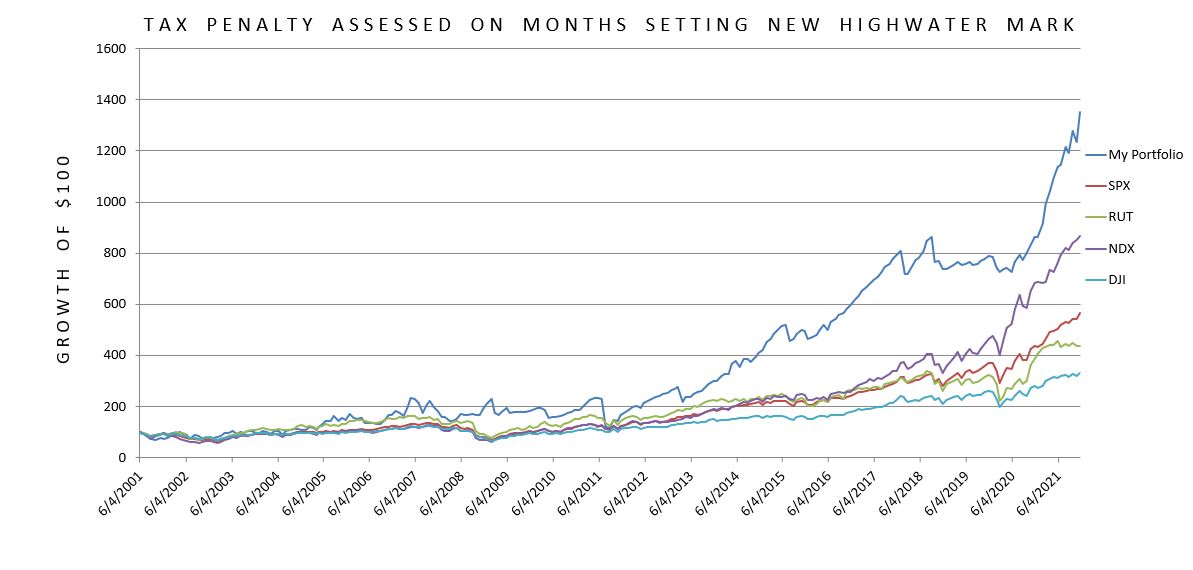
Done this way, I still come out ahead of the set of index benchmarks. To check my work, I multiply together the returns of all penalized months. I do not include the penalty itself because the intent is to determine what total return is being penalized.
Here is a comparison of method 1 and method 2:

Despite sounding reasonable, even method 2 penalizes too much. I think this happens for two reasons.
First, method 2 does not mind the edges. Suppose the highwater mark is 1048 and last month closed at 1000. If I gain 5% this month, then I achieve a new highwater mark (1050) by 0.19%. Method 2 assesses the tax penalty on the full 5%, however. That’s a big discrepancy.
Second, method 2 evaluates the highwater mark monthly rather than annually. Suppose for the first 11 months of a year, I make 3% each month only to lose 28% in the last month. In actuality, I end up down 0.3% for the year and would owe no tax. Method 2 would assess a tax penalty on 1.03 ^ 11 ~ 38%. That’s another big discrepancy.
I could resolve this by removing the penalty on select months to bring that 3880% closer to 2132% thereby lessening the overcharge. This would be completely legitimate, but for now I will resist the temptation. I can at least feel confident knowing I have insurance against some unforeseen oversight that might result in my performance numbers being artificially inflated.
In the end, if I [overly] err on the side of conservatism and still come out smelling like a rose, then my ultimate goal is achieved. I may be off to a good start because at first glance, the graph above has me sitting comfortably on top.
I still have a couple other things to address with the first being stock versus option trading. I mentioned in the second paragraph here a bit about the different types of trading I have done over the years. 2008 seems to be a major demarcation for two reasons: this is when I started trading full-time as well as when I started trading Section 1256 contracts.
Here’s the big question: should 2001 – 2007 be included in the analysis or left out?
That is something I will be sleeping on tonight.
Categories: Accountability | Comments (0) | Permalink2021 Performance Review (Part 4)
Posted by Mark on April 4, 2022 at 06:37 | Last modified: February 8, 2022 16:55I left off discussing the inclusion of a tax penalty given that my trading is short-term whereas the benchmark indices represent long-term buy-and-hold. How to err conservatively in such a way to spare myself the task of having to look up every tax code change since 2001 and the precise tax rates that accompanied them?
The answer is to determine an across-the-board tax penalty high enough to cover most months even if it ends up being a bit too high overall.
Let’s work from the 2021 tax rates table I composed in Part 3. Since I like to be optimistic and visualize maximum profits, I will use the highest tax bracket with 20% LTCG and 37% tax on ordinary income (short-term). As a blended 60/40 tax rate: (20% * 0.6) + (37% * 0.4) = 26.8%. Rounding up, that is a 7% higher tax rate than LTCG for a buy-and-hold benchmark. I will therefore multiply the monthly return by 0.93 anytime my portfolio posts a profitable month.
I was not trading Section 1256 contracts before 2008. That tax penalty is 37% (being optimistic so as to assume maximal tax rate) minus 20% = 17%. I will therefore multiply each profitable month from 2001 – 2007 by 0.83.
Compare this closely with the graph shown in Part 2:
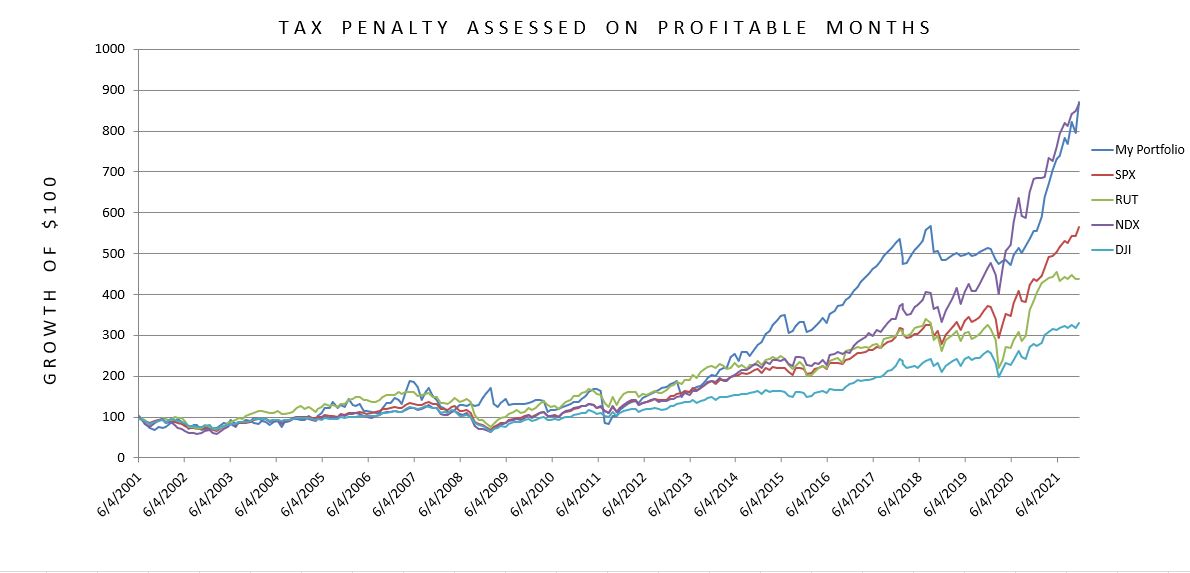
Big difference! My cumulative return has been cut from 2,032% to 771%. Furthermore, my trading edge over a set of major indices has all but evaporated.
To check my work, I multiply together all the positive months to get the cumulative return. This represents the profits on which a tax penalty has been assessed. The previous graph showed this cumulative return to be 2,032% sans tax considerations. Here, the cumulative return is 439,322%.
By charging myself the tax penalty on all positive months and giving no credit for negative ones, I overshoot by a huge margin! No wonder the trading edge is nullified.
This business is tricky because while I’m all about erring to the side of conservativism (as discussed in Part 2), I don’t want to be so conservative that I fool myself into believing I have a losing or mediocre trading strategy when in fact it may be decent or good. Depending on how one looks at it, statistics deems this a type I error (false positive) or type II error (false negative): neither of which is advised. In this case, I penalized myself far more than I should have for short-term trading.
Going back to the second paragraph above, let’s fine-tune this by changing the last sentence. Rather than penalizing all positive months, I will penalize months where the final account value makes an all-time high. This is much more realistic. When my year-end account value is higher than the previous year-end account value, I pay taxes on that profit. If the year-end account value is lower, then I pay no taxes and the losses carry over to offset profit (at least partially) in future years.
This is really where I should tell you to consult a tax professional for specifics since your situation may vary.*
I will continue next time.
* — I might also suggest exploring trading as an entity if you are more active.
2021 Performance Review (Part 3)
Posted by Mark on April 1, 2022 at 07:04 | Last modified: February 8, 2022 11:19I left off presenting a comparative graph of my trading performance versus the major indices from 2001 – 2021. The graph is best considered a rough draft, though, for a couple different reasons.
My trading has significantly changed over the years. From 2001 – 2006, I researched systematic criteria and used those to pick stocks. In 2007, I started trading equity options, and in 2008, I went full-time trading [mostly] index options. Even for the latter, my option strategies have evolved. I could make a case to completely separate out 2001 – 2007 but for now, just realize the graph does not portray performance of one fixed strategy over two decades.
I think the main thing masked by the graph has to do with taxes. Disclaimers I hear over and over include things like “please consult a tax professional,” “everyone’s tax situation is different,” and “your results may vary.”
Performance shown by the Part 2 graph could conceivably be achieved in a Roth IRA with after-tax money.
More likely, though, much of this trading is done in taxable accounts and for that reason, I want to do what I can to normalize the comparison between my portfolio and the benchmarks. What I am not looking to present are after-tax returns, which [per disclaimers above] may not be applicable to a heterogeneous audience.
I assume the benchmarks to be buy-and-hold [over 12 months] whereas my trading is generally short-term. The former qualify for long-term capital gains (LTCG) tax rates whereas the latter gets taxed as ordinary income. For the same reasons to err conservatively discussed in the last post, I feel hiding this would be deceptive.*
Although short-term, my trading does qualify for the blended tax treatment afforded to Section 1256 contracts where 60% the profits are taxed as long-term. This is still complicated because one’s total net worth dictates position size, which dictates magnitude of profits [or losses], and subsequently tax rates.
Here are the numerous tax-rate combinations of LTCG (second column) and ordinary income (third column) for 2021:
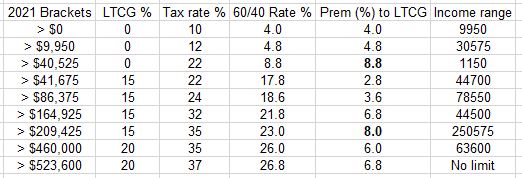
The fourth column sums 60% of the second column and 40% of the third column. The fifth column shows by what percentage the ordinary-income tax rate exceeds LTCG. The sixth column shows over what range of income this differential applies.
To make matters even more complex, tax rates have changed over the years. Aiming to err on the side of conservatism spares me from having to hunt down all tax-code changes to apply for each respective period.
I will explain this next time.
* — I do believe many financial professionals hide it, though, because it
may be easily swept under the mat with disclaimers as given above.
2021 Performance Review (Part 2)
Posted by Mark on March 29, 2022 at 06:47 | Last modified: February 8, 2022 11:23Last time, I began to lay the groundwork for a long-term performance review. Today I will continue the discussion.
My hopes for doing this in Python resulted in the project dragging on for a couple extra weeks until I finally decided to stick with my original Excel spreadsheet, which had data from 2001 – 2016. The first thing for me to do was to complete this through 2021. The first few months of the spreadsheet looks like this:
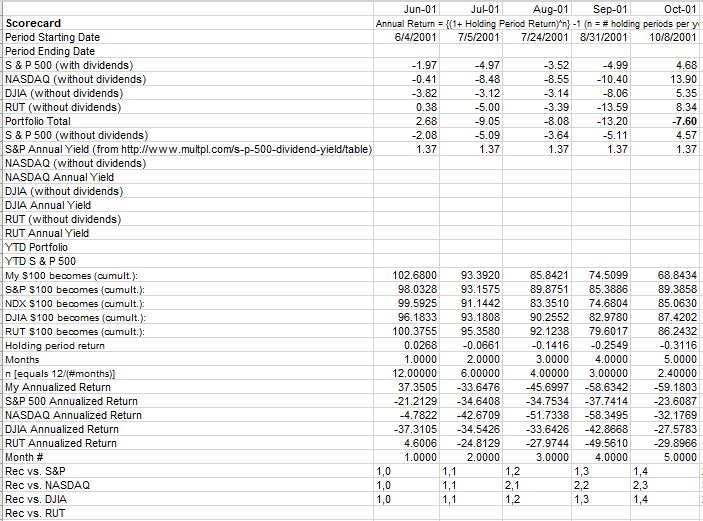
Eventually, I started adding the last Friday dates for the beginning and end of the monthly periods to make lookup quicker.
After entering the monthly performance of my portfolio through 2021, I calculated monthly performance for SPX, RUT, NDX, and DJI. As the spot indices do not include dividends, I fetched historical dividend yield data from http://www.multpl.com/s-p-500-dividend-yield/table for SPX and https://www.macrotrends.net for the other three. On the latter website, IWM and QQQ yields are provided quarterly and DIA yields monthly. For each data series, I took the highest value for all four quarters (or 12 months) and used that as the dividend yield for the entire year.
As a result of this conservative manipulation, the benchmark return is slightly enhanced and my comparative trading performance will be weaker. I prefer to err on the side of conservativism (see sixth paragraph here and last full paragraph here) just in case I’m ever caught wearing the rose-colored glasses without my notice (e.g. sixth paragraph here).
I also seize the opportunity for conservatism in my handling of missing QQQ yield data. No data are available prior to 2006. I therefore plugged in the highest quarterly yield recorded from 2006-2021 for 2001-2005. The gist of all this is to weaken my results when reasonable to do so. If I still come out shining bright then it may be a significant finding. I feel the same way about backtesting performance: bias against backtesting results in every way possible such that if the results still pass muster, I may indeed be looking at a viable trading candidate.
I have discussed critical analysis many times (e.g. third-to-last paragraph here). To believe something is worthwhile in this industry, performance results should be impressive beyond a reasonable doubt. Make sure to include the headwinds because you can be sure Mr. Market won’t forget them (see fifth-to-last paragraph here) at the hard right edge of the chart.
Here’s a first look at the performance comparison:
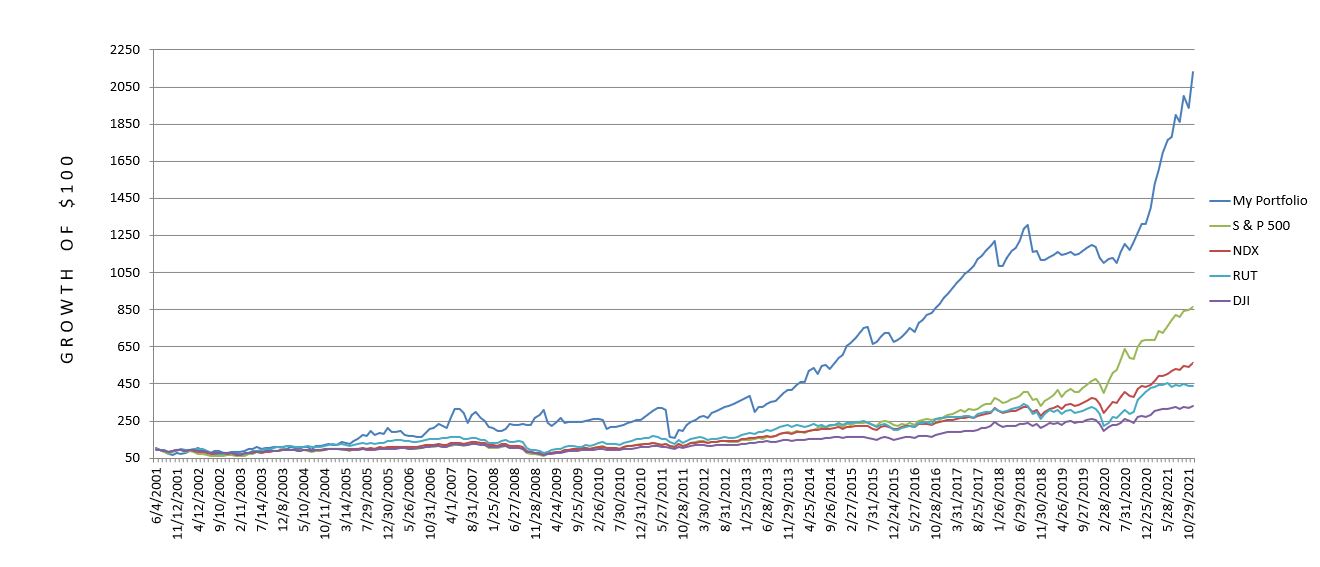
I will continue next time.
Categories: Accountability | Comments (0) | Permalink2021 Performance Review (Part 1)
Posted by Mark on March 24, 2022 at 06:59 | Last modified: February 7, 2022 10:20Today I begin a mini-series to update my trading performance through 2021.
I haven’t done a performance update in a while, but I should do this every year. My first such review began with this post. Four years later I did this one. Later that year I also did this post with some nice graphs and data. The following year I did this one. Finally, I did this one to finish up a draft I had begun months earlier. This post includes some performance notes.
2021 was my best trading year ever. One could say I was lucky. Then again, as traders we are always lucky whenever a different market environment would have resulted in a much worse outcome. This is especially the case when the superior performance is realized in the face of an improbable (subjectively defined) market environment.
I tend to be reluctant to take credit for things I do not control. I do not control the market, but I am the one doing the trading and for that I deserve credit. Certainly if my account tanks, I will always get the blame by my own worst critic (for starters).
Some of this is about humility, which is a topic I have written about or alluded to in the last paragraph here, this post, this mini-series, this mini-series, this post, and this mini-series where I gave a very honest and open evaluation of myself.
Aside from reviewing my 2021 trading performance, in what follows I will go back to 2001 and recalculate the numbers relative to different indices factoring in dividend yield and tax differential for active trading. I incur a 60/40 blended tax rate compared to the benchmarks, which for purposes here will be considered LTCG. I don’t have a CIPM®, but I think any accurate performance comparison should address this point.*
Because my original plan was to crunch numbers in Python, this has become more of an ordeal than anticipated. My spreadsheet breaks down monthly periods by the last Friday of each month being the starting point for one period and the ending point for another. Not every Friday is a trading day (holidays), though, which means I sometimes use Thursday values. I’m fine giving a Friday date even when there is no trading on that day because it’s still a true statement. In some extreme cases, we may have had no trading on a Thursday and a Friday. Programming all this can get rather involved.
I will continue next time.
* — If you start reading performance reports, I think you will come to the realization that most do not.
Getting Back to Basics
Posted by Mark on September 2, 2021 at 07:11 | Last modified: June 1, 2021 08:27Today’s post is about getting back to basics, which is something I periodically find myself forgetting to do.
I have no complaints about my trading this year. I’m sticking with the plan, which is my primary goal.
For a few different reasons, though, I want more. First, I may need a different plan when the market environment sours (a constant threat as seen in the tables here). Second, I can accommodate a few more small-sized trades in the portfolio. Third, I always want to be on the road to self-improvement. I don’t always accomplish this, but I certainly want to be trying.
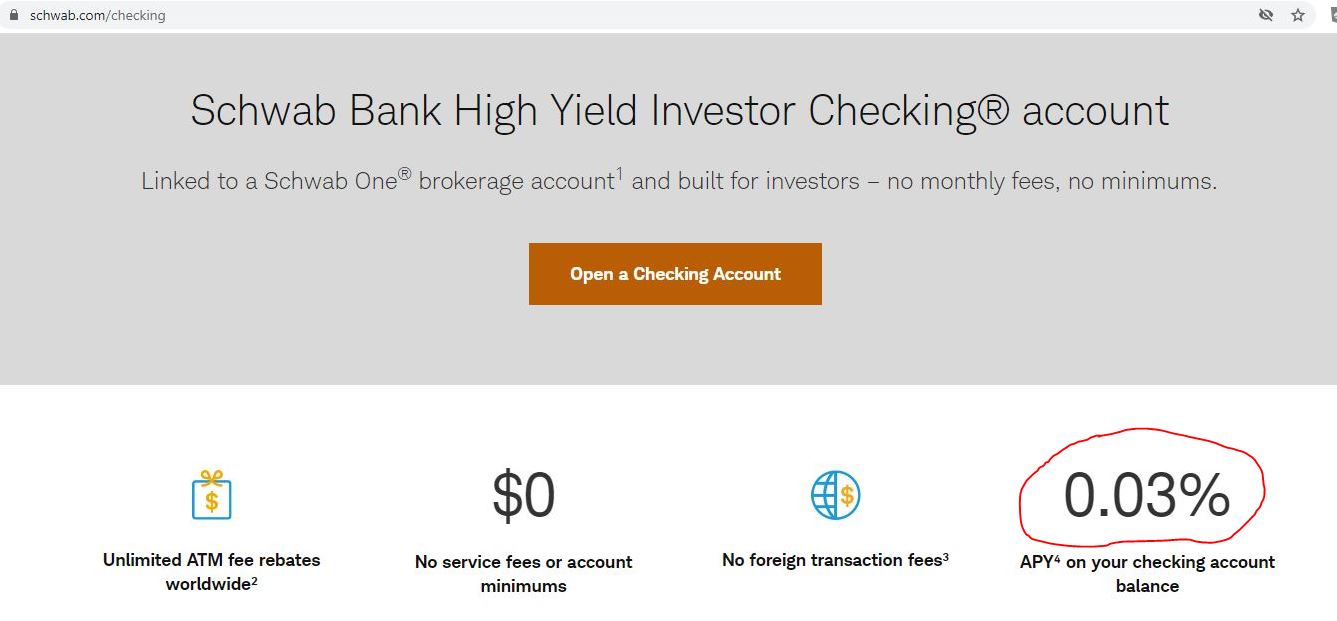
One further reason to want more: interest rates. I feel the need to make up for this deficit:
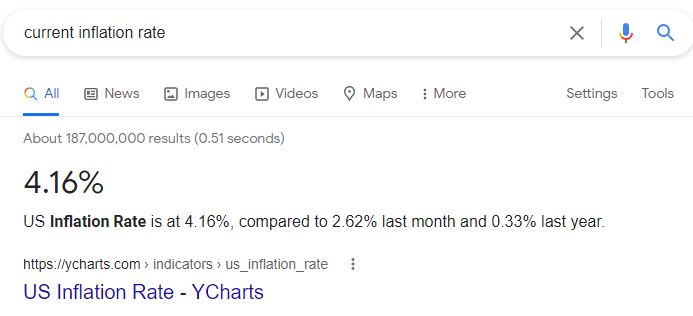
For all these reasons I want more, but I also have a lot on my plate right now:
- I’m trying to network with traders to establish new connections. This is a big ask (see third-to-last paragraph here, fifth paragraph here, and fourth-to-last paragraph here): probably itself equivalent to a part-time job.
- I’m mulling over potential job interviews (see here).
- I’m on the hunt for an automated backtester (see here).
- I’m doing some manual backtesting (see here).
- I’m studying one particular trading philosophy that is a paradigm shift away from what I currently implement. It takes a lot to wrap my head around this and to understand all the moving parts.
I occasionally hear about a relatively simple trading strategy that makes me think “I should have been doing this all along.” While I now recognize the periodic pattern, I never cease to be amazed when it repeats.
Maybe now is the time to do something to make sure the pattern repeats less. How can I make this happen?
- Write down the trading strategy in a straightforward, objective manner.
- Backtest the strategy enough to become comfortable with how the position moves and what I can expect with regard to relevant items like greeks, PnL, etc.
- Start trading live with the smallest position size available (one contract will suffice for many).
- As I feel comfortable, increase size slowly after trading through enough drawdowns and losses.
- Rinse and repeat (may also be done in parallel with multiple strategies).
I may get stopped out from #2 due to performance concerns. If the strategy is not viable in backtesting, then I need to junk it and make a note that development was unsuccessful. I am likely to stumble upon this strategy at some future date and I can save myself a lot of time and effort if I remember that I’ve “been there, done that.”
My discipline, to which the 900+ posts in this blog can attest, is beyond reproach.
My challenge is now to take that discipline and apply it to something new—something that, in this case, can potentially lead to multiple streams of income.
I have always liked the [quite marketable] sound of that!
Categories: Accountability | Comments (0) | PermalinkKD or the Retail Trader? (Part 3)
Posted by Mark on July 5, 2021 at 06:02 | Last modified: May 25, 2021 08:19I left off with mention of NS. Time to wrap up his story.
After I asked where he got my name, he responded:
> Hi Mark,
>
> I found your contact information on the… [collaboration spreadsheet]
> from KD.
>
> I have decided to continue to trade stocks only for now. I think this
> adventure and undertaking is premature at this moment in my life, the
> time commitment and capital needed to succeed is not there. Will
> revisit this in the future. Thank you for your understanding.
>
> NS
In 24 hours, NS apparently went from enthusiastically seeking collaboration on futures trading strategies to not trading futures at all. He doesn’t have the time commitment: did he just learn what kind of commitment it would take? He doesn’t have the capital: did he just learn about capital requirements? Did he research these critical details before spending thousands of dollars on the course? He seems like a responsible adult: a family man and a CEO of a company with 20 employees. Sudden reversal and complete oversight are not what I would expect from a guy with his head on straight.
This escapade with NS strikes me as the epitome of fickle. You know, fickle: capricious, changeable, variable, volatile, vacillating, mercurial, irregular, inconstant, undependable, unsteady, etc.
This also reminds me of trader reluctance to discuss losers (see second paragraph here and bullet points 6 – 7 here).
Since NS and the 12 e-mail contacts I wrote about are all associated with KD, I wonder if this behavior is a reflection of a lousy approach. Paying for a failing system is an ego-challenging experience when we feel ripped off, taken advantage of, or violated. I wrote earlier about my failure. I gave 3+ months of full-time effort. I was disciplined. I documented. I exchanged 50 – 100 e-mails with KD asking questions, discussing details, and reviewing examples. My time committed is more than I would would expect from most. If it didn’t work for me, then I would not be surprised to learn it didn’t work for others either. KD warns it may require even greater effort, but it could be a complete farce. I have my suspicion.
On another hand, statistics about the high failure rates among traders as a whole circulate often. Maybe the same sort of commitment and patience required to succeed with KD is required to succeed with trading and most people just don’t have it. Trading itself could be a farce, but I have to admit that I have succeeded with my overall efforts until now. This makes me less likely to reject the entire trading enterprise.
Categories: Accountability | Comments (0) | PermalinkKD or the Retail Trader? (Part 2)
Posted by Mark on July 2, 2021 at 07:29 | Last modified: May 24, 2021 15:29Is the takeaway from this blog mini-series more a reflection of KD or of retail traders in general?
I left off discussing my outreach to 12 people from the Y collaboration worksheet. Here are the results:
- One said he had moved on from KD’s approach and was now trying something else.
- One said he had not yet started to apply KD’s approach and would not be any help (despite the fact that he added himself to the spreadsheet months earlier).
- One said he hadn’t gotten anywhere with KD’s approach because he was struggling with the programming.
- Two responded enthusiastically about working together but did not respond to a subsequent e-mail.
- Seven did not respond at all.
I am shocked by the overall response. I stated in the third paragraph here that I could not recommend KD because I had yet to find any success. This is supported by the total reception to my e-mails. Most people having success would be happy to share stories, meet others who are like-minded, hear other potentially helpful suggestions, etc. Over half my e-mails went without any response, two gave no substantive response, and the rest expressed failure and/or remarkably weak excuses.
I cannot exclude the spam filter as reason for why so many e-mails went unacknowledged. Two of the nine were second e-mails following an initial response, which makes the spam filter doubtful. I don’t know about the other seven. Keep in mind, though, that all messages went to people who voluntarily put themselves on a list to be contacted. I am somewhat computer literate and know to check my spam folder periodically for non-spam messages. I would like to think that intelligent people spending thousands of dollars for strategy development education would also know, but I can’t be sure.
Six months later, a newbie contacted me. He wrote:
> Hello,
>
> How are you? I just took KD’s Y workshop and saw that you are
> open to collaboration.
>
> I’ve been recently liberated from a high-tech job as a product
> manager/business development in Silicon Valley. I’m trying to build
> a steady income stream by trading futures. I’ve submitted one
> strategy to the club so far and I’m trying to build up a diversified
> portfolio.
>
> Let me know if you are open to corresponding through email.
>
> Thanks,
>
> DO
I think the message I sent to others was a proper introduction and done with enough awareness to avoid alarm. DO’s message to me most assuredly accomplished the same. NS’s initial contact that I included in the last post: not so much.
Speaking of NS, I will get back to his surprising ending next time.
Categories: Accountability | Comments (0) | Permalink