Trading System #1–SPY VIX (Part 9)
Posted by Mark on October 25, 2012 at 10:15 | Last modified: October 12, 2012 09:01In http://www.optionfanatic.com/2012/10/20/trading-system-1-spy-vix-part-8, I settled on x = 5 to complete selection of the three parameter values for the SPY VIX trading system. It’s not ready for prime time just yet. Today I will begin exploration into Maximum Adverse Excursion (MAE).
I described the process I am about to undertake in http://www.optionfanatic.com/2012/10/24/maximum-adverse-excursion. Focusing specifically on x = 5, y = 25%, and z = 10, here is a scatter plot of P/L by maximum drawdown (MDD):
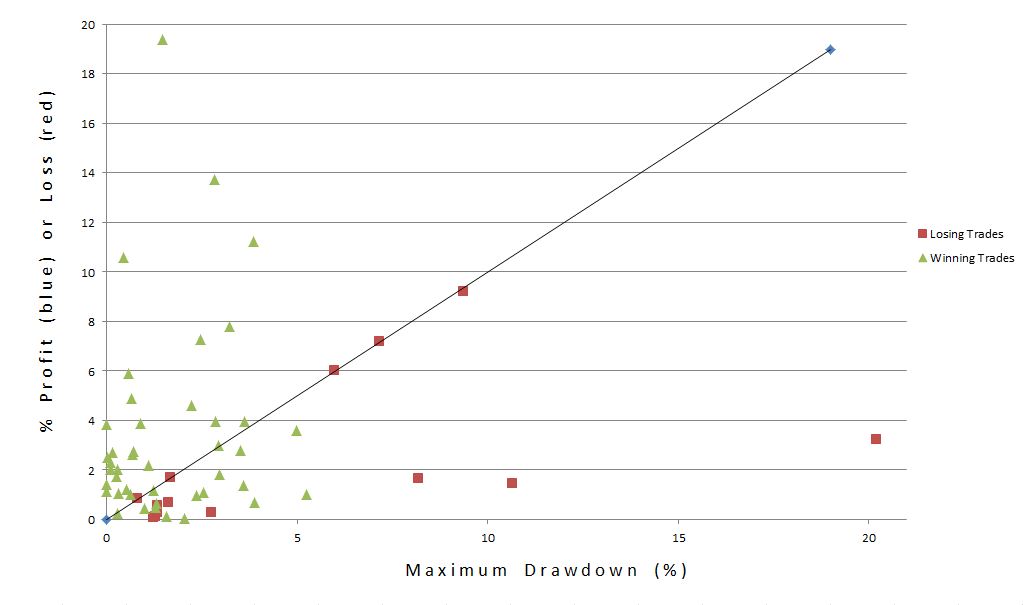
The triangles and squares are results of the 57 trades. The higher the point, the greater the profit (green) or loss (red). The farther to the right, the greater the MAE. The [roughly] 45-degree line is called the loss diagonal, and it represents the maximum loss for red squares. Losing trades can never be above the line because the most they can lose is the most they were ever losing (MDD).
A stop-loss would be represented by a vertical line on the graph. Any losing trades to the right of the vertical line would then move to the intersection of the vertical line and the loss diagonal. Any winning trades to the right of the vertical line would become red squares (losing trades) with height equal to the intersection between vertical line and loss diagonal.
What I want to see in order to implement a stop-loss is more of the former that lie above that intersection than below it and few of the latter. Red squares to the right of the vertical line and above the intersection are trades that would be stopped out for a decreased loss (+1 for system). Red squares to the right of the vertical line and below the intersection represent losing trades that would be stopped out before having a chance to recover (-1 for system). Green triangles to the right of the vertical line represent winning trades that would be stopped out for losses before being able to recover into profit (-1 for system).
I don’t see a good place to draw the vertical line such that the +1’s substantially outweigh the -1’s.
Before dismissing a potential stop-loss for this system altogether, I will undertake one more analysis in the next post.
Categories: Backtesting | Comments (0) | PermalinkMaximum Adverse Excursion
Posted by Mark on October 24, 2012 at 06:53 | Last modified: October 9, 2012 11:13I’ve reached the point with the SPY VIX trading system where I need to analyze maximum adverse excursion (MAE).
MAE is a technique published by John Sweeney in 1997 (John Wiley & Sons, Inc.) that measures the farthest a trade ever goes against you. For long (short) trades, this is calculated with the difference between entry price and the lowest low (highest high) price ever seen during the life of the trade.
MAE is very important from a risk management perspective to help determine potential benefit of a protective stop. A scatter plot of maximum drawdown (MDD) for each backtested trade by final trade profit/loss should be studied. If there is an MDD level beyond which few trades ever end up profitable then it may be useful to keep a protective stop at that level. This may lessen some extreme losers while preserving most of the winners.
The difference between MAE and MDD is that MAE pertains to each individual trade whereas MDD may pertain to an individual trade or a series of trades made by a system.
From a risk management perspective, MAE and MDD both address trader tolerance. Both measure “the farthest X ever goes against you.” Consider the broad stock market as an example. Over the last several decades, the broad market has returned roughly 6% per year. Every now and then, the market crashes and loses 40-60% (or more!) of its value. The MDD is essential to understand because that moment of worst loss is when I will be a nervous wreck, unable to sleep at night, or contemplating a jump out of the nearest 10-story window. If I can’t tolerate the MDD (or MAE) then at best, I won’t be able to reap the benefits of a profitable trade[ing system]. At worst, I may end up suffering catastrophic loss.
In my next post, I will begin to analyze MAE for the SPY VIX trading system.
Categories: System Development | Comments (3) | PermalinkTrading System #1–SPY VIX (Part 8)
Posted by Mark on October 23, 2012 at 01:41 | Last modified: October 9, 2012 06:53In http://www.optionfanatic.com/2012/10/19/trading-system-1-spy-vix-part-7, I finalized values for y (25%) and z (10). Today, I want to make a final decision on x.
From statistical tables in http://www.optionfanatic.com/2012/10/16/trading-system-1-spy-vix-part-5 and http://www.optionfanatic.com/2012/10/19/trading-system-1-spy-vix-part-7, I have cherrypicked just the rows corresponding to y = 25% and z = 10:
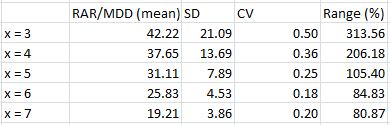
As trade length increases, exposure will increase and RAR will consequently decrease (assuming all else remains equal). This explains the trend lower in RAR/MDD as x increases from three to seven. If I want the most concentrated returns then I should aim for the smallest x-value.
Stability of RAR/MDD across different values of z increases with trade length as evidenced by the trend lower in CV and Range (%) as x increases from three to seven. This suggests I should aim for the largest x-value.
I am favoring x = 5, which will provide a decent RAR/MDD and stability therein.
Since RAR/MDD can obscure Net Profit, I want to add one additional column to the above table:
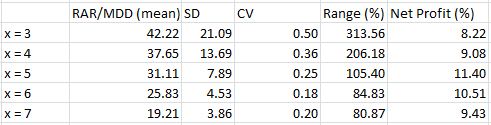
I am somewhat surprised to see Net Profit trail off when x > 5 because the longer the trade, the more opportunity for profit to accumulate. It is possible that after five days mean reversion has occurred and no further edge is available.
The average number of trades for y = 25% is 55.7 (range = 34) across all values of z. This is not a large sample size. If it weren’t for the preponderance of positive numbers across all 150 systems and the trend toward more concentrated profit at higher y-values then I might abort this system altogether and look for something with more backtesting data.
Given all these considerations, I feel comfortable implementing SPY VIX with x = 5, y = 25%, and z = 10.
Categories: Backtesting | Comments (1) | PermalinkHighlights of System Development
Posted by Mark on October 22, 2012 at 06:33 | Last modified: October 8, 2012 09:16Today I want to review a couple major points that have been covered in my last two blog posts.
Trading represents a dream because I am able to work for myself from the comfort of my own home on my own schedule. As hard as it is in this economy to get any job, to get a gig like this will demand out of me something the vast majority of others are not putting forth. This just makes sense because otherwise, everyone would be doing it! For starters, I must be willing to put in extensive legwork at every turn whether or not it ends up being required.
Trading as a business can never coexist with laziness.
The trading landscape for independents is like a hot desert littered with mirage. I am constantly bombarded with alluring returns and trading strategies that sound good. Greed pushes me to gamble with speculative trades on a whim. Wishful thinking accelerates the process. Other cognitive heuristics also combine to stack the deck against me.
System development must be extremely thorough to flush out any oversights that may lead to false profit expectations. One could say the whole point of system development is to highlight the arbitrary and determine it to be lucky or good: discard the former and implement the latter.
This was the idea behind realizing the need to backtest 3-, 4-, 6-, and 7-day trades before moving forward with a 5-day SPY VIX trading system. Failure to perform these additional steps could leave me unknowingly chasing an illusion. When lucky, traders will eventually find out by losing precious capital and often going bust. When good, traders are able to stay in the game.
All trading recommendations, whether technical strategies or stock screens, are due only one response: backtesting within the confines of a complete system development process to assess how likely they are to perform in the future. This is a labor-intensive process where many false leads and dead ends potentially await.
Categories: System Development | Comments (0) | PermalinkTrading System #1–SPY VIX (Part 7)
Posted by Mark on October 19, 2012 at 08:09 | Last modified: October 7, 2012 11:27In http://www.optionfanatic.com/2012/10/17/trading-system-1-spy-vix-part-6, I determined that for x = 5, y = 25% produced the best backtesting results for z-values between 6-15 (see first paragraph of http://www.optionfanatic.com/2012/10/18/laziness-dissected for a refresher on the SPY VIX trading system). I now want to see if this holds for x = 3 to 7.
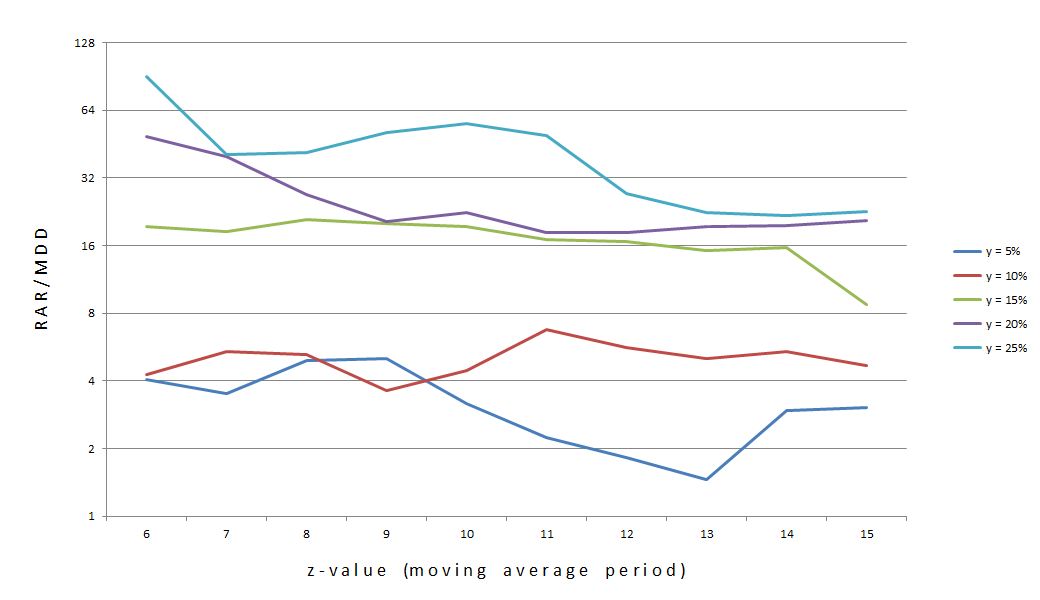
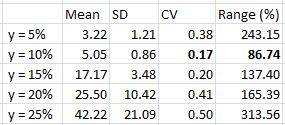
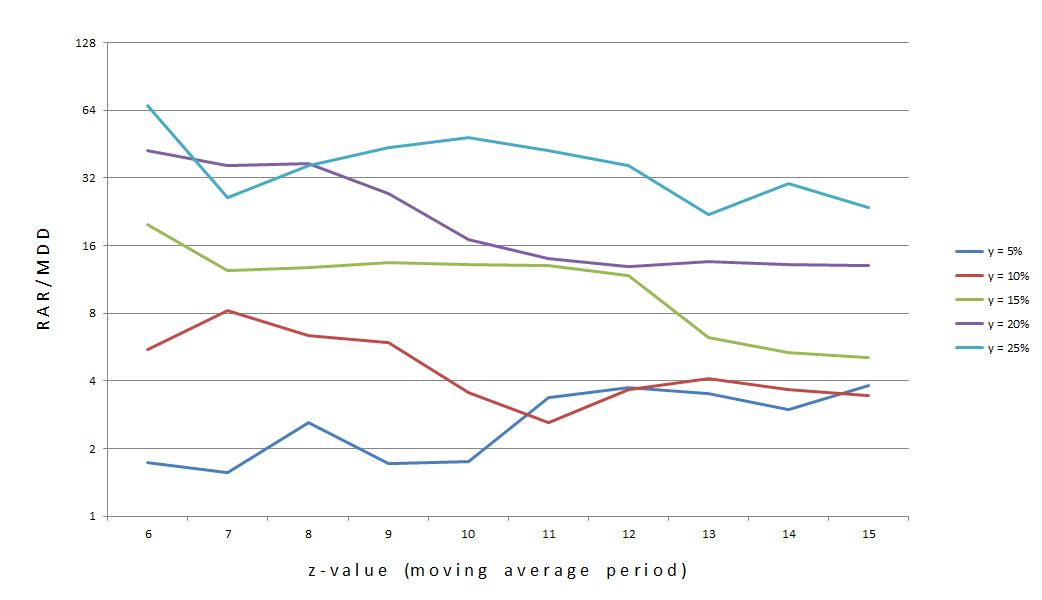
Here is the graph and statistical analysis (lowest stability numbers in bold) for x = 3:
Here is the graph and statistical analysis (lowest stability numbers in bold) for x = 4:
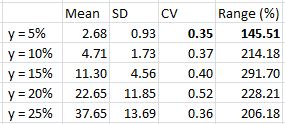
Here is the graph and statistical analysis (lowest stability numbers in bold) for x = 6:
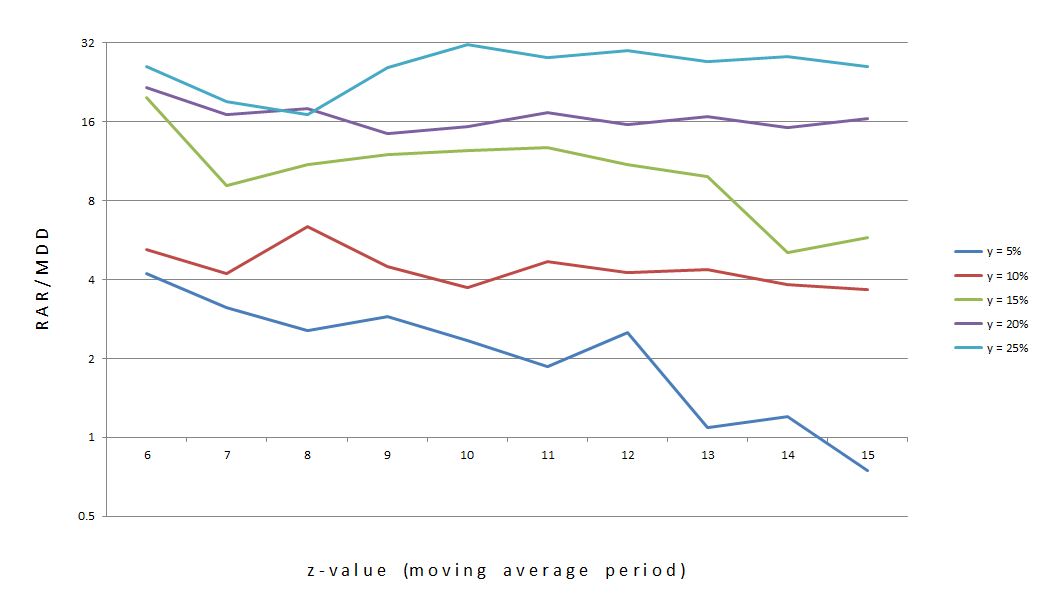
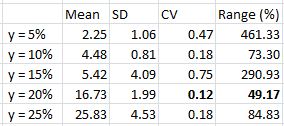
Here is the graph and statistical analysis (lowest stability numbers in bold) for x = 7:
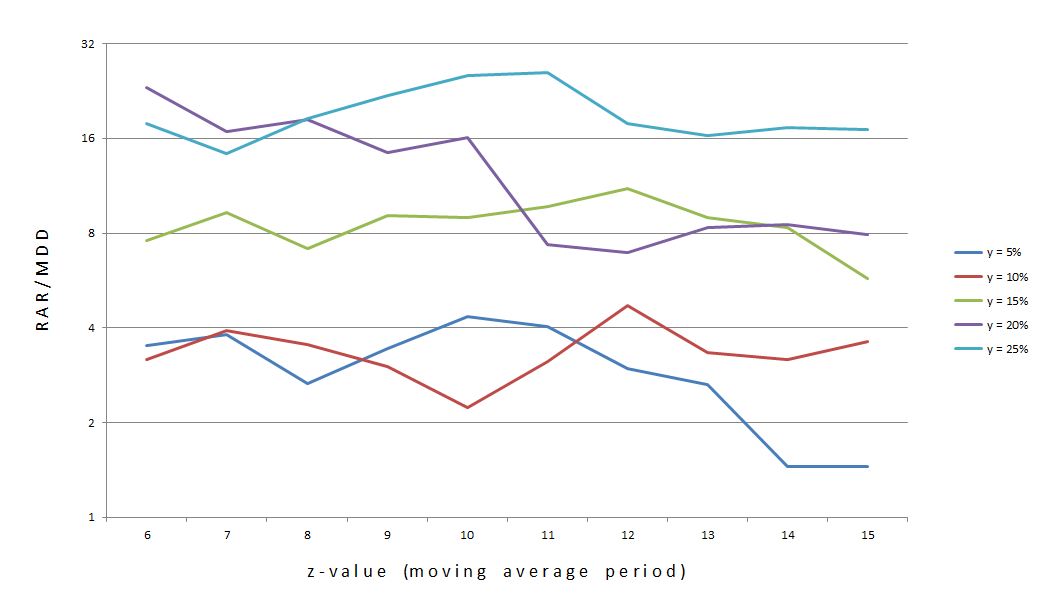
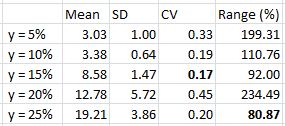
Which value of y had the most stable curves as measured by lowest CV (SD / mean) and lowest Range (%) statistics?
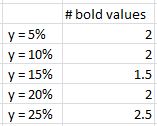
No edge there…
The y = 25% curve prints the largest RAR/MDD for most values of z on all graphs. Out of 50 total backtested systems, RAR/MDD was largest along the y = 25% curve 44 times (by random chance alone, one would expect 10). Six times, y = 20% resulted in a larger RAR/MDD value. These six cases occurred with z = 6 (once), z = 7 (three times), or z = 8 (twice). Never did this occur for z-values of 9-15.
In conclusion, y = 25% is as consistent as any other y-value across all values of x and z. Furthermore, y = 25% reliably scores highest on the subjective function RAR/MAD. In looking at the five y = 25% curves, I would choose z = 10 as the center of the most consistent plateau region where the curve is least likely to fall off “precipitously” at neighboring z-values. Even if the y = 25% curve does fall off, however, RAR/MAD is still very likely to be larger than curves of any other y-value and in all cases would still have generated respectable profit.
Categories: Backtesting | Comments (2) | PermalinkLaziness Dissected
Posted by Mark on October 18, 2012 at 11:50 | Last modified: January 14, 2019 10:38Back in Part 1, I described the SPY VIX trading system as having three variables. The system trades when VIX is y% extended from its z-SMA with an x-bar stop.
Full disclosure: I don’t want to consider the x-bar stop as a system variable. So the trade lasts five days. That seems routine and unlike a technical indicator I employ where I set the critical value to be tested. Why bother checking x for validity? Besides, I have already entertained y-values from 5 to 25 (five total) and z-values from 6 to 15 (10 total). Allowing x to vary from three to seven, for example, would increase the number of potential systems from 50 to 300. Furthermore, keeping one variable constant would now leave two to vary. This suggests employment of college Calculus rather than high school Algebra in order to study performance.
It doesn’t take much introspection to discover that this bellyaching is simply a matter of laziness. At some level, most people tend toward laziness. This may be the primary reason why most new traders fail in the first 1-5 years. They think this is an undiscovered country where hard work doesn’t exist. They are eager and willing to pay hundreds to thousands of dollars on trading books, investment webinars, or educational programs that promise consistent profits in 10 minutes per night or a couple hours per month. They are fertile ground for scammers and con artists, alike.
I have written this before and I’ll write it again: no free lunch is available in the world of trading and investment. I’m up against institutions with billions of dollars at their disposal and highly-educated quant teams with thousands of advanced degrees between them all focused exclusively on gaining the slightest bit of Edge. The easy way out is no longer a viable option. Screw the ego-laden label of “busywork…” when it comes to labor-intensive, painstaking tasks, I need to shut my eyes, puff out my chest, and rush headlong into the pile so I can get the job done.
The x-bar stop: in focus with my next post.
Categories: System Development | Comments (2) | PermalinkTrading System #1–SPY VIX (Part 6)
Posted by Mark on October 17, 2012 at 05:50 | Last modified: October 6, 2012 07:18In http://www.optionfanatic.com/2012/10/16/trading-system-1-spy-vix-part-5/, I took a close look at the subjective function RAR/MDD by % extended across moving average length (z). I will continue that analysis today.
Let me begin by reposting Figure 1 from my last post:
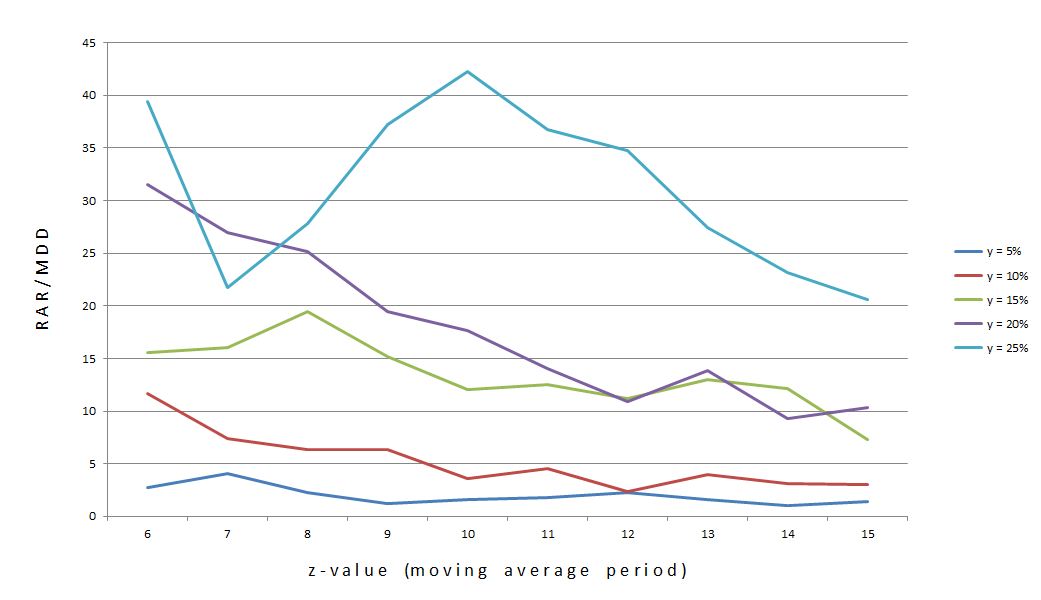
The statistics showed that y = 25% (top curve) is actually the flattest of the five. Perhaps this graph is more convincing:
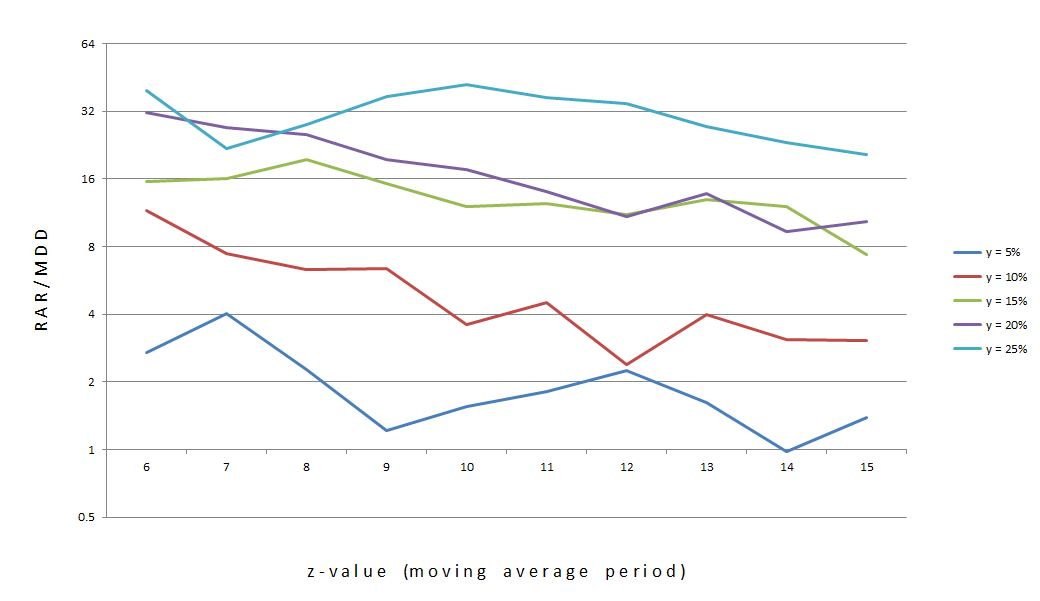
Do you see the difference? The y-axis is logarithmic in the bottom one, which means any given length represents the same multiplier rather than addend. Each tick on the y-axis multiplies the previous y-value by two rather than adding five. This eliminates distortion caused by widely-ranging (in percentage terms) values.
In addition to choosing y = 25%, I will choose z = 10. This is roughly the center of the middle, high plateau region of the curve.
Going back to Table 1 in http://www.optionfanatic.com/2012/10/16/trading-system-1-spy-vix-part-5/, another observation about these 25% extended systems is the low number of trades. Indeed, a regression analysis shows that total number of trades and % extended are highly correlated (R-squared = 0.8921). On average, these 25% extended systems traded 55 times over 20 years, which is just over 2.5 trades/year.
Despite trading infrequently, these 25% extended systems have been very profitable in the past. Profit factor (PF) is positively correlated with % extended with an R-squared value of 0.7516. The 25% extended systems have the highest average PF of all with an average of 3.13.
To recap, I have 2.5 trades/year x 5 days/trade = 11 days/year and 11 days/year x 1 year / 252 trading days = 4.4%. If I can find 10 more systems that have a good basis for diversification then I can have be invested on roughly 50% of all trade-days (# trades x trading days invested) with good probability for concentrated profits (high PF). A good basis for diversification includes mean-reverting and trend-following systems along with different (non-correlated) asset classes.
I’m not done developing this system, though. In the next post, I will discuss the x-bar stop.
Categories: Backtesting | Comments (1) | PermalinkTrading System #1–SPY VIX (Part 5)
Posted by Mark on October 16, 2012 at 06:40 | Last modified: October 5, 2012 07:07The subjective function is now in hand: RAR/MDD. I will now recreate the results presented in http://www.optionfanatic.com/2012/10/02/trading-system-1-spy-vix-part-3-2 and redo the consequent analysis.
Here are the results for the top 30 parameter combinations as sorted by RAR/MDD:
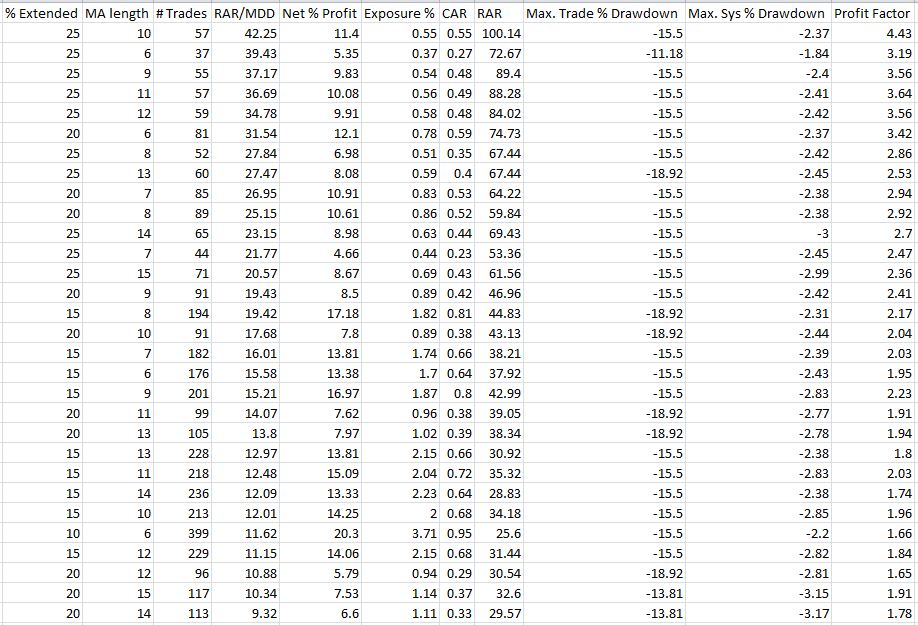
Table 1
My first observation is that a cluster of 25% extended systems sit right at the top. Indeed, running a linear regression analysis on all 50 systems shows that % extended and RAR/MDD are correlated with an R-squared value of 0.77 (R-squared > 0.80 is typically considered “strongly correlated”).
This makes logical sense as a mean-reversion trading system. Mean-reversion systems are based on the idea that the farther the rubber band gets stretched, the more likely it is to snap back [to the mean]. The more extended VIX gets above or below the VIX moving average, the more likely SPX is to move higher or lower, respectively. This was also seen [less clearly] in the graph of Net Profit % (http://www.optionfanatic.com/2012/10/03/trading-system-1-spy-vix-part-4/).
If I break down systems by z-value (moving average period), then the results look like this:
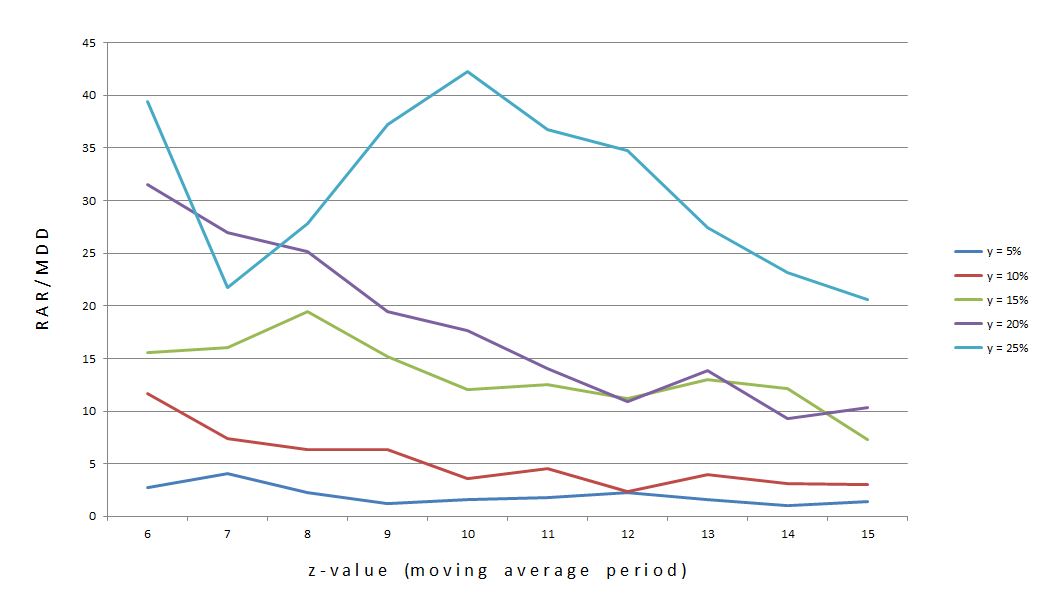
Figure 1
Keeping in mind that I want to see plateau regions rather than spike regions, the bottom curve (y = 5%) looks best. The statistics do not bear this out, however:
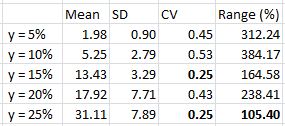
Table 2
Mean = average RAR/MDD
SD = Standard Deviation
CV = Coefficient of Variance (SD / mean)
The lower the SD, the flatter the curve. Even more important is to interpret SD as a percentage of the mean since the means vary over 15-fold. By that metric, y = 25% is the most consistent.
Indeed, y = 25% has a greater RAR/MDD over the entire range of z values. Even the lowest RAR/MDD for y = 25% (at z = 7) is greater than the highest RAR/MDD for y = 15% (at z = 8). Given these observations, y = 25% seems to be the best choice.
I will continue this analysis in the next post.
Categories: Backtesting | Comments (0) | PermalinkMotion to Dismiss System Development?
Posted by Mark on October 15, 2012 at 06:07 | Last modified: October 4, 2012 06:38I now have the subjective function from http://www.optionfanatic.com/2012/10/12/the-subjective-function-part-6/. Before I move on and apply this to the SPY VIX trading system, I want to briefly discuss one other point that threatens to derail system development.
In my last post (see above), I mentioned the following with regard to high-profit, infrequently-trading (i.e. “surgical”) systems:
> Ideally, I would like to take advantage of the time one such system is not in the market
> by trading with another surgical system that is in the market. I am therefore in the
> market more frequently with systems that deliver concentrated profits.
When trading with surgical systems, the only way to achieve a reasonable percent return on the entire portfolio in a risk-controlled manner is to combine them.
Statistically speaking, this is the employment of non-correlated systems (i.e. low R-squared values). With two non-correlated systems, one system may be making money while the other is flat (i.e. out of the market) or one system may be losing money while the other is making a bit more. The catch is that R-squared is calculated based on historical data. During explosive market conditions, one system may make money when the other system suddenly loses much more. Even worse, both systems may become correlated and lose money together.
While these are threatening possibilities, without more details I can’t say it’s reason to dismiss system development altogether. You could look at a long historical backtesting period to determine how often these conditions occur. When they occur may be generalizable to a particular type of market condition. You could explore the possibility of including a failsafe filter–for example, suspending trade of a mean-reverting system in case of powerful breakout or breakdown. Whether the markets traded by these systems are the same or different could also affect the severity of this threat.
I will continue analysis of the SPY VIX trading system in my next post.
Categories: System Development | Comments (0) | PermalinkThe Subjective Function (Part 6)
Posted by Mark on October 12, 2012 at 04:51 | Last modified: October 1, 2012 06:31I unmasked the systems in yesterday’s post (http://www.optionfanatic.com/2012/10/11/the-subjective-function-part-5). Prior to that I made all my observations about the graphs shown in http://www.optionfanatic.com/2012/10/09/the-subjective-function-part-3. Once and for all, the time has arrived to select the subjective function.
On one hand, I like a system that trades more and presents more opportunity for profit. This sort of system has a profit factor (PF) just over 1.00 and grinds out a small profit in each of many trades. This would be insert #3.
On the other hand, I prefer systems that are surgical in their efficacy. These generate infrequent trades and have larger PFs (e.g. over 1.50 or 2.00). Ideally, I would like to take advantage of the time one such system is not in the market by trading with another surgical system that is in the market. I am therefore in the market more frequently with multiple systems that each deliver concentrated profits. I prefer this model.
The risk of using surgical systems to make the equivalent dollar profit as a frequent trading system is that larger position sizing must be employed. Although the likelihood is that these trades will end up profitable, in case the next trade results in MDD the larger position size could result in catastrophic loss.
I want a subjective function that takes into account both profit and DD. A system may have had minimal DDs in backtesting but as one author on system development described, your worst DD is always ahead of you. If the subjective function does not factor in DD then I fear the Risk of Ruin.
Therefore, I will choose RAR/MDD (insert #1) as the subjective function. By using RAR instead of compound annualized return, I also like the fact that the more a system is out of the market, the more it is rewarded.
Categories: System Development | Comments (1) | Permalink