Posted by Mark on June 19, 2013 at 06:53 | Last modified: August 1, 2013 07:40
In this blog series, I’m backtesting a weekly option trade described here.
The first week was flawless. At inception, the trade looked like this:
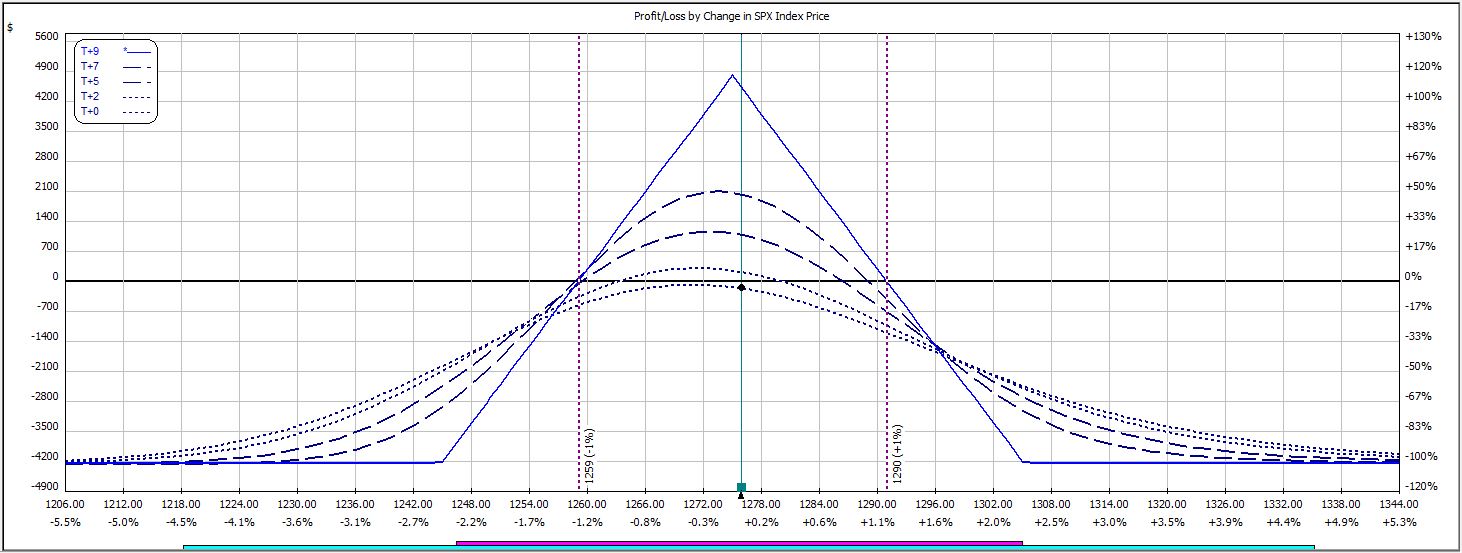
P/L on Day 1 ranged from -$237 to -$12.
P/L on Day 2 ranged from +$18 to +$333.
P/L on Day 5 (nothing happened over the weekend) ranged from +$123 to +$528. The latter included allowing the long call to expire worthless since it was listed at $0.15 upon trade close, which looked like this:
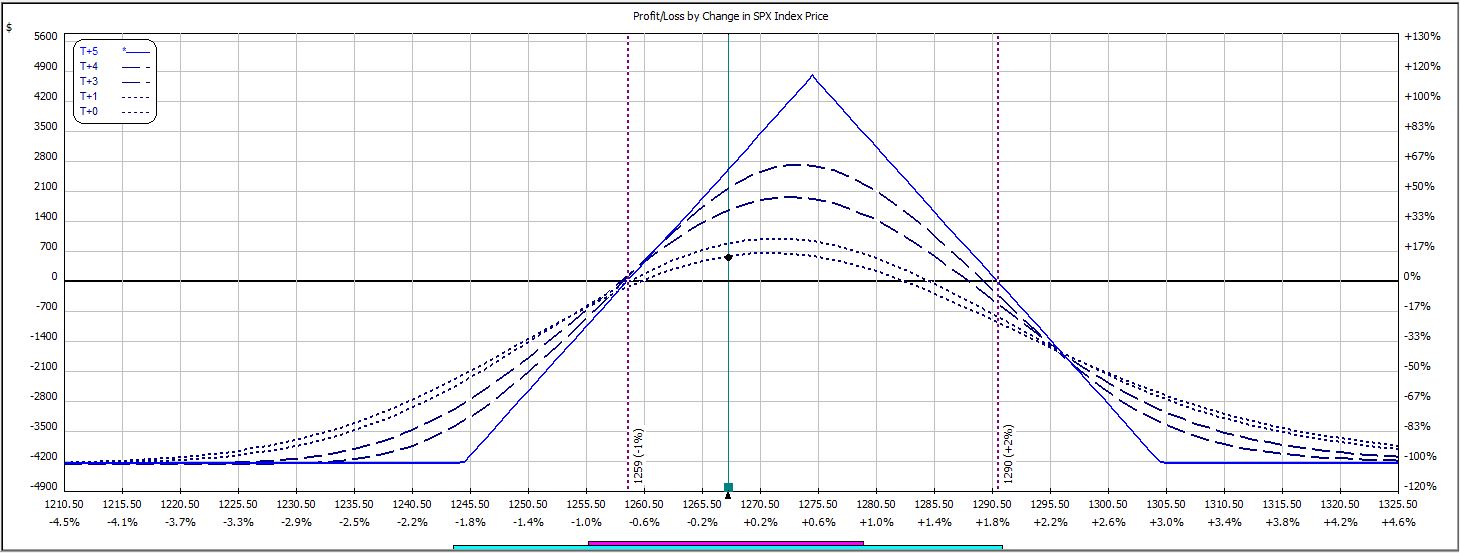
No adjustments were required for this trade. While the market was over 10 points from its starting point on Day 5, since the trade was still profitable I did not adjust.
Margin remained constant at $4,236 for three contracts. Return on investment was 12.5%.
Categories: Backtesting | | Permalink
Posted by Mark on June 17, 2013 at 06:10 | Last modified: August 1, 2013 08:23
With this post, I’m going to start backtesting a weekly iron butterfly trade. I have been hearing from a number of traders that when traded every week, this can generate an average profit of 3-5%. My skepticism reigns supreme.
My trading plan will be as follows:
–Enter trade at the money on Thursday before expiration week.
–Target 10% profit on initial capital and keep max loss at 20%.
–If market rallies 10 points from initial price then roll out distressed short option by 10 points.
–If market moves another 10 points in the same direction then repeat adjustment or roll entire spread.
–Also at second adjustment, roll profitable vertical closer to the money to manage margin requirement.
–Do not adjust if P/L is positive.
–Assess transaction costs of $6/contract.
Hopefully I will be out of most trades by Monday or Tuesday of expiration week.
I have backtested this before using $16/contract transaction fees and gotten terrible results. I realize $16/contract is harsh. When it comes to transaction costs in backtesting though, I usually spare no potential expense because this is a great way to make a trade seem more profitable than it really can be.
As I said, I’ve heard a number of other traders say this works.
Traders lie.
Could I be missing out on a good thing by being too skeptical?
Here’s to second chances!
Categories: Backtesting | | Permalink
Posted by Mark on June 11, 2013 at 04:12 | Last modified: July 25, 2013 12:31
In my last post, I discussed an MTZ trade that Dan Fitzpatrick explained could have easily made you 10% in a short period of time. Upon closer scrutiny this trade seems to be more difficult than promised, no thanks to the illusion of Retrospect.
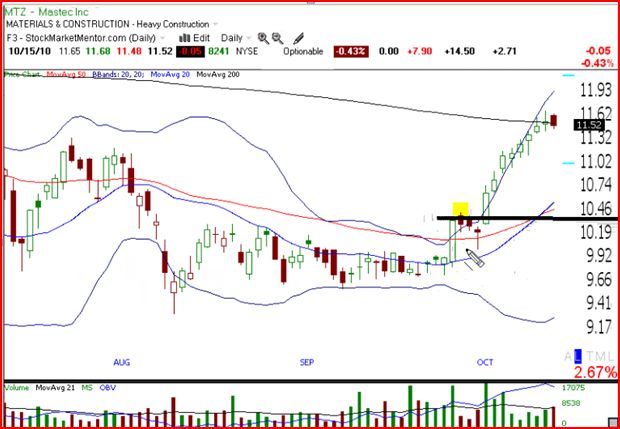
Fitzpatrick said you could buy on a move above the thick black line and ride the stock to victory:
A closer look reveals that MTZ definitely traded higher the next day:
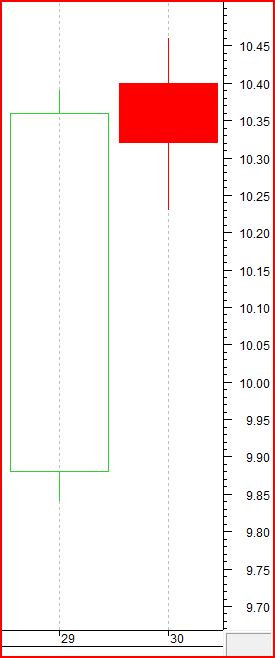
MTZ closed at $10.36 on the 29th and opened at $10.40 on the 30th. MTZ then traded up to $10.46: a full 1% above the previous close. While Fitz suggests this day to be weak and not reason to buy, nothing weak is evident in the first 30 minutes when the stock opened higher and continued higher.
If I were to truly follow Fitz’s directions then I would have had a more difficult trade than Fitz represents. The easy way to follow Fitz’s lead would be to set a buy-stop to enter long above $10.36. Two days later, MTZ traded down to $10.04 intraday: a loss of 3.1%. This would have undercut the 50-day moving average (seen on the top chart) and caused some people to exit at a loss. If I would enter on a buy-stop intraday then why wouldn’t I exit on an intraday stop-loss?
Retrospect is the illusion that masks the difference between what Dan Fitzpatrick says would happen with this trade and what really would have happened. Getting on-board and riding the stock up 10%+ is the fairy tale we want to believe. The difference between that and the reality of buying, losing 3.1%, and then riding onto victory was significant for those who didn’t stick around to be rewarded with the profits!
Application of Retrospect means trading away from a chart’s hard right edge, which is not reality. The illusion of Retrospect therefore allows one to gloss over particular details that involve a great deal of endless debate, instruction, and theory. This is what makes trading so difficult to learn and to master.
Categories: optionScam.com | | Permalink
Posted by Mark on June 3, 2013 at 04:01 | Last modified: July 25, 2013 11:50
Dan Fitzpatrick (a.k.a. “Fitz”) is a talking head who has been featured on CNBC’s “The Call,” Jim Cramer’s “Mad Money,” and theStreet.com where he posts “3 Stocks I Saw on TV.” Not surprisingly, he also has his own premium trading service called Stock Market Mentor. In his free chart of the day from October 16, 2010, he did something that I have seen virtually every “educated” stock market commentator do: try and get us to fall for the illusion of Retrospect.
In this video, Fitz discussed a breakout trade on Mastec Inc. (MTZ). The chart is shown below:
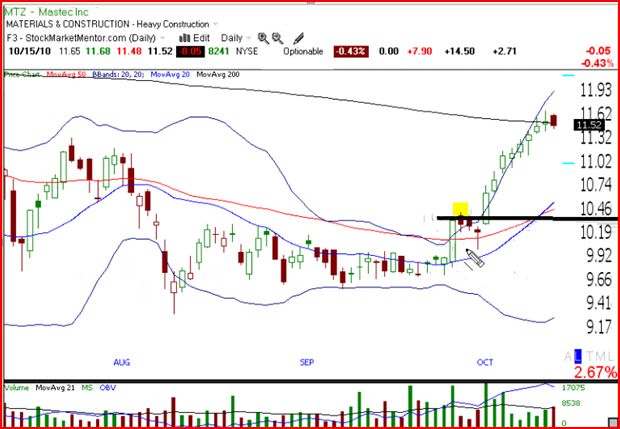
On the chart, you can see the black line Fitz drew to coincide with the top of the large green candle in September. This is the breakout level. Fitz then explains:
> “When the stock gets above the initial breakout level is when you want to
> participate… this is a textbook volatility squeeze. I see this so much where
> you get the initial move one day—BAM—that draws your attention to the
> stock, only the next day—yeah it went up a little bit but it was kind of
> weak. It came back down and then finally you get this blowout above the
> initial breakout level… now you’re in at, say, $10.50 and you ride it clear
> up to $11.50 and you’ve made 10%.”
How easy does that sound as a way to print money?
The premise of this trade is to enter long when MTZ trades above the black line. MTZ did just that the very next day (yellow highlighting). Fitz notes this even though “it was kind of weak.” He glosses over it as if you would not take this trade. His chart pretty much hides it, and unless you were watching with a critical eye, you might not really see it, either. The dramatic breakout, after all, is a few days later.
I will conclude with my next post.
Categories: optionScam.com | | Permalink
Posted by Mark on May 30, 2013 at 06:40 | Last modified: July 25, 2013 12:30
This blog mini-series initially aimed to discuss whether independent trading success is actually possible.
I have observed many people who claim to be successful traders and most have something to sell. Some people start off with blogs and a web site and others progress to a subscription newsletter, a mentorship service, or an “educational program.”
As Gregory House says, “everybody lies.” People may lie for many reasons. This realization forces me to accept only authentic account statements and tax returns rather than completed questionnaires.
Since these documents are regarded as intensely personal in our society, I have a research problem. I might be able to collect such data in exchange for significant compensation but I don’t have that kind of budget. I am therefore left with no investigative means for a practical research question.
Is independent trading success possible vs. can we demonstrate the existence of statistically significant independent trading success? The latter seems to be “no,” which leaves me to be content with a sample size of one: myself. Human greed is what keeps us all searching for the “holy grail” and this hope will sustain trader interest and activity even when proven success stories are nonexistent.
“We believe what we want to believe.”
As for those looking for a new line of work, I might encourage a profession where demonstrated efficacy (i.e. a regular pay check) exists rather than one that might be sustained only by urban legend or anecdotal reports of success.
Categories: optionScam.com | | Permalink
Posted by Mark on May 22, 2013 at 06:10 | Last modified: July 25, 2013 12:28
In this mini-series, I may have raised more than reasonable doubt as to whether verification of independent trading success is even possible.
One thing I cannot do is gather data by survey or questionnaire. As mentioned previously, people will exaggerate and lie especially when it comes to matters of performance. Someone believed to be successful can develop a tremendous amount of respect and admiration from others. At the very least, this can fulfill Maslow’s needs for affiliation and esteem. This can also serve as sales and marketing for products or services–especially trading newsletters or “educational” programs. Can you say “conflict of interest?”
Since word of mouth cannot be trusted, I must focus exclusively on authentic documentation. Some people may show me a trade confirmation or two, but this is far from satisfactory. I need to see account statements and tax returns over a lengthy period of time to establish consistent profitability. As discussed in my last post, I would also need to see them from a large number of people.
Fahgettaboudit, right? In our society, people just don’t share such information with strangers.
While brokerages have access to the requisite documentation, I don’t believe they can be trusted. No brokerage could serve as an objective investigator when promotion of trading stands to increase its profits. To publish findings that independent traders are doomed to fail would be a conflict of interest with the brokerage’s bottom line.
The IRS also has access to the requisite documentation but from a practical standpoint, I see no justification for the research expense. The IRS cares about collecting taxes, not demonstrating independent traders’ ability to succeed. If they cared about success rates then they would certainly study numerous other professions as well, which would drive costs to an enormous sum.
Supposing independent trading success is indeed possible, now I question whether this is something we could possibly know.
If a tree falls in a forest and no one is around to hear it, does it make a sound?
Categories: optionScam.com | | Permalink
Posted by Mark on May 14, 2013 at 04:33 | Last modified: July 25, 2013 12:27
This series of posts asks whether independent trader success even exists. I concluded last time with mention of hundreds to thousands as a requisite sample size and today I will discuss why so many.
I begin with the notorious claim that 80-90% of all new traders fail within the first 1-3 years. Due to concerns over sampling methodology, I question the veracity of this claim just like I question the existence of independent trader success. For current purposes, I will conservatively assume that 80% of all new traders fail within the first three years. A sample of 100 may therefore generate 20 successful traders.
To not fail during the first three years is a far cry from achieving consistent profits over time, though. The latter may hint at a decade or two of activity. Out of the 20 successful traders found, how many of them have been trading for a decade or two? I would guess not many, which would significantly increase the requisite sample size.
Furthermore, I believe years of trading experience are required before consistent profitability is really possible. Losses, after all, are the trader’s best teacher: especially the bigger ones. Perhaps I need to find people who have traded 15-25 years rather than 10-20.
Can you see how each step of increased selectivity requires a larger sample size to find a reasonable number of hits?
Another issue to address is why just a handful of successful traders does not necessarily establish the existence of independent trading success. I want to know from a statistical perspective to avoid the possibility of fluke. Is it one out of 10 who is successful or one out of 100,000? The latter would be 0.001%, which is much more likely to be fluke. Another complication? If it is only one out of 100,000 then my chances of even finding them are much less likely.
I will continue in the next post.
Categories: optionScam.com | | Permalink
Posted by Mark on May 6, 2013 at 05:08 | Last modified: July 25, 2013 12:26
My “Holy Grail” is consistent profits over time and I use this blog to help me continue moving forward to that end. While I hope I can one day look back on my performance having realized that goal, whether consistent profitability even exists for independent traders is a question worthy of debate.
As a research project, I can accomplish the first step: operational definition of trading success. For me, this is about consistent profits over time and I can certainly quantify that.
The challenge begins in earnest when trying to conceptualize the data collection process. I have little doubt that large institutions prove successful with their trading activities. Many publicly-owned corporations must disclose profit and losses in their financial statements, which makes this a matter of public record.
What happens with individuals is extremely private, however, which is why I raise the question of trading success in the first place. In a previous post I wrote:
> I also want to note that only brokerages and the IRS truly know if
> significant individual trading success even exists. Only these entities
> see account values over time for thousands of individuals (i.e. an
> adequate sample size).
People can and do exaggerate or lie for various reasons. Nothing short of authentic brokerage statements and tax returns would be sufficient to scientifically verify profits and losses from trading activity. We live in a society where details about personal finances are shroud in secrecy. Merely catching a glimpse of brokerage statements and tax returns belonging to immediate family members is a difficult thing for many. The thought of broadening this sample to hundreds or thousands of randomly selected individuals may easily be regarded as an impossible feat.
Aside from being an insider for a brokerage or the IRS, I’m not sure how I would ever generate a statistically valid sample.
I will continue this discussion in the next post.
Categories: optionScam.com | | Permalink
Posted by Mark on May 2, 2013 at 06:17 | Last modified: July 25, 2013 12:24
As discussed in the last two posts, the road to trading success is very long and chock-full of laborious work. Despite what Wall Street and the multitude of trader service entities would have you believe, no shortcut exists to consistent profits over time.
Rather than “breaking my back” to learn what I need to know, human greed urges me to take the easy road. This is the road targeted by trader service marketing campaigns (e.g. mentorships, trader education programs, trader newsletters, trader psychological services, meetups with commercial organizers, etc.). All of it is designed to use human greed as a manipulative tool to take my eyes off the difficult road just long enough to give my credit card number or write a check for the dream scenario.
I can only encourage you to keep “time-tested wisdom” in mind:
“Caveat emptor” = “Let the buyer beware”
“There’s no such thing as a free lunch”
“If it seems too good to be true, it probably is.”
I have found one potential benefit to trader meetups. I weighed potential pros and cons to one particular networking meetup in part 7 and decided the chance of being useful for me was slim to none. In general, although I believe most trader meetups organized by those with commercial interests will be loaded with beginners and not useful to me, I may occasionally find a wayward advanced trader like myself venturing out from his/her trading cave in an effort to meet like-minded souls. This is a person with whom I could work.
Whether reality or fantasy, one can always hope.
Categories: optionScam.com | | Permalink
Posted by Mark on May 1, 2013 at 05:34 | Last modified: July 25, 2013 12:22
I left off in part 16 discussing the vast amount of work required to move from beginner to advanced trader. In my experience, meetups are notorious for making the road seem easy with alluring marketing materials rather than collaborative system development.
I have chosen to pick on meetups for this blog series, but they certainly don’t have a monopoly when it comes to misdirecting traders from the one “proven” road to success described in part 4 and part 5. So many trader education programs, mentorships, newsletter services, coaching, and psychological services promise success with little time and effort. For a fee, they will show you the way to Easy St. I do not believe any easy street exists even though Wall Street (i.e. the multi-billion dollar institutions) wants you to believe it.
Listen to the voice of Wall Street:
> Go ahead, get happy and overconfident so you trade real big hoping to make
> millions with your greedy intentions. You may even win for a while (e.g.
> 2006-7, 2011-2, 2013, etc.). When (not “if”) you lose, though, you’ll be all-in
> and you will more than pay us off for our patience and sales/marketing efforts.
I should note that while my claims of the laborious work as a prerequisite for trading success make logical sense, I will never prove them. For myself, I will one day be able to look back and determine whether I succeeded. I have done and continue to do the laborious work, which will give me a sample size of one. Only brokerages and the IRS see account values over time for a sample size sufficient to do this analysis. Everything else–especially how successful people may claim to be–is just sales, marketing, and braggadocio.
I will conclude this blog series with my next post.
Categories: optionScam.com | | Permalink