Covered Calls and Cash Secured Puts (Part 9)
Posted by Mark on November 11, 2013 at 06:14 | Last modified: January 14, 2014 07:35Earlier in this blog series I posted a risk graph showing why CCs and CSPs are less risky than stock. In the last post, I reviewed backtesting results showing index CC returns ($BXM) to be roughly equivalent to the index itself with only 67% of the volatility. This affirms my former illustration and can mean better returns for traders.
I will use downside volatility to explain why this is the case. Volatility of returns is always something to monitor when understanding performance of a trading system. Volatility is measured by standard deviation to determine how much returns deviate from their average. Returns may deviate to the upside or downside but downside volatility is what makes me uncomfortable as a trader. The more I lose, the more stress and discomfort I will experience. If this becomes extreme then I will stop trading the system even if it means exiting at the worst time. At least I can then begin to accept the magnitude of loss and not have to worry about future losses becoming even larger.
Lower standard deviation of returns means the system may be traded in larger size. Suppose my loss tolerance is 20% of the total account. For the sake of simplicity, I will say the S&P 500 lost 50% in the 2008-2009 financial crisis. I therefore would not have wanted to invest more than 40% of my account in the S&P because the resultant loss would be 20% total. Because the $BXM exhibits roughly 67% of the S&P volatility, the $BXM may have only lost 33.5% during the financial crisis. I could therefore have invested 60% of my account in $BXM while remaining within tolerance limits.
Being able to invest more of my account equates to larger returns. An 11.7% per year return equates to 4.68% on the whole account when investing 40% and 7.00% on the whole account when investing 60%. These differences compound over time. Over 25 years, $1 million becomes $3.138M in the S&P 500’s case vs. $5.427M in the $BXM’s case.
Categories: Money Management, Option Trading | Comments (2) | PermalinkCovered Calls and Cash Secured Puts (Part 8)
Posted by Mark on November 8, 2013 at 05:50 | Last modified: January 14, 2014 06:26Aside from being less risky than stock, the $BXM is another reason I am biased to believe in CCs and CSPs.
When the stock market is in a bullish phase, success trading CCs and CSPs is reported a thousand different ways by investment newsletters, services, and retail traders seen in forums and mailing lists over the Internet. While everyone has their own particular way of doing this, I want to know how it all shakes out on average. Is there any true Edge?
The Chicago Board Options Exchange along with Standard & Poor’s created a benchmark index that tracks performance of a hypothetical CC strategy on the S&P 500 index. Known as the $BXM, this index was created in 2002. The index is designed as follows:
- Hypothetically purchase the S&P 500 index [e.g. using spot SPX price]
- Sell a one-month slightly out-of-the-money (OTM) [SPX] option
- Hold until expiration Friday and then cash-settled
- Sell a new one-month slightly OTM call
In 2004, Ibbotson Associates performed a 16-year backtest on $BXM. The backtest ran from June 1, 1988, through March 31, 2004. The compound annual return of the $BXM was 12.39% vs. 12.20% for the S&P 500. Volatility of the $BXM was only about two-thirds that of the S&P 500, though. This makes for higher risk-adjusted performance: 0.22 vs. 0.16 (Stutzer index) in favor of the $BXM.
In 2006, Callan Associates performed an 18-year backtest on $BXM to extend the research done by Ibbotson. The backtest ran from June 1, 1988, through August 31, 2006. The compound annual return of the $BXM was 11.77% vs. 11.67% for the S&P 500. Again, volatility of the $BXM was only about two-thirds that of the S&P 500, which again makes for higher risk-adjusted performance: 0.20 vs. 0.15 (Stutzer index).
Both studies noted $BXM outperformance in down markets and underperformance in bull markets due to limited upside profit potential.
I will continue this discussion in my next post.
Categories: Option Trading | Comments (0) | PermalinkCovered Calls and Cash Secured Puts (Part 7)
Posted by Mark on November 5, 2013 at 07:04 | Last modified: January 14, 2014 05:35In my last post, I discussed conflicts of interest that potentially compromise the credibility of commentators cited in part 5 of this blog series.
The general conflict of interest principle suggests that whether or not those commentators believe option trading to be a worthwhile pursuit, they stand to profit by representing it that way. Regardless of whether you, as a trader, make or lose money, they can profit by getting you to take interest, buy books, subscribe to services, and/or trade options. More likely than not, the commentators do believe the positivity they spread because in the future there is potential profit to be had through “word of mouth.” In other words, if they represent option trading positively and if I have success with it, then I may speak highly of the commentators to other people, which can generate additional referrals for them.
Whether the additional referrals occur, however, the commentators’ consistent positivity will generate some immediate revenue. This alone makes it worthwhile for them.
If the commentators are sociopathic in nature then their external positivity toward the subject matter will be offset by internal skepticism. This is often hard, if not impossible, for the critical thinker to judge.
Conflict of interest is always something to be on the lookout for in any discipline, field of inquiry, or business transaction. In some cases it is blatant and egregious and in other cases it’s a moot point. Does the last post deserve membership in my optionScam.com category? Probably not because as discussed in part 3, CC/CSPs are less risky than outright stock ownership. A great many people are willing to own stock. At least as many people should be willing to trade CC/CSPs.
Another reason I am biased in favor of CC/CSPs is because of $BXM, which I will discuss in my next post.
Categories: Option Trading | Comments (0) | PermalinkCovered Calls and Cash Secured Puts (Part 5)
Posted by Mark on October 29, 2013 at 06:20 | Last modified: January 10, 2014 08:09In part 3 of this blog series, I discussed why CC and CSPs are less risky than outright stock. Why don’t more investors make use of them? I believe an inherent fear of options within the retail trading community has capped their use.
I have spoken with a number of stock investors over the years who have bulked at the mention of option trading.
The fact that brokerages have historically limited or disallowed option trading in retirement accounts has probably biased some traders against them.
Searching the Internet for “option myths,” I found a few articles that address the fear. Here is one:
> If you received or read a disclosure from your broker about options
> trading stating that trading options is dangerous and you may lose
> money, do not believe it. If you know what you are doing and what
> to expect from options, they can be very safe and they actually can
> be less dangerous than trading stocks themselves.
In this second article, Michael Sincere discusses it:
> Myth #1: Options are too risky
> …
> Myth #2: Options are difficult to understand
> …
> Myth #5: Options are the cause of stock market crashes
Here is a third article that also addresses the fear of trading options:
> Myth #1: Options trading is only for professional traders with
> years of experience.
> …
> Myth #3: Option trade execution is a rip-off.
> …
> Myth #5: Option trading is for older and wiser investors only.
> …
> Myth #6: Option trades are difficult to execute and should
> only be handled by professionals.
> …
> Myth #8: You have to spend thousands of dollars to get a good
> options trading education.
I would recommend reading the second and third articles in full as they cover some really good informational content.
Bottom line for today: some apprehension toward option trading and therefore toward CC/CSPs does persist. This may help to explain why more traders don’t use them.
In my next post, I will offer an opposing viewpoint.
Categories: Option Trading | Comments (2) | PermalinkCovered Calls and Cash Secured Puts (Part 4)
Posted by Mark on October 24, 2013 at 07:20 | Last modified: January 9, 2014 12:37In the last post, I argued that CCs and CSPs are less risky than owning stock outright. People are often surprised by this because some brokerages suggest otherwise.
Certain brokerages in the past did not allow CSPs or any option trading in retirement accounts. I found a number of links on-line devoted to the subject. This article from a few years ago talks about Scottrade.
This article is from 2013 and describes trading restrictions in an IRA. The article writes:
> The only universal restriction is tied to IRS rules that do not allow
> borrowing from an IRA account. This restriction blocks short
> selling, leverage using margin, and the sale of naked put or call
> options.
Since CCs and CSPs are less risky than outright stock, why should they not be allowed in retirement accounts if long stock is? They should.
This article discusses some possible reasons for the illogic.
> The higher suitability standards in an IRA makes the firm concerned
> that even though the strategy is safer than buying the stock, it’s more
> complex, and the duty to ensure that the client understands the
> risks… makes it not worth offering.
>
> The firm’s systems can’t differentiate between cash-secured put
> writing and other types of put writing that are not appropriate for
> IRAs (naked put writing, covered put writing against short stock,
> etc.)
>
> The firm’s permitted options strategies for IRAs have not been
> changed in many years. This is the most common one. Most firms
> established covered calls, or covered calls and protective puts as
> the only strategies they’d allow when they first became IRA
> custodians, and simply haven’t changed them since.
In my opinion, the tide seems to be changing as time goes by and this is good news for traders/investors. TradeKing was a holdout that did begin to allow CSP Trading in IRA accounts a couple years ago.
Categories: Option Trading | Comments (0) | PermalinkCovered Calls and Cash Secured Puts (Part 3)
Posted by Mark on October 22, 2013 at 06:03 | Last modified: January 9, 2014 11:49In this blog series, I’m detailing different aspects of the CC/CSP trade in an attempt to develop some trading guidelines for future use. Today I want to explain why a CSP is less risky than owning stock outright.
Yes a CSP, or naked put, is less risky than owning stock. Why this is counterintuitive to many is something I will discuss in a future post. The first step to understanding it is to recall that a CSP and CC are synthetically equivalent.
Saying that a CC is less risky than owning stock outright may feel more comfortable because CCs have long been touted as a “conservative [option] strategy.”
Risk management is about limiting potential loss. With a CC, I buy the stock and sell a call. Selling the call puts money in my pocket. The CC is therefore cheaper than the stock. If the stock goes to zero then I lose less money with the CC than I do the stock because I already put money in my pocket. The CC is therefore less risky than the stock because I cannot lose as much money. The CSP is also less risky than the stock for the same reason.
The following graph plots the PnL of AAPL stock (blue line) and CC position (purple line) 365 days after trade inception. The option expires on that day. Stock dividends ($1,040) are included:
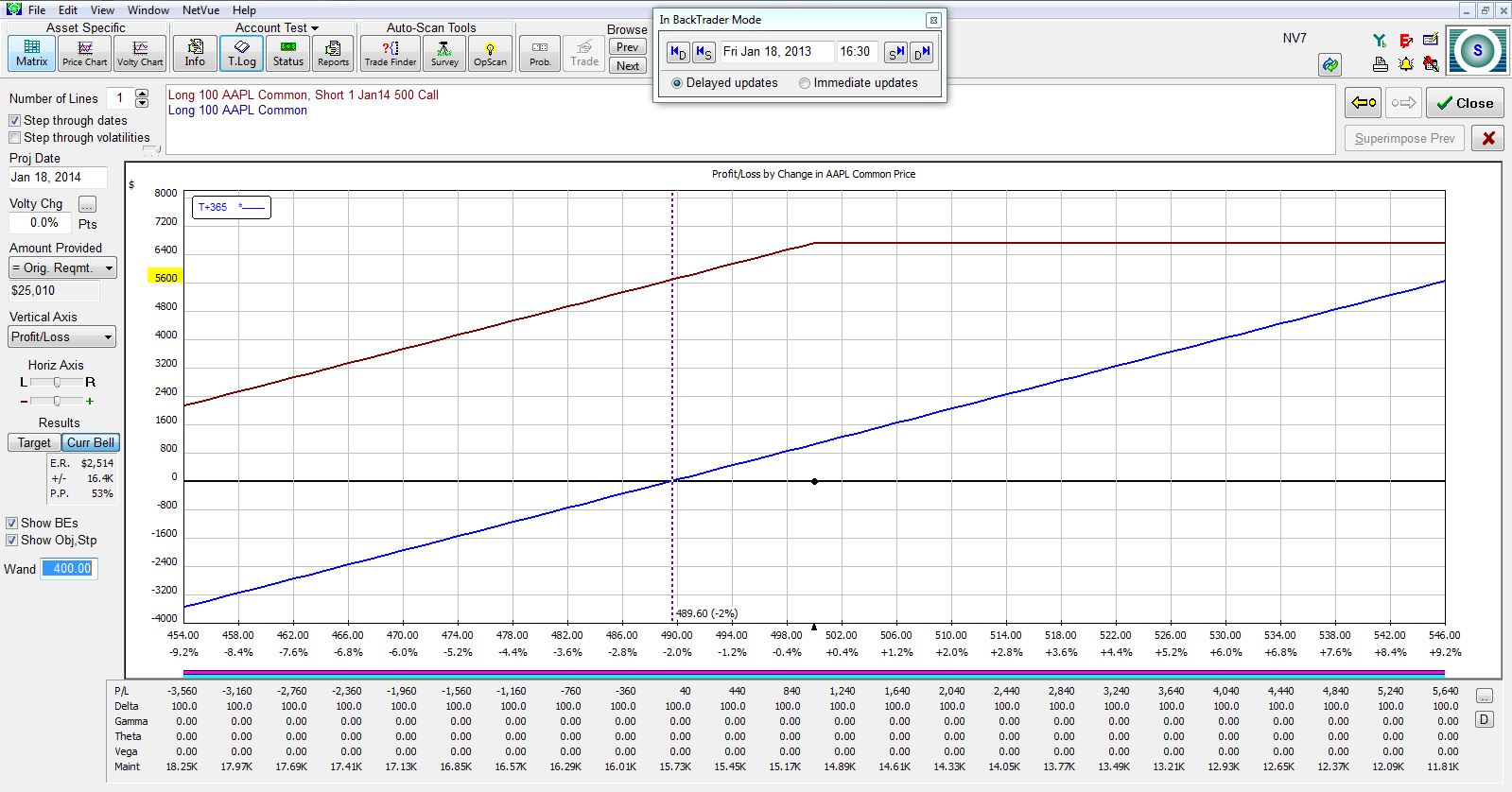
The vertical, dotted line shows breakeven for the stock position if the stock price falls. At this zero profit level, the CC shows a profit of $5,600, which is the profit from selling the call at trade inception. The stock is more risky than the CC.
Viewed another way, for the CC (green line, below) to be at breakeven after one year, the stock would have to fall to 432.74, which is more than $55 lower than breakeven for the stock position (purple line, below) alone:
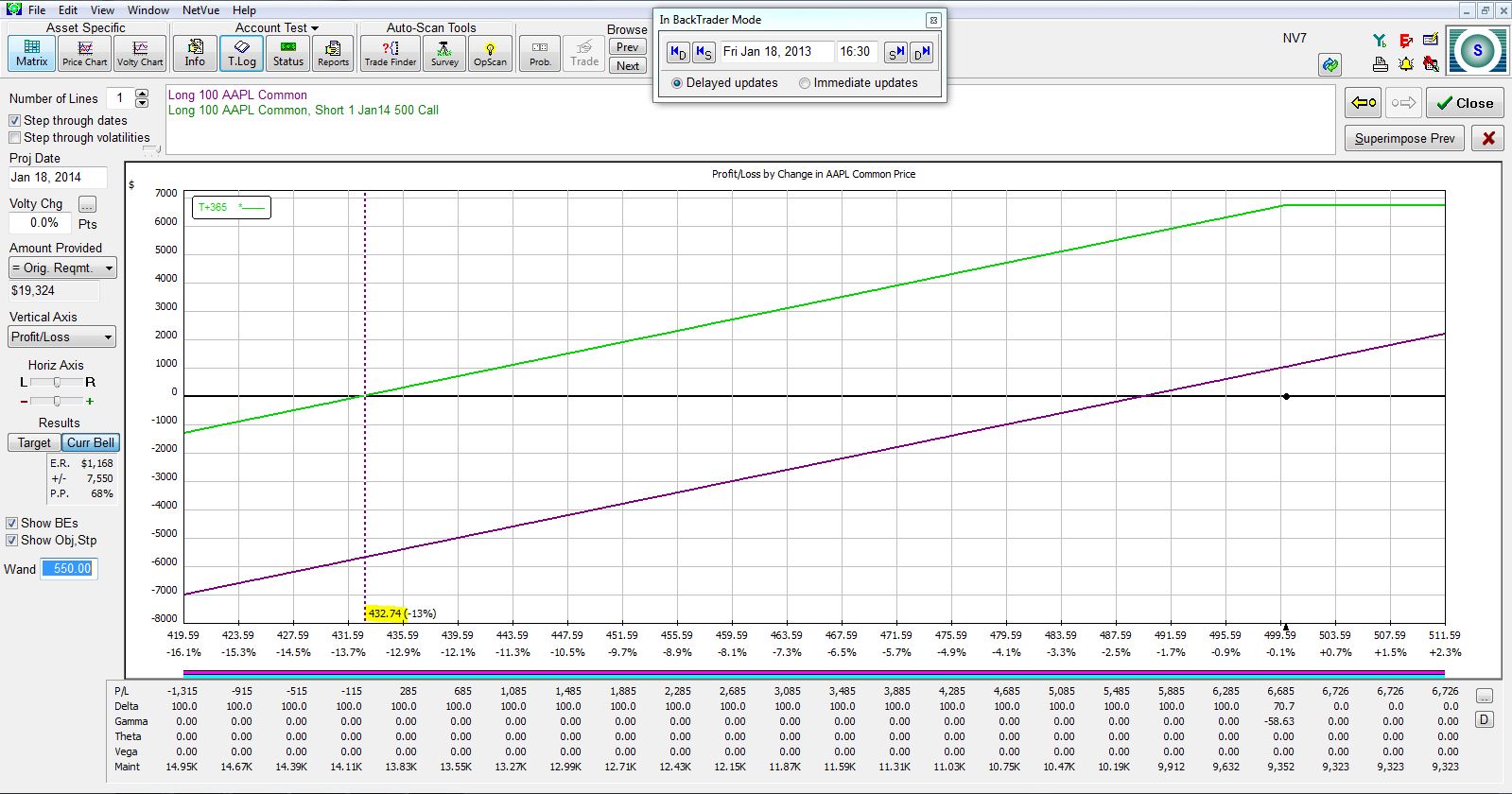
Either way you look at it, the stock is more risky than the CC.
Categories: Option Trading | Comments (6) | PermalinkCovered Calls and Cash Secured Puts (Part 2)
Posted by Mark on October 18, 2013 at 07:15 | Last modified: January 8, 2014 10:05A cash secured put (CSP) is a naked put (NP) covered by cash. If I sell the Nov 495 AAPL put, for example, then I would need $495/share * 100 shares = $49,500 in the account for a CSP.
While covered calls (CC) and NPs are synthetically equivalent, one apparent difference is that the CC is more expensive. In a margin account, a CC costs approximately 50% of the stock price whereas a NP costs approximately 20% of the stock price. I say this is an “apparent” difference because in the worst case scenario, the NP trade would require me to pay the strike price for a worthless stock. The total loss, then, would be the same loss incurred if the CC were traded: strike price minus the credit received for the option sale.
Practically speaking, only under exceptional circumstances would a NP [or CC] result in total loss. More commonly, the stock might lose value, which would force me to buy it (option assignment) for more than its current market price. That could result in substantial loss but at least I have shares that I can turn around and immediately sell. If I lose 10-20% of the stock’s purchase price or even 50% then that is still far less than total loss.
For this reason, some people suggest using NPs to establish “additional positions” in margin accounts. Assuming I have cash available to buy 100 shares, these gurus say it’s okay for me to sell 2-3 NPs because even this would only cost me 40-60% of the stock price. USE CAUTION, I say, because if the stock price falls sharply then you may be on the hook for more than you have. Your trading days could be over!
In a retirement account, all NPs require at least as much cash in the account to purchase the stock at the strike price. In other words, in a retirement account all NPs are CSPs.
Categories: Option Trading | Comments (0) | PermalinkCovered Calls and Cash Secured Puts (Part 1)
Posted by Mark on October 15, 2013 at 06:24 | Last modified: January 8, 2014 07:28In an effort to break my analysis paralysis and develop an additional stream of income, today I begin a blog series on covered calls (CC) and cash secured puts (CSP). I will begin today by defining the trades.
According to www.investopedia.com, a covered call is defined as:
> An options strategy whereby an investor holds a long position
> in an asset and writes (sells) call options on that same asset in
> an attempt to generate increased income from the asset.
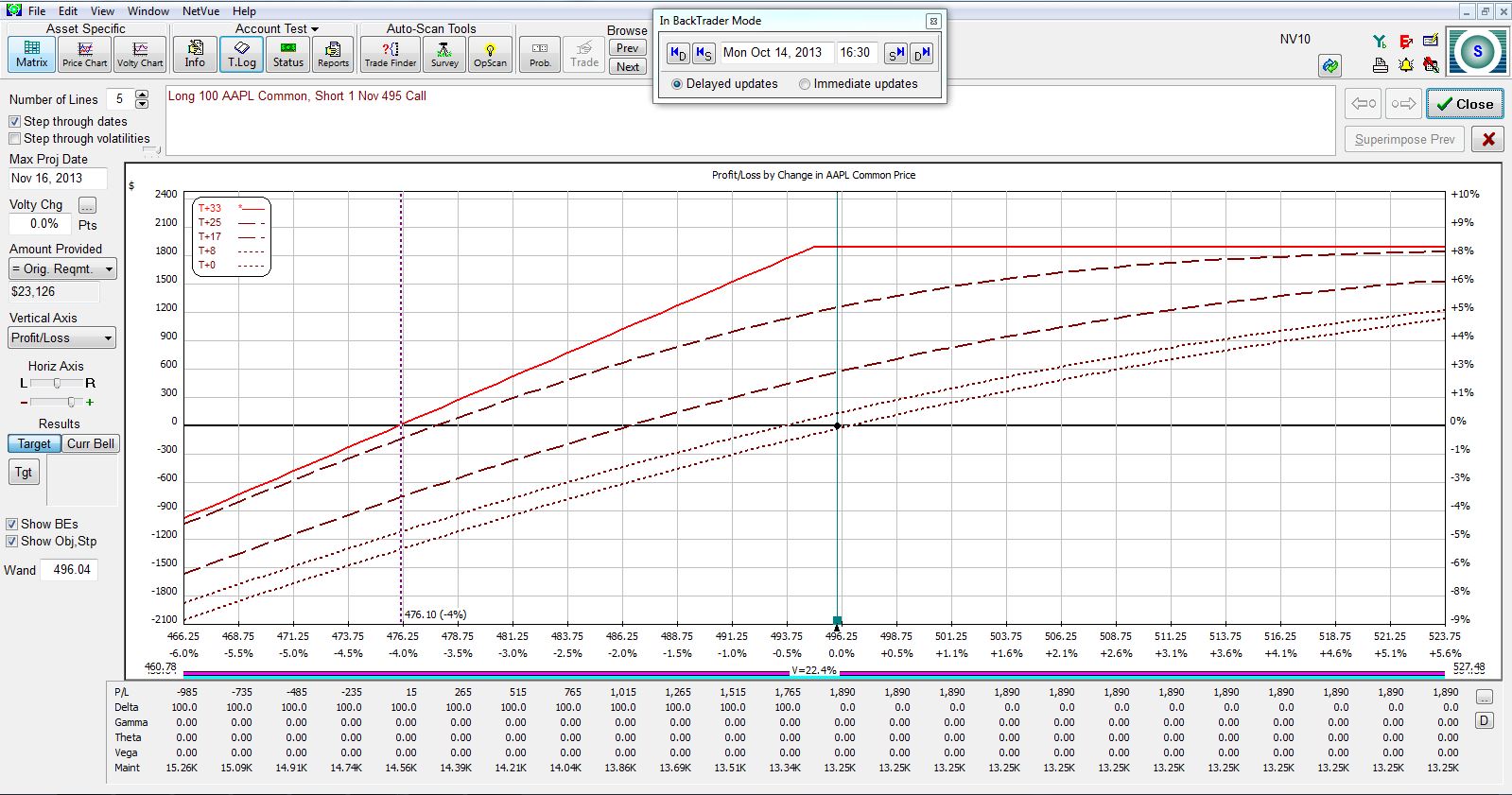
With Apple (AAPL) stock closing yesterday at 496.04, an example of this trade would be to purchase 100 shares of AAPL and sell a November (33 days to expiration) 495 put:
According to www.cboe.com:
> An investor who employs a cash-secured put writes a put contract,
> and at the same time deposits in his brokerage account the full
> cash amount for a possible purchase of underlying shares. The
> purpose of depositing this cash is to ensure that it’s available
> should the investor be assigned on the short put position and
> be obligated to purchase shares at the put’s strike price.
With Apple (AAPL) stock closing yesterday at 496.04, an example of this trade would be to sell one November (33) 495 put:
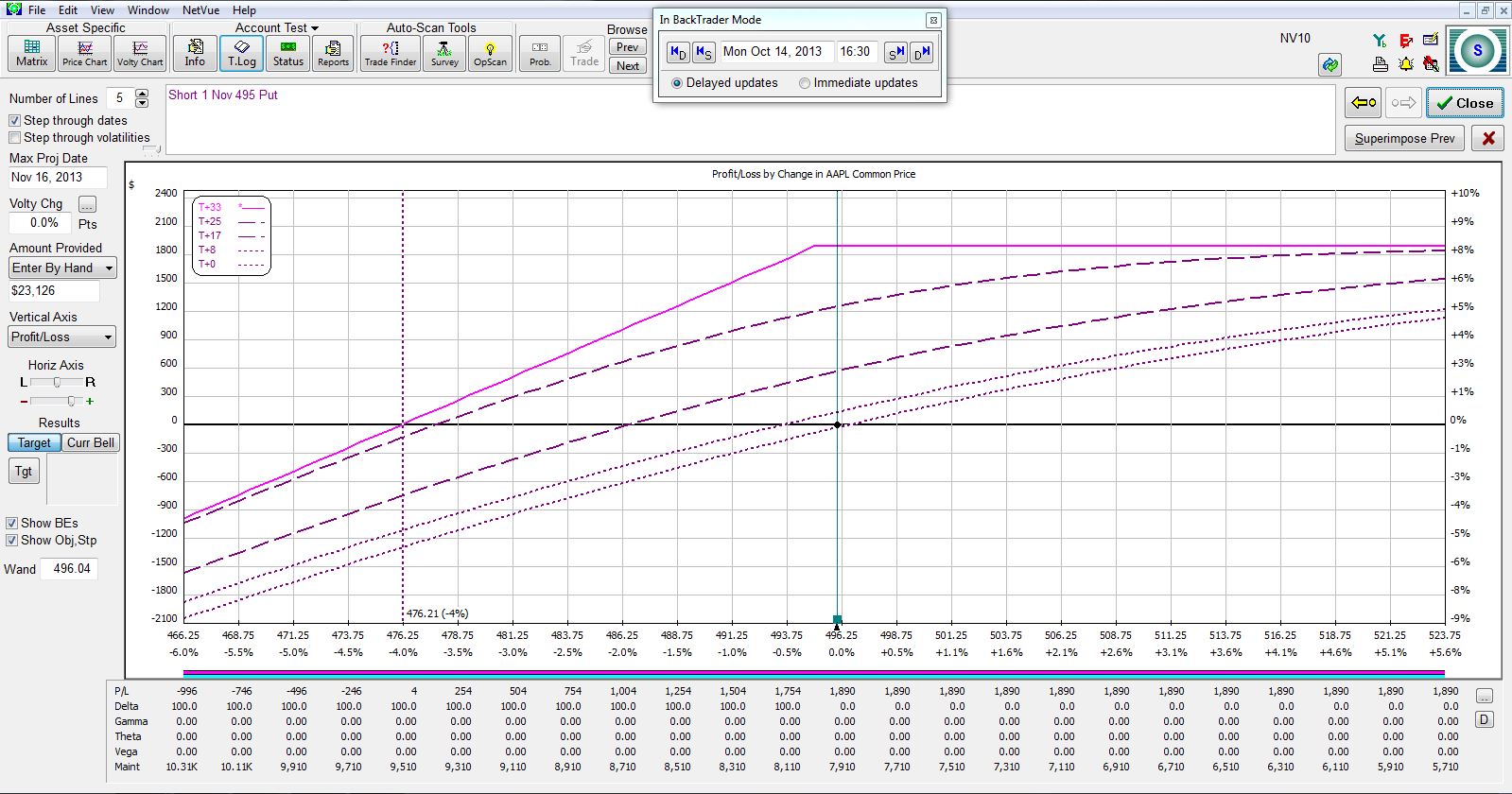
Notice that the two risk graphs are virtually identical. While the two may differ by a few bucks depending on the particular moment in time for the marketplace, if the same strike is selected to sell the call or put for the CC or CSP, respectively, then the trades are identical. These are known as synthetic positions.
While the trades are synthetically equivalent, the CC initially requires two brokerage commissions (buying stock and selling option) whereas the CSP initially requires one (selling option).
I will take a temporary detour with my next post and detail the “cash secured” nature of [naked] put selling.
Categories: Option Trading | Comments (3) | PermalinkRealistic Expectations (Part 4)
Posted by Mark on October 10, 2013 at 06:30 | Last modified: January 8, 2014 06:12Today I will conclude this blog series by talking about making a living through full-time trading.
I cannot accomplish this task by relying solely on trading income to cover monthly expenses. This is too much stress for anyone who is required to think clearly. Any trader will have periods of “feast” and of “famine.” If I require trading profits every month to pay the bills then at some point I am likely to fail. Treat trading as a business. Nobody starts a successful business without having savings to sustain them through the rough times until the business becomes profitable [again].
While I cannot rely on monthly income, I should aim to cover the expenses each and every month. I look to make $X per month. I don’t care what percent return that is or how it fares relative to the broad market. My goal is to avoid having to go back to work for someone else. If I cover my bills on a regular basis then I will be successful.
I would offer two footnotes to the above-stated points. First, while I do not care much about it, if my monthly requirements demand an unrealistic percent return then I need to be cognizant of that to lower risk of going bust. Second, for me a particular type of trading strategy is needed to trade for a living. Because the mortgage is due every month, my personality requires something that will make money most of the time. This means I need to place trades that give me a high probability of making my monthly requirement. More speculative trades tend to have a lower probability of profit, a higher reward-to-risk ratio, and are characteristic of less liquid markets. Speculative trades, as an experienced trader once described, can buy me “dinner and a movie” but are not something to trade with the goal of covering the mortgage. I need to understand the difference.
In summary, I need to implement critical thinking to help determine realistic expectations and then I need to develop a mind-set that keeps me focused on requisite monthly income generation rather than the commonly advertised percent return relative to a benchmark.
Prospective traders: you can do it!
Categories: Option Trading | Comments (0) | Permalink