Can We Scientifically Understand the Financial Markets? (Part 1)
Posted by Mark on December 9, 2014 at 06:21 | Last modified: May 2, 2015 12:34A couple years ago I stumbled across an interesting article by Jeffrey Mishlove, Ph.D. In the article, he presents some survey responses to the question about whether scientific understanding of the financial markets is possible.
While Mishlove does not present us with the optimistic responses, he does show us some of the more pessimistic ones:
> …The future never resembles the past and persistence in
> performance for any length of time in the investment industry
> is almost unheard of.
> I am surprised that you do not know that predicting financial
> markets can’t be done. It’s a “Fool’s Game”
> “Never…” there is no useful research. The minute any useful
> research emerged (to the general public as suggested by the
> question), it would immediately be incorporated into financial
> markets, rendering that research no longer useful.
> Most of us, including myself, are all about data, but, as
> others have said, no empirical results – back, realtime or
> front, regardless of the power applied – can be the basis for
> long-term successful trading. Sadly, not even actual results
> can form such a basis – as actuals are indistinguishable
> from random.
> Back testing is essential but most of the output is a
> curve fit illusion… Forward testing is of little use
> either; especially for longer term trading….I fear that
> studying scientific research is not a route to Eldorado.
> Investors should remember that at the end of the day,
> Candide gave up the attempt and resorted to peacefully
> cultivating his garden. Most would be traders would do
> well to do the same.
> Building models incorporating genuinely objective data
> into a probability based decision chain is an
> interesting pursuit. However, no one knows what happens
> next particularly within any specified time slice.
> Seeking a useful predictive model producing near term
> efficacy is an exercise in futility.
I will conclude with the next post.
Day Trading Is Not All That (Part 3)
Posted by Mark on December 4, 2014 at 06:52 | Last modified: May 1, 2015 09:23Inspired by the writing of Louis Horkan Jr., today I will conclude by sharing more experience of a full-time trader.
I am just one [full-time trader] so please take this for what it’s worth.
I do not find trading to be a business where I make money all the time. I make money much of the time but on rare occasion I lose far more than I ever make in a short time periods. This makes me interested, motivated, and humble. I am interested to overcome the challenge of staying on top. I am motivated to grasp and manage my risk every day in order to prevent career-ending losses. I am humble enough as a result of my experience to know it never makes sense to claim victory in this pursuit. I am always one catastrophic loss away from being forced to return to Corporate America.
I disagree with Horkan Jr. because I do believe trading is about having nerves of steel. The “preconceived ideas” are formidable distractions that have good potential to cost me a lot of money if my nerves of steel don’t resist the illusory temptation. I have found it necessary to flex my nerves of steel and be mentally tough in the midst of stressful drawdown. When I’ve had catastrophic losses, those nerves of steel have prevented me from walking away forever with tail between my legs.
Finally, I find it noteworthy that the amount of time I spend doing the actual trading (e.g. entering, working, and executing) is just a fraction of my overall workday. I do many other activities that keep me engaged and, I hope, “sharp.” I spend a lot of time blogging. I spend time backtesting. I listen to trading calls and trading groups. I tweet with other traders. I read trading forums. I sometimes talk with other traders to share ideas and develop new strategies.
Thanks to Louis Horkan Jr. for a very thought-provoking article.
Categories: Wisdom | Comments (0) | PermalinkDay Trading Is Not All That (Part 2)
Posted by Mark on December 1, 2014 at 07:01 | Last modified: May 1, 2015 09:11In the last post, I presented an excerpt from Louis Horkan Jr. seen on the About.com website a couple years ago. Today I will comment on that based on my personal experience.
Unlike Horkan Jr., I am not a day trader. What I do is better described as position trading. I prefer to check the markets once per day.
Having said that, I trade full-time for a living and I treat my work as I would any other business. I track my hours. I work a regular schedule. I work mainly from my home office as opposed to “anywhere [there is] an Internet connection.” No coffee shops unless I’m meeting another trader(s) after market hours to discuss strategy. No beaches (although I’m not in Florida or California). No trading at gyms.
Also pertaining to business is wardrobe. I work at home but I do not lounge around in shorts and flip flops. In the warmer months, I am usually barefoot! In the cooler months: sweats. I’ve heard a theory that when working routinely from home, a way to prevent losing personal “edge” is to dress the part of a professional. I think button-down shirts, slacks, and even a tie can psychologically benefit some people. In my case, I do not currently have a need to do so but I keep it in mind.
I agree that many people attempt trading as a business without an adequate understanding of capitalization, in particular. I strongly believe a full-time trader needs savings on which to live until profits are consistent enough to bear the burden of ongoing living expenses. When trading profits are required to pay the bills, pressure to perform can be substantial. This stress is enough to crack someone with inadequate experience who still has much to learn about the craft.
I will give some concluding thoughts in my next post.
Categories: Wisdom | Comments (0) | PermalinkDay Trading is Not All That (Part 1)
Posted by Mark on November 25, 2014 at 06:52 | Last modified: May 1, 2015 08:26A couple years ago, I read an article by Louis Horkan Jr. on daytrading at About.com. I found the article interesting enough to cut and paste it as a blog idea, which I will present today.
He wrote:
> The allure of day trading is powerful to most people. Who isn’t drawn
> to the notion of trading stocks, crude oil or the Euro and making good
> money, setting your own schedule and working from anywhere you can
> establish an Internet connection, be it the beach, the gym, Starbucks
> or trading from home while lounging in shorts and flip flops?
>
> Sound almost too good to be true? That’s because it is too good to be
> true and the romantic or cool notions that people harbor about trading
> for a living are far afield of reality. While that sounds pessimistic,
> it is a harsh reality that must be dealt with up front.
>
> Truth is that for the vast majority of people, trading for a living
> (day trading) and dealing with trading risk makes absolutely no
> sense – they have no business doing so. It’s not about being smart
> enough or having nerves of steel to stare down some imaginary
> opponent or any of the other preconceived ideas that abound.
>
> No, the reality is that most people wouldn’t enjoy trading, nor
> would they ever start doing so daily if they understood what it was
> really all about. Yet most people who do decide to trade simply
> jump in before ever learning what is entailed or what it takes
> for success – let alone knowing whether they’d actually want to do
> this type of work.
>
> Such an approach is doomed to failure from the very start – much
> akin to starting a business you know nothing about, with a high
> degree of likelihood you’ll hate the actual work once you’re
> knee-deep in the endeavor. Most people would run from such a
> situation when put in that perspective.
Some further thoughts in my next post.
Categories: Wisdom | Comments (2) | PermalinkGrow Up! (Part 3)
Posted by Mark on November 20, 2014 at 05:35 | Last modified: April 29, 2015 09:55The last post was my response to a disgruntled student trader who lost big money on a collar trade. I have one further critique for today: I don’t think her claim even makes sense!
JD tried to accuse X for big losses on a collar trade due to undisclosed risk of the collar trade itself.
Here’s the risk graph for a zero-cost collar trade:
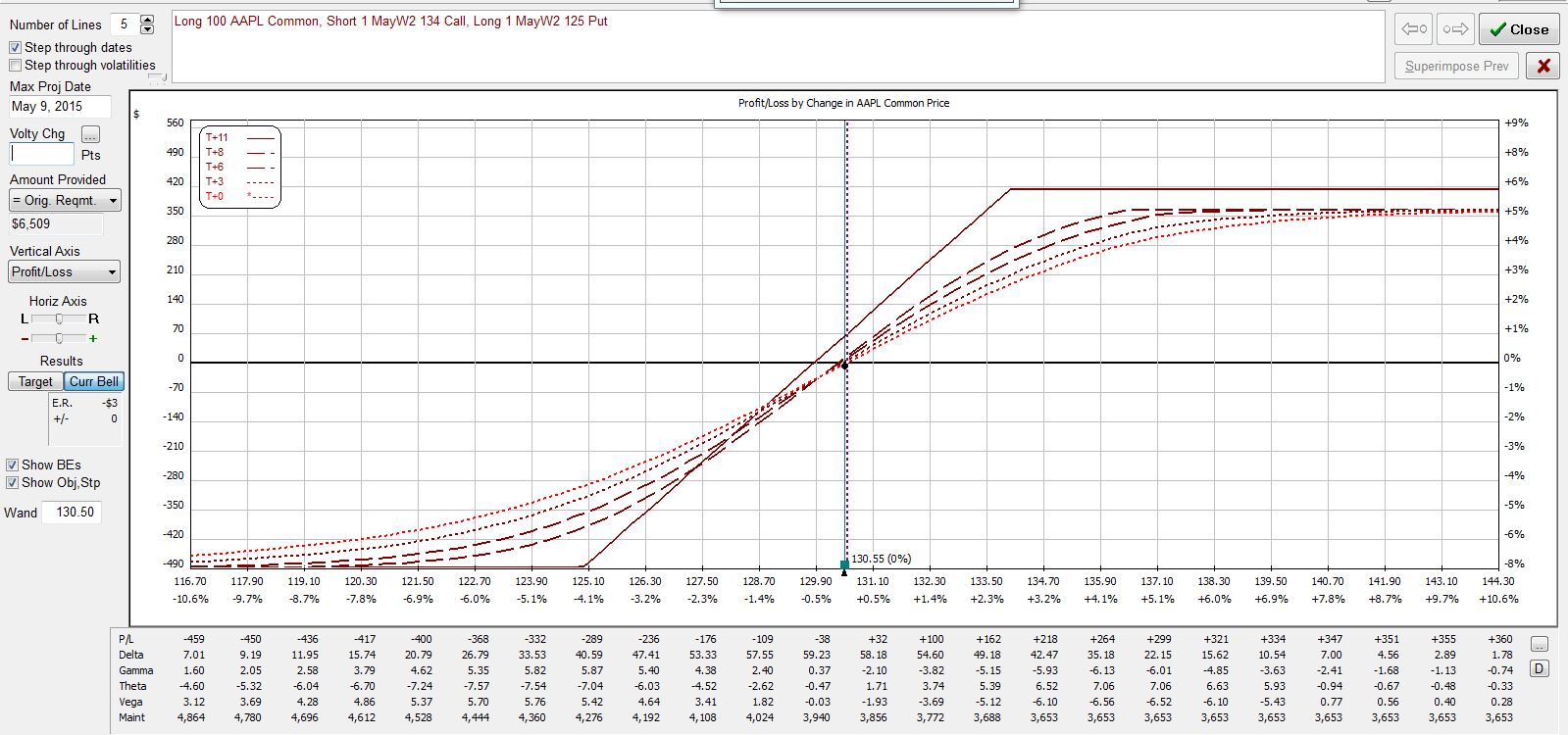
For her to lose on the trade, the stock must have gone down. If implied volatility increased by 10% then the risk graph would look like this:
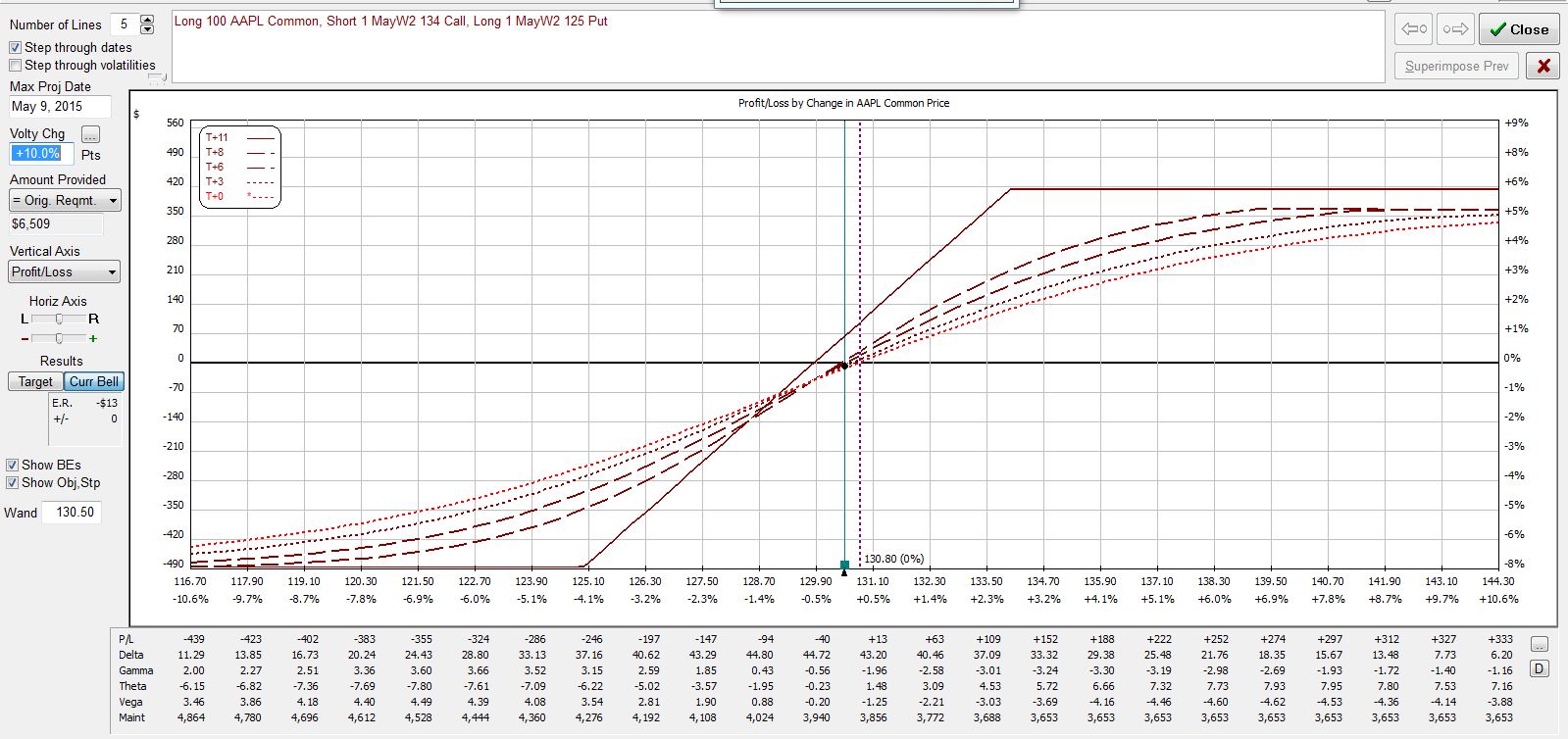
The T+0 line (today) actually flattens out, which prevents the loss from being as big! If this were earnings and implied volatility actually decreased by 10% then the risk graph would look like this:
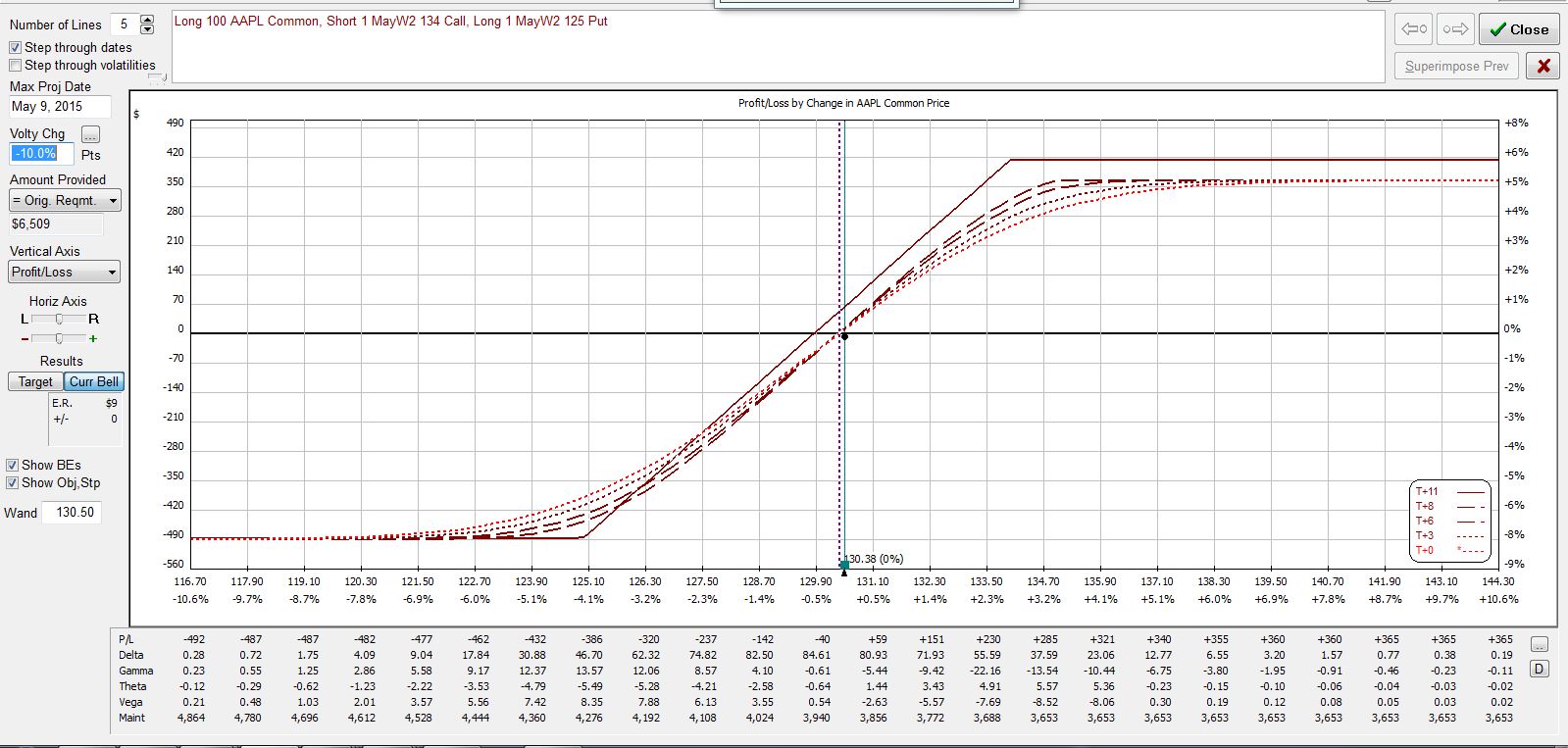
Compared to the first image, losses along the T+0 curve are worse here. However, note that in all three graphs, the expiration curve is identical. Even if losses were worse today, in 11 days there would be no difference.
Aside from not blaming anyone but herself, the only thing JD really should have critiqued was her stock selection. This trade lost money because the stock went down: period! A collar trade is a collar trade: it caps potential losses. To blame the collar trade strategy for losses really makes no sense in any context.
The bottom line here is about trader psychology. I believe to be successful we must own responsibility for every trading-related activity we do. I am the only one who submits orders and clicks the execute button. If I am going to blame anyone then it should be me.
On another hand, I could just realize “you can’t win ’em all” and expect some trades to be losers. In that case, I have no need to blame anyone for trades that do not go my way.
Categories: Trader Ego | Comments (0) | PermalinkGrow Up! (Part 2)
Posted by Mark on November 17, 2014 at 07:21 | Last modified: April 29, 2015 09:28Today I continue with my response to a forum post from a disgruntled student of options trading:
> Disclaimer: I mean no offense here, JD, but I do hope you
> learn something.
>
> I believe your post is inappropriate. Your post does nothing
> less than blame X for losing money. As a student, you should
> only be doing paper trades for now and paper losses do not
> justify the harsh tone of your post. If this were a real
> trade then you deserve the consequences because you should
> not yet be trading real money! That has been repeated over
> and over and over around here. If you are a graduate of this
> program and do not know the real risk of collars then you
> clearly didn’t put much effort into learning the material
> and/or listening to lectures.
>
> Ultimately, if you’re going to be a successful trader then
> you need to take responsibility for yourself. You will have
> winning trades and you will have losing trades. The losing
> trades are not the market’s fault, not X’s fault, not a
> coach’s fault: they are your fault and your fault alone.
>
> Understand the responsibility and own it. If you traded
> too large and suffered a loss too great for you to bear
> then learn the lesson and vow to do better next time
> so it doesn’t happen again.
>
> In trader psychology terms, grow up JD.
That pretty much says it all.
I’ll save one more thought on this matter for the next post.
Categories: Trader Ego | Comments (1) | PermalinkGrow Up! (Part 1)
Posted by Mark on November 14, 2014 at 06:21 | Last modified: April 29, 2015 09:24My last series of posts was based on an e-mail correspondence I had a few years ago. Today I continue that “blast from the past” with a quick hitter: a forum post from March 2013.
This post was made in the forum belonging to an option education community. She wrote:
> The down side of collars
>
> I went to your summit lecture on collars and came away thinking
> this was a way to protect a position. No where did you explain
> about what you are risking by putting on a collar. So I put on
> a collar on ARMH since it’s PE is so high and there was some
> uncertainty about just how much the Arm chips would contribute
> to the Galaxy 4 announced Thursday.
>
> The result was I’ve now lost almost $13,000. You never said
> that the cost of the collar if the stock goes up is so high!
> Not only is there the cost of the options but all my gains
> from the stock going up are offset by the decline in option
> value. The collar is a dangerous trade unless you are really
> convinced that the stock is going down. Just my opinion but I
> really think you should have told us about the substantial
> down side of using options.
>
> Signed,
> JD
I will continue with my response in the next post.
Categories: Trader Ego | Comments (1) | Permalink