How Hard is It to Develop a Viable Algorithmic Trading System? (Part 4)
Posted by Mark on March 23, 2015 at 06:43 | Last modified: May 14, 2015 12:16Do you realize this has been a whirlwind exploration into advertising, marketing, epistemology, and scientific method?!
We started with Davey’s claim about 100-200 trading ideas being required to generate a tradable system.
Then we thoroughly analyzed the idea that strategies in the public domain will not be profitable.
We talked about the impact of the “big boy” institutions with all their funding, personnel, and technology (i.e. computing power, lightning-fast networks, high-frequency trading platforms).
We talked about the impact of good-sounding ideas and the limits of our ability to understand the actual veracity of such claims.
In the final analysis, I think reasonable doubt abounds with regard to many things covered in these last four posts. Yes, strategies in the public domain should be low-hanging fruit for the institutions who can easily develop them.
But we don’t know if this actually happens.
We don’t even know how many institutions are fully staffed with financial engineers, quants, and an overload of computing power.
We certainly don’t know how much capital these institutions control nor how much capital is sufficient to exhaust the profitability from a trading system.
So I say give it a whirl! If you have the wherewithal then start with something simple that you can find in a book or on-line. Optimize to understand the parameter space and get an idea if the strategy is capable of robust results or only fluke occurrence. Walk it forward to see how the out-of-sample results look. If it survives those steps then incubate it by paper trading to monitor it. Finally, start live trading in small size…
…all the while, continuing to develop other systems to compliment or replace when need be.
This is how business gets done.
Categories: System Development | Comments (1) | PermalinkHow Hard is It to Develop a Viable Algorithmic Trading System? (Part 3)
Posted by Mark on March 20, 2015 at 06:46 | Last modified: May 14, 2015 11:40Good-sounding ideas may have persuasive impact when coming from sources perceived to be reputable.
If this is true then since some gurus say strategies in the public domain will not be effective, many retail traders will not even try to develop them. Paradoxically, the less attention a strategy gets, the more likely it is to work. The big institutions with all the funding, financial engineers, and computing equipment are less likely to be deterred by claims that “sound” good. Running trading strategies through the mill and live trading in large volume is what they do. They will cut to the chase to see if anything is really there.
The retail traders who are persuaded not to develop these public strategies may also be more prone to curve-fitting. If they believe it will take something more than simple public strategies to be profitable then they may try complex combinations of indicators in hopes of finding the Holy Grail.
This is all speculation, of course, and a digression at that…
Going back to the original forum post, I responded:
> At the risk of getting my nose chopped off,
> I’m going to voice an opinion here:
>
> I completely disagree based on semantics.
> The difference between a trading strategy
> and a trading system is money management.
> In reality, unless people are trading
> “small” they are trading systems. An
> infinite number of possible trading
> systems may be derived from any given
> trading strategy. Some may win with a
> trading strategy and others may lose with
> the same trading strategy based on
> differences in money management and
> personal/institutional tolerance.
In other words, given the many different subjective functions that will be used, the different combinations of data used to develop systems, etc., any given strategy may give rise to a large number of potential trading systems. Edge is not likely to be squashed out so quickly, then, because there aren’t an infinite number of big money players and it is the big money players who rule the markets.
Take these last three posts, shake them up, roll, and what do we have?
Categories: System Development | Comments (1) | PermalinkHow Hard is It to Develop a Viable Algorithmic Trading System? (Part 2)
Posted by Mark on March 17, 2015 at 02:46 | Last modified: May 14, 2015 10:49I left off with the idea that trading strategies in the public domain will be quickly developed and traded by institutions until the Edge runs out.
While I think this sounds good, it is only speculation. As with so many claims about investing and trading, the only way to know for certain would be to develop a large number of trading systems in the public domain and to trade them live for a period of time. Only then would I have the data necessary to collate the returns, to analyze the results, and to use statistical testing in determining whether Edge exists and for how long Edge persists. This could take a lifetime of work and many millions of dollars in trading capital to test.
Not gonna happen! Therefore, I can never truly evaluate veracity of the claim.
In the world of trading and investing, I believe ideas that sound good do have persuasive impact because many traders lack critical thinking skills. For this reason, I think traders perceive the words of apparent authority figures and trading gurus to be meaningful and true when in fact they are little more than good advertising pitches and marketing claims.
As mentioned above, though, I also believe I cannot know this for sure. The only way to evaluate the latter claim would be to interview a large sample of traders to determine what it takes for them to believe “good-sounding ideas” and to determine how much critical evaluation is involved. Just the task of operationally defining much of this (e.g. what it takes to believe, what constitutes a good-sounding idea, a scale for critical evaluation) strikes me as an extremely complex task that may or may not even be possible to carry through.
In case you’re keeping score, we have here a claim that cannot be evaluated for reasons that themselves cannot be evaluated.
I resign for the night before I get too confused.
Categories: System Development | Comments (1) | PermalinkHow Hard is It to Develop a Viable Algorithmic Trading System? (Part 1)
Posted by Mark on March 12, 2015 at 05:47 | Last modified: May 14, 2015 10:16The title of this blog post poses an interesting question that is very difficult to answer.
In his book Building Winning Algorithmic Trading Systems (2014), Kevin Davey claims it takes 100-200 trading ideas to yield one tradable system. In my view, this is a daunting statement because from what I’ve read on trading system development and from the challenges I have faced with coding, this could be a lifetime! The claim is a bit vague, though. What exactly constitutes a “trading idea?” If each parameter value counts as a different trading idea then it might take only a few trading strategies to come up with a “tradable system.” This phrase is vague too. Does “tradable system” mean a system that would be acceptable to me given my particular requirements for profit and my subjective function?
Last year I saw a forum post that got me thinking on this topic. Somebody wrote:
> Any strategy which is publicly available cannot by definition be
> profitable, since nobody would play against it and be the loser
> to make it profitable.
I disagree with his conclusion and I especially think “by definition” is too strong.
However, this does make me wonder what the institutions can do with publicly available strategies. I believe these trading strategies are low-hanging fruit for institutional quants who have tons of computing power and lots of experience doing this work. Being in the public domain, these “big boys” can find the ideas easily, run them through their system development mills, and quickly determine whether Edge exists. If so then they will trade these systems. Edge will run out when enough money is deployed to trade these systems, which will likely happen when enough institutions get on board. For this reason, once in the public domain they probably won’t stay profitable for long.
I will continue this discussion in my next post.
Categories: System Development | Comments (3) | PermalinkProtect Your Nakeds!
Posted by Mark on March 9, 2015 at 07:46 | Last modified: May 13, 2015 11:49I subscribe to a mailing list that focuses on covered call writing. I often see people fail to acknowledge risk and it makes me a bit uneasy.
This was taken from a 2014 post:
> I will be happy to buy QCOR at 65 if it is put to me.
> Based on reading many of the QCOR reviews I believe
> QCOR is fundamentally very strong… If put to me I
> appreciate Citron’s work that adds to volatility and
> will reward me if and when I sell a CC for a high
> premium.
People short puts on Enron or any other stock that ultimately went bankrupt said the same thing before it went to zero. When the stock is well on its way to zero, no stockholder, naked put trader, or covered call writer will be happy.
Some people use explicit wording instead of a smug “I’ll be fine because I feel comfortable owning the shares” attitude. An example is often given by people advertising covered call services or option educators who say “sell the put at a strike price at which you would be happy to purchase the stock.”
I think either of the above clouds the real issue: risk management.
The bottom line is if I take assignment on a naked put then I’m probably losing money. If I don’t have an exit strategy then I better hope to high heaven the stock doesn’t go to zero! Regardless of how “happy” I say I’ll be if assigned, I’ll feel more and more heat if the stock continues to slide further. If the stock tanks substantially and then trades sideways then I will be highly frustrated sitting on what feels like dead money because I won’t be able to collect meaningful premium on the [now] deep OTM calls.
Categories: Option Trading | Comments (0) | PermalinkThe Myth of “Unusual Option Activity” (Part 1)
Posted by Mark on March 3, 2015 at 07:58 | Last modified: May 12, 2015 12:05The financial media often treats unusual option activity as a predictor of how large institutions are trading. This may or may not be very misleading, which in my view casts doubt over the entire strategic approach.
Traders will sometimes study the option flow for a stock because they believe this helps them to understand sentiment. Particularly when a stock is extended, some believe option activity can offer predictive signals. For example, if one large block is going against the trend, it can mean the institutions are starting to think trend reversal. On the other hand, increased small-lot activity in the direction of the trend conveys a message that can fool the beginning trader.
What options are predictive of trend persistence versus trend reversal is not at all obvious. For example, heavy put volume on a beaten down stock could be a trader(s) shorting puts in expectation of mean reversion: either reversal to the upside or at least a temporary reprieve before the downtrend resumes. If this trader(s) is also shorting stock against the put sale then the overall position is actually bearish rather than bullish. The trader(s) took advantage of the high implied volatility to collect some extra premium in the hedge but the primary profit generator is downward stock movement (upside has unlimited risk).
Married puts and covered calls are two other examples of misleading option activity. Buying puts in the former suggests a bearish position but having purchased the stock, this is really a bullish position with downside protection. Selling calls in the latter suggests a bearish position but having purchased the stock, this is also a bullish position with [limited] downside protection. In fact, if the stock is purchased before the option is traded then the stock price may be higher to allow for a cheaper put purchase or more expensive call sale: both advantageous to the combined position.
I will conclude with the next post.
Categories: Option Trading | Comments (0) | PermalinkGhost Education (Part 7)
Posted by Mark on February 26, 2015 at 07:46 | Last modified: May 11, 2015 13:19Terry Lane’s article certainly qualifies as ghost education. Should we have expected anything more?
“About the Author” reads:
> Terry Lane has been a journalist and writer since 1997.
Journalists and writers don’t necessarily know anything about trading.
> He has both covered, and worked for, members of
> Congress and has helped legislators and executives
> publish op-eds in the “Wall Street Journal,” “National
> Journal” and “Politico.”
Op-eds usually have nothing to do with trading: even (especially?) those in the WSJ.
> He earned a Bachelor of Science in journalism from the
> University of Florida.
I wonder if he had to take any finance classes as part of that concentration?
According to Lane’s LinkedIn page, his background includes nothing about trading or finance. He has listed as “Skills:”
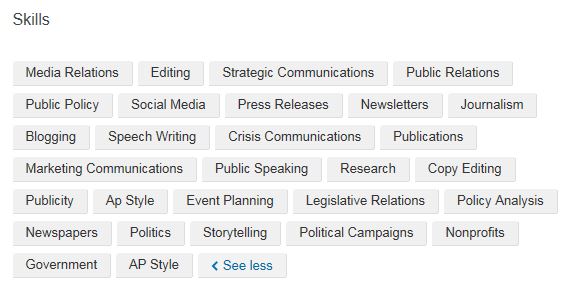
Apparently, Lane has no investing background, no background at all in the financial industry, or even specifically the financial media. I wonder if he has ever traded a stock or option contract in his life? It might be bad enough for the average investment adviser with no trading experience to report on this. What the devil is someone completely outside the financial industry doing by trying to report on it?!
I mean nothing against Terry Lane. He seems like a solid writer. He could be a very nice guy, a wonderful family man, and he may be great at what he does: writing and communications.
Lane seems extremely unqualified to be writing any kind of article about trading, though, and that is exactly what his article reflects from a content standpoint. This is ghost education: a subset, in my opinion, of optionScam.com. Many people will read this article expecting to learn and learn they will not. Lane might get hits for Demand Media, which may be his job. To me and the rest of us traders, though, Lane’s content is absolutely meaningless and a waste of our time.
Categories: optionScam.com | Comments (0) | Permalink