Naked Puts (Part 9)
Posted by Mark on December 22, 2015 at 06:39 | Last modified: November 7, 2015 12:58I suspect my discussion about leverage is as important a concept to explicate as anything else regarding this approach.
I started by comparing naked puts and long shares with equal capital risk. The graph makes it clear that long shares are more profitable. To get that profit, though, I was going to have to endure a whole lot of pain.
This process also helped me realize the trade can be very expensive in terms of capital risk. With options it looks possible that I can take on even more capital risk and still be safer (historical drawdowns) in bear market conditions.
As a cautionary note, I feel people must understand other details I did not cover before trading this strategy. I did not take several more blog posts to explain technicalities I work with every day. One should understand differences between underlying markets, what options to trade, and when to trade them. One should also understand details about execution and about transaction fees. I took all this into account when running the numbers.
Specific details will also vary from one trader to another in terms of position sizing. One needs to understand what kind of accounts will allow this type of trade. One needs to understand margining and what to expect as the market moves. Fixed vs. variable position sizing should be understood along with particular implications about the graphs as I have presented them. These are things people learn as they take time to study how options work and how to trade them. Many of these details I have described elsewhere in this blog.
I may come back at a later time and flush out more of the technical details. For now though, I will affix the bow: that’s a wrap!
Categories: Backtesting | Comments (0) | PermalinkAn Argument for Statistics (Part 4)
Posted by Mark on December 21, 2015 at 07:09 | Last modified: December 7, 2015 14:43In my opinion, trading system development is similar in importance to hypothesis testing and inferential statistics in addition to being something most traders don’t know much about.
Aside from my familiarity with statistics, I am a student of trading system development. Trading system development looks at measures related to profitability, consistency, drawdowns, and much more.
While I find this all interesting and potentially very useful, at the outset maybe I just want to know if my system is better than trading at random. Maybe I just want to know if my system is better than zero profitability. These are questions that lend themselves to inferential statistics because the null hypothesis would say “the system is not profitable.”
In the final analysis, I think we have at least two different approaches to trade validation. One approach involves hypothesis testing and inferential statistics. Aside from those with research backgrounds of some sort, I’m not sure who might think to employ statistics for this purpose. I think trading system development is more popular among algorithmic traders and those employed in finance since it uses parameters and jargon created specifically for the industry.
Perhaps the two are accomplishing the same thing but from completely different theoretical angles. I may never know.
Categories: Financial Literacy, System Development | Comments (1) | PermalinkAn Argument for Statistics (Part 3)
Posted by Mark on December 18, 2015 at 06:16 | Last modified: March 31, 2016 06:27I left off with a general description of the statistical hypothesis testing process.
Once the assumptions behind a sample or experimental design are identified, the next step is to choose an appropriate statistical test to run on the data.
Select a level of significance (greek letter alpha: α), which is a probability threshold below which the null hypothesis will be rejected. Common values used are 0.05 or 0.01. By definition, status quo is likely to maintain. α states “if the chance of the sample being status quo is less than one in 20 (or 100, respectively), then I believe it is not status quo (i.e. reject H0) but rather something different (i.e. accept HA).”
Perform the statistical test, which will output a p-value. The p-value gives the probability of the groups being from the same population (e.g. no difference, or H0 is true). If the p-value < α then reject H0 and accept HA.
Hypothesis testing is not perfect. A type I error occurs by rejecting H0 when H0 is in fact true. This is also known as a “false positive” and the probability of making this mistake is equal to α. On the flip side, a type II error occurs by not rejecting H0 when H0 is in fact false. This is a “false negative.”
People spend so much time backtesting trading strategies but I believe without statistics, essential context is missing to make sense of it. As an example, here is some data I saw recently:
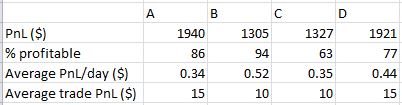
With regard to average trade, groups A and D look best but we need something more to conclusively determine. An average trade PnL of $15 for groups A and B is 50% more than groups B and C! Is that a real difference or is it likely to have occurred by chance? Sample sizes would affect our evaluation of this question as would variance within/between the groups. Inferential statistics wrap all these factors together into context we can definitively understand. Without the inferential statistics we really can’t know much at all.
Categories: Financial Literacy | Comments (1) | PermalinkAn Argument for Statistics (Part 2)
Posted by Mark on December 17, 2015 at 07:48 | Last modified: November 6, 2015 08:50Most people who know anything about statistics understand descriptive ones: numbers used to summarize and describe data. I feel strongly that as traders, we need to understand inferential statistics too.
Inferential statistics are used to reach conclusions that extend beyond the immediate data alone. These might be used to infer from a sample characteristics about the whole population.
Inferential statistics are also used to determine whether an observed difference between groups is dependable or simply a chance occurrence. This is called hypothesis testing.
I said one could lie with descriptive statistics by including certain things and excluding others.
Inferential statistics may also mislead by including/excluding certain differences/similarities in experimental design. Even before hypothesis testing begins, validation of experimental design is essential albeit beyond the scope of today’s post.
Hypothesis testing begins by defining the hypotheses. The null hypothesis (Ho) generally states that both (all) groups are the same. The value of a group is often given in terms of an average (e.g. arithmetic mean) and standard deviation. The null hypothesis represents the status quo. The alternative hypothesis (HA) generally states the groups are not equal. HA may or may not go one step farther and state which group is thought to be greater than the other.
The next step is to consider the statistical assumptions being made about the sample(s) involved. For example, a given statistical test may require the samples be independent (e.g. not affecting each other) or that the distribution (shape) of a sample be “normal” (bell curve, which has a specific mathematical definition), etc. If the assumptions for a statistical test are not met then the test should not be used or the caveats/limitations should be discussed to put reasonable context around any conclusions.
I will continue next time.
Categories: Financial Literacy | Comments (3) | PermalinkAn Argument for Statistics (Part 1)
Posted by Mark on December 15, 2015 at 07:21 | Last modified: November 6, 2015 05:55I could go on with incriminating quotes throughout history about statistics:
“There are three types of lies — lies, damn lies, and statistics.”
–Benjamin Disraeli
“Facts are stubborn things, but statistics are pliable.”
–Mark Twain
“If your experiment needs a statistician, you need a better experiment.”
–Ernest Rutherford
“All statistics have outliers.”
–Nenia Campbell, Terrorscape
“There are two kinds of statistics, the kind you look up and the kind you make up.”
–Rex Stout, Death of a Doxy
During my undergrad years I saw a number of students develop an antipathy toward statistics because it was a subject that either clicked or totally did not. I think much of the negative press statistics gets is partially a result of the fact that many people simply do not understand it.
I have a decent familiarity of statistics. I took an advanced stats class in undergrad and I used statistics in my published manuscript as well as my Pharm.D. research project. That education has made me statistically-minded, which is probably one reason option trading feels comfortable. I constantly think in terms of sample sizes and the relevance of conclusions. I believe these are things anyone on the path to trader success should understand.
I agree with some of the negativity reflected in the quotes above. Just because you have a statistic does not mean it’s a valid one. Scrutiny must be applied to see if the experimental design makes sense and was conducted properly.
Most people only know about descriptive statistics: numbers used to summarize and describe data. These are your averages, standard deviations, and ranges. These are found everywhere when talking about sports. Descriptive statistics can certainly be skewed to include certain things and to exclude others, which is where much of the lying comes from.
I believe another branch is equally, if not more important than descriptive statistics. I will talk about that next time.
Categories: Financial Literacy | Comments (3) | PermalinkNaked Puts (Part 8)
Posted by Mark on December 10, 2015 at 05:38 | Last modified: November 5, 2015 07:15I want to go in another direction today and consider exactly how I might go about doing the naked put trade, which really becomes a question about position size.
As I prepared the initial graph comparing naked puts with long shares, I became aware how much capital risk this arbitrary position size was commanding:
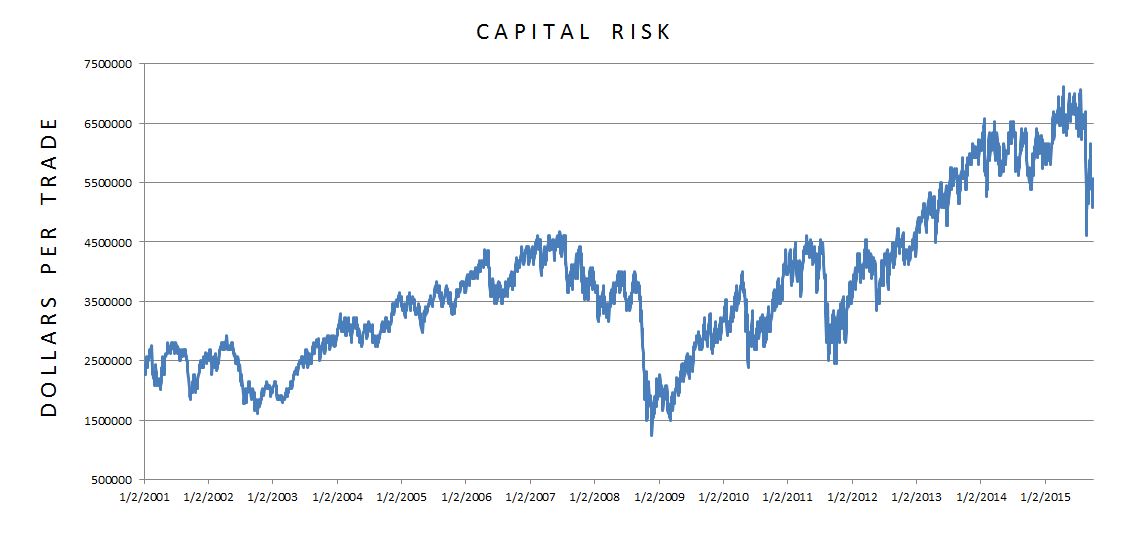
The graph illustrates two important points:
(1) This is not a constant capital-risk trade
(2) Capital risk is extremely large.
With regard to backtesting, (1) is very important. Position sizing should be held constant throughout the system development process. This allows for an apples-to-apples comparison of PnL changes throughout the period of study. A drawdown (DD) at any point should be evaluated as if it occurred from Day 1; this is one way of interpreting maximum risk.
Even though capital risk did not remain constant, contract size did and for that reason I believe the backtest is acceptable. I had a gross dollar target range for profit and maximum loss that remained constant regardless of underlying price. Leverage, being directly proportional to capital risk, is what changes. This is a difficult concept to understand.
With regard to (2), it especially became evident how large capital risk is when I realized the graph shows one trade at a time. With an average of 27.6 days in trade, I can multiply the average capital risk by 27.6 to get an estimate of how much capital risk is on at any given time. Over the 14+ years that number is $103M each day!
To personalize this trade, clearly I have to cut down the position size and then make some decisions about whether the return potential vs. expected DD is acceptable for me.
Categories: Backtesting | Comments (3) | PermalinkNaked Puts (Part 7)
Posted by Mark on December 7, 2015 at 05:16 | Last modified: November 5, 2015 06:51Comparing long shares and naked puts with equal capital risk ended up being far superior for the latter in terms of drawdown (DD).
If I cut the long shares position size by a factor of eight, here is how the two compare:
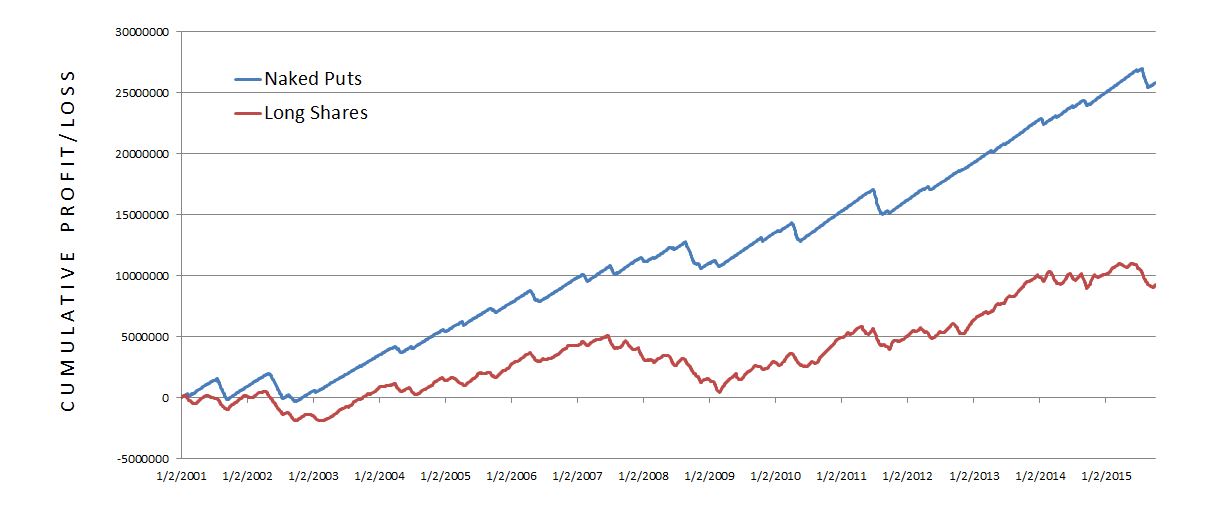
This is a huge difference. The long shares now gain $9.31M (down from $74.5M) compared to the (same) $25.8M for the naked put trade. In other words, observation 1 has been reversed. The naked put trade still has a lower max DD (-$2.27M vs. -$4.65M). The naked put trade still has better consistency with an average (mean) daily DD of -$378K (vs. -$924K). The naked put trade is still in DD only ~49% of the time (vs. ~82%).
The naked put trade appears to make more money with greater consistency than long shares.
For me, putting context around this trade means playing devil’s advocate over and over again. This trade certainly looks pretty good. What am I missing?
Particularly impressive to me is the fact that even with 8x as much capital risk, the option trade has less DD risk.
But it does now have eight times as much capital risk. Were the market to take a huge hit, the option trade could lose much more than the long shares.
In deciding whether to do this trade, I think one’s level of pessimism must be assessed. The “huge hit” that would cause the naked put trade to lose more than long shares would have to be worse than what we’ve seen since 2001. So if you are truly the prophet of doom, you worry about a catastrophe worse than the Flash Crash (2010), than the August 2015 correction, than September 11 (2001)… you worry about a decline worse than the 2008 financial crisis.
Depending on your exact level of paranoia, at some point I would wonder why you are even in the market at all. Keeping your money safe under the mattress might be a better choice.
Alternatively, maybe you simply follow the same traditional recommendation given for long shares: allocate a limited percentage of the portfolio to naked puts.
Categories: Backtesting | Comments (0) | Permalink