Fixed Position Sizing in Trading System Development
Posted by Mark on May 5, 2016 at 06:20 | Last modified: March 24, 2016 12:31I have mentioned the importance of fixed position sizing on multiple occasions. Today I want to present another example.
Here is a table showing performance of five different investing strategies. Which one is the best?
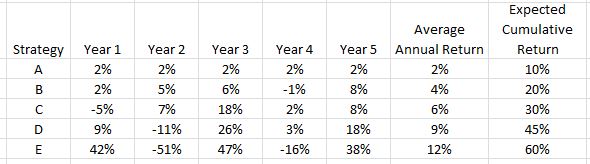
Do you agree with E > D > C > B > A?
This assumes fixed position sizing. No matter how good or bad the strategy does in any given year, fixed position sizing means I risk the same amount for the following year. This is not typically how longer-term investing is modeled. You’ve probably seen the compound growth curve that so many investing firms and newsletters like to market:
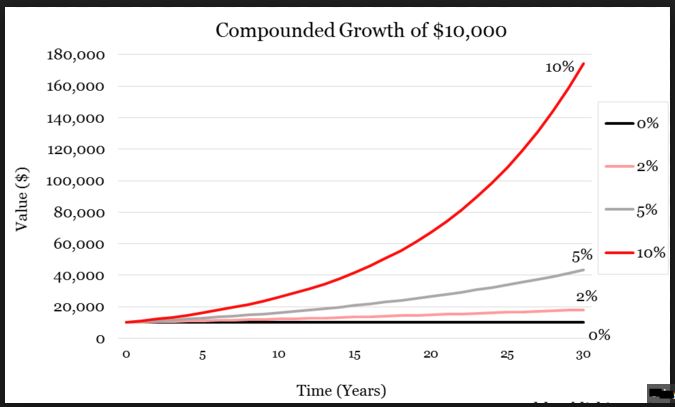
I will not get curves like this by doing the math shown under the “Expected Cumulative Return” column. Beautiful exponential curves are only possible if I remain fully invested. As the account grows, my position size grows. Exponential returns are not a by-product of fixed position sizing.
Following a fully-invested, compound-returns financial plan will generate the following from our five investing strategies:
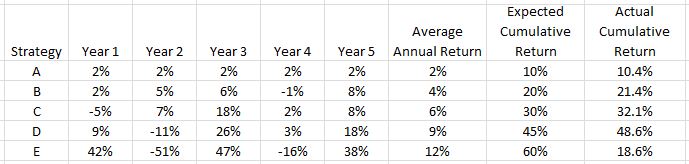
Now it seems the investment strategies should be ranked D > C > B > E > A. Note how the mighty (E) has fallen! This is the risk of trying to compound returns. Big percentage losses early leave a small amount in the account to grow when the strategy performs well. Big percentage losses late when account equity is at all-time highs have the biggest gross impact.
So which strategy is best?
We must first determine whether fixed or variable position sizing is used to better understand what we are looking at.
One additional column presents some revealing information:
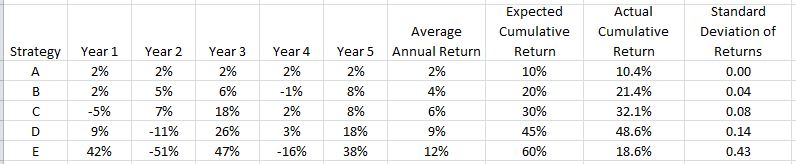
E, the strategy that initially looked best but proved to be rather poor, has by far the highest standard deviation (SD) of returns. SD measures variability of returns. This is why the Sharpe Ratio—a performance measure where higher is better—has SD in the denominator.
In summary, when comparing performance higher average annual returns are better but only to a point. Returns must also be consistent because excess variability can be detrimental. This is why I often study maximum drawdown: the kind of variability capable of keeping me up at night and causing me to bail out of a strategy at the worst possible time.
Categories: System Development | Comments (1) | PermalinkDay Trader Meetup Review (Part 3)
Posted by Mark on May 2, 2016 at 05:58 | Last modified: March 4, 2016 12:46Today I will conclude my review of the first day trader Meetup.
Once we finally got around the table and through the introductions, the organizer took 15 minutes to present one strategy and a few other slides. We then got to eating and talking among ourselves. It seems like a good group of people. Being filled with newbies, I think the group could benefit from some basic presentation about trading. This would include some teaching on trading system development, countering heuristic thinking tendencies, and general tenets of optionScam.com.
Later that evening, WM posted a comment on the website:
> I came to a day trading group with undesired long term ideas. I
> then tried to force them on the group. SORRY won’t happen again.
My intent was not to make this guy feel bad but rather to teach him something. I figured that unfortunately, he would just go on studying Hurst and continuing to get nowhere. WM is like the occasional entrepreneur we see on Shark Tank who has spent a huge amount of money [and time] trying to develop a product/business. Without revenue the Sharks often shake their heads and say things like “this is just a bad idea,” or “cut your losses already and move onto something else.”
The Holy Grail is advertised and marketed in many places. I firmly believe it is myth and only capable of impeding my progress by draining resources. One way I avoid this trap is to steer clear of anything too complex. In WM’s case, the advanced theoretical math is literally way over his head. Anything “proprietary” is also too complex for me because by definition, I will never know what it is.
A second Meetup was held a few weeks later on a Wednesday evening and only three of us (WM, the organizer, and myself) showed up. Yes, WM was still trying to preach Hurst theories and he eventually stood up and said “thanks guys but this group just isn’t for me.” I think he’s too brainwashed to contribute but I do hope others attend future Meetups.
Categories: Networking, Trader Ego | Comments (0) | PermalinkDay Trader Meetup Review (Part 2)
Posted by Mark on April 29, 2016 at 06:36 | Last modified: March 4, 2016 11:48Last time I praised the organizer of this new Meetup for being a humble, normal guy. Despite his best intentions, we were not spared from blind ego supplied by someone else in attendance.
Like Mr. Know-It-All and our friend DY, let me introduce you to WM. Before the meeting, he posted on the website, “Everyone should check out J M Hurst. He discovered how the market works by using electrical engineering math.”
The Meetup started with the organizer having everyone introduce themselves. WM began by taking 5-10 minutes to explain how Hurst has figured out the markets with his engineering math. He said this works for all markets including stocks, commodities, futures, and currencies: “if you analyze the data then you will see for yourself!”
Since my turn was next, I looked WM squarely in the eye and said “I tend to be skeptical so we will probably do some arguing later on.”
For 30 minutes out of the two hours, we did just that. I started by asking WM whether he is making good money with Hurst’s methods. He said no. I asked if WM’s level of sophistication is sufficient to understand the complex math behind Hurst’s methods. He said no. I asked if WM could reliably predict the future price move on some random charts by applying Hurst’s methods. He hemmed and hawed then failed at several attempts.
WM tried to defend himself by saying “I don’t understand Hurst’s teachings but I have no doubt that a group of us can combine our efforts and make great money.” My blood was boiling and I couldn’t help but raise my voice in talking to him because I felt he wasted so much of our time.
WM reminded me of entrepreneurs appearing on “Shark Tank” with outrageous valuations for their pre-revenue companies. Revenue is proof the product can sell. Without revenue there is little value. Unless WM had been successful making money the Hurst way, we have no reason to think anyone can. Why is he trying to sell it as the Holy Grail? How would he know?!
I am a fool destined for the poorhouse if I have blind faith in matters related to trading and investing.
Categories: Financial Literacy | Comments (1) | PermalinkDay Trader Meetup Review (Part 1)
Posted by Mark on April 26, 2016 at 07:25 | Last modified: March 2, 2016 08:48A couple months ago I went to a new Meetup for day traders. This is only the second such group I have seen in the state. The other one has a few hundred members but has been inactive for years. The organizers are franchisees of a well-known national trading school that I believe to be a spam-filled money pit. I had met the organizer of the current Meetup twice in the past so I was interested to see what he put together.
I made my way through the wintery cold on a Saturday afternoon to a quaint, Italian restaurant close to downtown. Eight attendees sat around a table with a TV monitor in the room. Two out of the eight seemed to trade stocks regularly but only the organizer was a consistent day trader.
I give props to the organizer for his humility. He claims to make some money day trading but does not profess to make a lot. He said last year he made $30K but lost $10-20K. He’s looking to become more consistent and to that end he started this group as a means to exchange ideas with others. With a smile, he describes himself as lazy: he wakes up in the morning, sets his entries/exits, and then goes back to sleep. He once told me he hits the bars most nights.
Yes, I am giving props to a guy who doesn’t make much because he prefers to be out late drinking on weeknights!
To me this represents something more insidious about the whole lot of retail traders: we aren’t perfect! Nobody is. So why do I get the marketing/advertising face of positivity, of triumph, and of ego all too often when hearing other traders talk? People sound like they’ve expertly got things all figured out. People try to sell others or to garner a following. You’ve seen me write about this time and time and time again.
No, there’s nothing particular about this organizer. He seemed to be a typical, John Doe type of guy.
If only the story would end right there…
Categories: Trader Ego | Comments (1) | PermalinkAccuracy of the Expected Move (Part 2)
Posted by Mark on April 21, 2016 at 06:54 | Last modified: March 31, 2016 05:19I previously reprinted a post from a trading forum along with my response from last year.
The original poster says the ATM straddle is a poor estimate for the Expected Move. What irked me was that he provided no data to support this claim. Had he done a large number of trades? Had he studied it? In case he did, I asked in my response who had done the backtesting on it. He did not respond.
Tasty Trade offers a specific definition of Expected Move: 85% of the value of the front month at-the-money (ATM) straddle OR the arithmetic mean of ATM straddle and the nearest OTM strangle. How do they know that is what people expect, though? They really don’t and they really can’t. It’s not like they surveyed a large sample of people to find out what size move is expected.
A deeper understanding of options does offer some association between the name and the definition. The straddle/strangle will profit on a move in either direction greater than its original price. If traders, in general, think the move will be larger (smaller) than the cost of the straddle/strangle then they will buy (sell) it. The net result of these supply/demand pressures will be the price. Theoretically speaking, then, one could say it reflects what size move traders are expecting.
In the past, I heard more discussion about “implied move.” I have no reservations about the word implied. “Expected” is potentially a misnomer because it connotes some intelligence is explicitly regarding this as likely to happen. We don’t know why traders are buying or selling those options, though, or how many of them even have anything to do with the straddle/strangle itself: they may be components of different positions.
Going back to the top, whether the Expected Move has any predictive value is a completely different question that lends itself to backtesting. Tasty Trade has since done some backtesting to suggest the actual move is usually smaller than Expected. This would be an instance of “herd instinct” and why it might pay to be contrarian.
Categories: Financial Literacy | Comments (1) | PermalinkAccuracy of the Expected Move (Part 1)
Posted by Mark on April 18, 2016 at 07:19 | Last modified: March 23, 2016 08:51Last year, the following post appeared in a trading forum I follow:
> Using ATM straddles to estimate expected moves is
> very inaccurate, to say the least. I remember seeing
> this in some “beginner’s tips and shortcuts”
> resources years ago.
>
> For those interested in a more accurate, but still a
> quick-and-dirty estimation:
> https://www.tastytrade.com/tt/learn/expected-move
>
> You could always go more advanced and use a tool
> like Hoadley’s and GARCH(1,1) model. Or just use TOS
> IV numbers and Analyze tab to keep it simple.
I responded with the following:
> I don’t mean to sound critical but I think you
> bring up a couple good points worthy of
> discussion.
>
> Who knows how good either ATM straddles or
> any other formula is to estimate expected moves?
> In other words, who has done the research to
> study it?
>
> I’m guessing there are traders who have
> backtested this. I am not aware of backtesting
> data targeted for the public domain before
> Tasty Trade (TT). TT studies actual vs.
> expected moves all the time. I’m not sure if
> they’ve looked at ATM straddles vs. any other
> approach (like average of ATM straddle and one
> strike OTM strangle), though.
>
> A separate question from what is a good estimate
> is what is the expected move? The answer to
> this is whatever “most people” (or the “loudest
> talking heads”) regard as the expected move.
> In most cases, I think this is terminology that
> many people throw around casually without
> precisely defining. In most cases too, I think
> most people hear the term and think they
> understand even though they probably don’t
> because the definitions aren’t given.
>
> There’s a lot of crap in the Financial
> [trading/education] space that is neither
> actionable nor reliable. I believe we’re
> even bombarded with such information in
> this forum. That’s not to say forums like this
> aren’t worth reading though. Between the
> cracks, people do offer up some really good
> ideas every now and then.
I will conclude next time with a bit more commentary on this subject.
Categories: Financial Literacy | Comments (1) | PermalinkFixed Credit vs. Fixed Delta
Posted by Mark on April 15, 2016 at 07:08 | Last modified: March 22, 2016 10:13The issue of fixed credit vs. fixed delta has come up a couple times recently including the previous blog series.
I used fixed credit when backtesting naked puts. Fixing credit rather than delta means short delta decreases as the underlying price goes higher. This boosts probability of profit (PP).
Fixed credit may be apples-to-oranges because an increased PP over time means fewer losses. This will likely result in more linearity to the equity curve as underlying price increases. In other words, as time goes on the system may work better for no reason attributable to the strategy itself. Compared to fixed delta, I am effectively trading smaller and more conservatively with the end result serving to retain profits I already have.
Because of the similar feel, I wonder if this is another form of apples-to-oranges comparison: variable position sizing. This would be a definite no-no in trading system development. Number of contracts remains constant throughout. Max loss per contract remains constant throughout. Only when I looked at capital risk did I see the variability. I would be interested to analyze capital risk over time with fixed delta to compare.
While fixed credit may seem like apples-to-oranges, the pursuit still seems defensible to me. Without question, I want that linear equity curve. If fixing credit generates a linear equity curve then have I cheated by allowing the probabilities to increase over time? Intuitively, I feel a higher PP and concomitant lower credit may mean larger net losses when the market suffers significant corrections. This disadvantage to fixed credit should even the score.
Whether the magnitude (%) of corrections is correlated to underlying price is a different study altogether. I could probably attempt to analyze this but I have a very small number of market corrections to sample. Since the financial crisis, we had the Flash Crash (2010) and the Fiscal Cliff (2011), but then nothing until fall 2014 and the two recent 10% corrections of Sep 2015 and Jan 2016.
In summary, I like what I see with fixed credit but remain uncertain about its validity. While it seems semantically valid (“remains constant throughout“), the effect of the fixed numbers is analogous to variable position sizing and that is what troubles me. Completing the fixed delta backtesting must be done to answer some of these questions.
Categories: System Development | Comments (0) | PermalinkMusings on Put Credit Spreads (Part 8)
Posted by Mark on April 12, 2016 at 07:54 | Last modified: March 21, 2016 09:31Today I will continue to ramble on about some possibilities of backtesting the put credit spread.
I could stick with the naked put and buy a unit or two for a fixed percentage of the naked put premium. After backtesting a put spread I was thinking about including insurance like this as a ratio backspread. Maybe what I am really talking about here are two distinct backtests—naked puts and long options—that I overlay and sum to generate an equity curve. If this is valid then I would be killing two birds with one stone because the put spreads would not have to be backtested.
Alternatively, I could opt to buy the same number of longs as I short in the back month. The extra time could synthetically substitute for the additional contract especially because for any given series of shorts, two longs would be in place. I might not include this additional bonus for backtesting purposes since each trade would consist of the naked put plus a farther out-of-the-money option in the following month. Nevertheless, I feel a sense of comfort anytime I have reason to believe actual results would be better than those backtested.
Practically speaking, a problem here is the availability of deep-out-of-the-money strikes in the database. This is especially the case in the early years (2001-4). I should call OptionVue and ask why the strikes displayed are limited and what it would take to be able to see 5-10 more strikes automatically generated by the software.
As it is now, I need to add those strikes manually and then set the prices to fit some logical vertical skew. The skew I employ is 1.0%-1.2% IV per 10 underlying points or, in subjectively perceived crash conditions, 1.5%-2.0%. Of course, too, 10 points is much larger percentage of the underlying early in the database compared to later.
After the last eight posts, I’m not sure I have solved my problem with backtesting put credit spreads. I do think everything is on the table in front of me to mull over and consider, though. I will go forth in my writing from here.
Categories: Backtesting | Comments (0) | PermalinkMusings on Put Credit Spreads (Part 7)
Posted by Mark on April 7, 2016 at 06:26 | Last modified: March 21, 2016 08:54That last sentence strikes me as quite profound.
For the sake of backtesting, given these two choices I should go with the one offering a decent sample size. Discretionary traders make a [temporary?] living trading based on small sample size. Trading system salespeople use small-sample-size examples as presentation material (e.g. fallacy of the well-chosen example). I want to limit the chance of something unexpected happening, though, and a small sample size puts me at risk.
From a marketing standpoint it can’t hurt to be net long puts. I cannot reliably backtest efficacy because the number of cases where they would have saved my bacon is so few. Especially because I have to believe “my worst drawdown is always ahead,” though, long puts are insurance against something horrific. I feel confident in saying that while the broad market has never gone to zero, if people are exposed to huge risk should that happen then they would be reluctant to invest. On the flip side, while the broad market has never gone to zero, if being net long puts would result in windfall profits should that happen then people would feel quite secure about investing.
It couldn’t hurt to have both, either. Maybe I should choose a conservative profit-taking target and also buy an extra long option to serve as catastrophic insurance.
Getting back to the matter of the spread backtesting itself, my deliberation led me to believe going wider on the spread might be necessary to overcome slippage. The greater credit received would somewhat offset slippage but result in a lower ROI and it wouldn’t help in a market crash where slippage would be gigantic either way. It’s a bit sad if I have to widen the spread simply for the sake of backesting but I may have to since I don’t know how spreads have traded in real time.
I could aim for a fixed credit but that might result in variable short deltas and probability of profit. As the underlying increases in price, a fixed option premium is available farther OTM. I am assuming this would pertain to spreads too although with the long option offset, I really don’t know for certain until I look at some historic data.
Categories: Backtesting | Comments (3) | Permalink