Posted by Mark on February 17, 2015 at 06:28 | Last modified: May 11, 2015 11:39
The last sentence of Lane’s article told us the key to profit is to buy options traded in high volume with no discernible cause. Because this seems a bit weak, I want to scrub the cited Options Alpha article to make sure I have not missed anything.
The Options Alpha article gives an example of high SPX option trading volume:
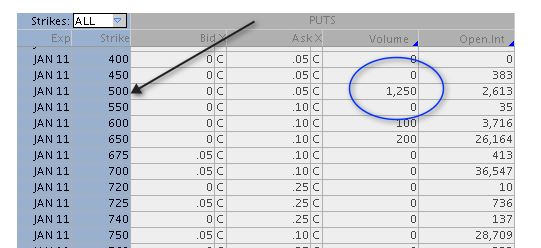
The article writes:
> CLEARLY, this is a classic example of hedging buy [sic]
> a large institutional trader and/or hedge fund.
This is an unverifiable claim and there is nothing “clear” about it. Yes, this could be a deliberate attempt to hedge, which is #2 of three main reasons the article gives for high option trading volume. This could also be #3: an example of “an idiot getting loose in the market” and speculating on a big drop by purchasing cheap OTM options. This could also be #1: upcoming news. We see predictions almost every day in the financial media warning of a catastrophic market crash just over the horizon. Maybe someone read one of these news articles and thought there was reason to buy this option.
To muddle the waters further, I will suggest this could have been a trading error! Any seasoned trader will talk about “Laurel and Hardy” trading mistakes. Maybe the trader(s) intended to buy 1000 strike puts and selected the 500 strike instead. Maybe the trader intended to buy 125 contracts instead of 1250. Purchase of 1250 contracts at a nickel each would only have cost $6,250 plus commissions. That could be but a pittance for an institutional trader, but it could be a retail trader as well (yet another detail that isn’t clear like the article suggests).
The article continues:
> Once you find out who is buying these options then only
> can you decide how YOU would like to make money off THEM.
No, we can never find out who is “buying” these options. Does this mean we can never do anything in terms of making money “off THEM?”
I will continue next time.
Categories: optionScam.com | | Permalink
Posted by Mark on February 13, 2015 at 06:36 | Last modified: May 11, 2015 11:31
I am in search of instruction on how to trade for profit, which this article’s title promised to be forthcoming. In 4+ paragraphs thus far, Terry Lane has failed to deliver on that promise. Today I will continue with the final paragraph:
> Options trade at higher volumes when the strike price is close
> to the current market price, as they are more likely to expire
> “in the money.”
This does not tell me how to trade for profit.
> An option trading at 200 percent or more than similar strike
> prices signals unusually high volume, according to Option
> Alpha.
Here is another article citation. Still in search of that secret to profit…
> Trading volume can be high because of news events, such as
> earnings or product launches, or from hedging by institutional
> investors.
Potential reasons for high volume do not tell me how to profit…
> When these events can’t discount the volume, it may signal
> that investors have reasons to be optimistic about the
> options and could be a buying opportunity.
That’s the end! No more. This must be therefore be the secret to profit: buy options traded in high volume without any apparent reason.
I should scrub the Options Alpha article to make sure I haven’t missed anything. As good writing practice, Lane should have highlighted relevant points from that article in his. I will double check.
The Option Alpha article is entitled “Learn How To Profit From Unusual And Abnormally High Options Trading Volume.” The article says three main reasons exist for high options volume: upcoming news, hedging, and uninformed retail investors.
I think these are possible reasons but how can we ever know? In order to know why options volume is high I would have to interview everyone who traded that option on the day in question. This can never be done since buyers and sellers are anonymous. The door is wide open to speculation and the financial media takes full advantage of this each and every day.
I will continue in the next post.
Categories: optionScam.com | | Permalink
Posted by Mark on February 10, 2015 at 06:25 | Last modified: May 11, 2015 09:05
I previously introduced an exemplar of what I am calling “ghost education.” Its title is what drew me to the article via a Google search and I discussed how the title seems to fit the marketing mold quite well. Let’s look now to determine whether the rest of the article is good as advertised.
How are we going to profit, Terry Lane?
The first paragraph defines “volume,” “options,” and “calls.” He makes no mention about profit.
The second paragraph explains why people trade call and put options. Lane also writes:
> Options can be risky investments that are often traded by
> advanced and sophisticated investors.
I would say options are not risky when traded by advanced and sophisticated investors who thoroughly understand them. When traded by newbies who have been blinded by outrageous promises of excess return, yes they are very risky. I see nothing in this paragraph about profit, though.
The third paragraph describes an options chain. Again, he writes nothing here about profit.
The fourth paragraph talks about volume and slippage. Once again, Lane writes nothing about profit. The article is only five paragraphs long, which means my sole purpose for reading must be immediately forthcoming!
With baited breath, I embark onto the fifth paragraph:
> Unusually high trading volumes can indicate a buying
> opportunity, according to The Options Playbook.
A “buying opportunity” suggests an opportunity for profit. Since the title said “How to Trade… for Profit” this would seem to be false advertising since profit and the opportunity for profit are different. Nevertheless, we can click on the link to see what Terry is citing.
The Options Playbook was written by Brian Overby. Overby is a Senior Options Analyst at TradeKing. I have watched a number of his presentations and I respect him a lot for his ability and approach to teaching.
In Overby’s cited article, however, no mention is made about profit. This is an article about open interest and liquidity. Why did Lane cite it?
Perhaps we need to read on to find out…
Categories: optionScam.com | | Permalink
Posted by Mark on February 5, 2015 at 07:05 | Last modified: May 8, 2015 10:42
Today I am going to detail a particular sort of content available across the internet. For lack of a better term, I am going to call this “ghost education.” I believe to succeed as traders, we should understand what ghost education is and how it fits into the financial landscape.
In order to develop this concept of ghost education, I am going to pick on one particular article. Please understand, however, that what I discuss here applies to a plethora of articles I have found over the years.
This is the article I will dissect today. I encourage you to go to the link and take a quick read.
I am no marketing guru but in order to design a successful advertising campaign, here might be some observations to keep in mind:
1) People are interested in ways to make money.
2) People tend to be especially interested in quick ways to make a buck.
3) The less people have to pay for 1) and 2) the better.
The title of this article is an embodiment of this psychology:
> How to Trade High Volume Call Options for Profit
1) is described by the last word: “profit.”
2) is communicated by the word “options.” People tend to think options are speculative and risky. Many people consider them to be gambling. They are known as a way to make fast money especially if stock direction can be correctly predicted.
3) is suggested by the first words. “How to” material is usually educational. When found on the internet, these articles are often free. How-to seminars also exist but quite often cost thousands of dollars. I think people are very willing to take a couple minutes reading an article that might provide some useful information especially given the alternative of taking a chance by spending thousands of dollars on something that might teach them very little.
I will continue in the next post.
Categories: optionScam.com | | Permalink
Posted by Mark on February 2, 2015 at 05:46 | Last modified: May 7, 2015 12:49
Last time I presented a generic screen to identify high implied volatility percentile candidates. Today I will conclude discussion on this strategy.
Criterion #3 searches for stocks with a minimum average true range. Average true range is a measure of stock price movement in relation to the previous close. Generally stocks that move very little have options that are very cheap. While a tradeoff exists, profit potential is generally limited when selling cheap options.
Criterion #4 searches for stocks with current implied volatility (IV) percentile in the top 5% of their 12-month IV range. Being mean-reverting, according to theory, IV will be likely to drop in the near future. Short options will profit when IV falls.
Once the screening is complete, the next step is to inspect the price charts of stock candidates. Any stocks that are at solid support levels are candidates for short puts or put credit spreads. Any stocks that are at strong resistance levels are candidates for short calls or call credit spreads. Stocks that seem range-bound, or trading sideways, are candidates for iron condors or naked straddles/strangles.
For each stock that turns up on the screen, we must be sure to identify the earnings announcement date. IV tends to peak just before earnings are announced. After the announcement, IV crashes. This is good for a short premium strategy. However, stocks tend to make big price moves following earnings announcements too. Depending on how much price risk a proposed trade has, we may want to avoid earnings announcements to decrease risk of earnings-induced price shocks.
Finally, look for news that might signal reason for high IV percentile. Pharmaceutical stocks (especially biotechnology) are notorious for big price moves related to FDA approvals or bans. Similar to earnings announcements, we may want to avoid placing trades if an FDA decision is imminent.
Categories: Option Trading | | Permalink
Posted by Mark on January 30, 2015 at 06:18 | Last modified: May 7, 2015 12:18
Since many people believe IV is mean-reverting, I discussed the idea of generating trade ideas by looking for stocks at IV extremes. Today I will continue that discussion.
We want to look for stocks with high IV. Once we have found these candidates, we can then plan trades that take advantage of an anticipated IV drop from these extremely levels back toward average levels.
Here is a key point to differentiate, though: we want stocks with high IV relative to their own average IV as opposed to high on an absolute basis (i.e. compared to other stocks). I will call this IV percentile: where current IV falls within the low-high IV range over the past year. IV percentile of 100 (0) means current IV is at its highest (lowest) level over the past 12 months.
We can also invoke that second trade consideration and determine whether we have a forecast for the underlying stock price. If we are wrong with IV forecast then we might still make money if we are right on stock movement (and vice versa). For the latter, we would look to use bullish or bearish premium-selling strategies (e.g. naked options or credit spreads) if we are decidedly bullish or bearish, respectively. If we believe that price will remain in a range then we can use strategies that are short premium to the upside and downside: short straddles, short strangles, or iron condors.
Any option scanning tool should allow us to scan for IV. You can choose whatever specific criteria you like. Since I have no reason to think any one set of criteria will perform better than any other, here is a generic screen:
1. Last stock price at least $15 (low-priced stocks may have wide strike increments)
2. Average daily volume of the underlying > 1,000,000 (liquidity requirement)
3. Average true range of price between 1-8%
4. IV Percentile > 95
I will conclude with the next post.
Categories: Option Trading | | Permalink
Posted by Mark on January 27, 2015 at 07:06 | Last modified: May 7, 2015 10:42
Today I will discuss one approach to trading options: screening by implied volatility (IV).
The sheer volume of option trading possibilities can be overwhelming. To find good trading candidates, I need to keep in mind the three sources of option profits: price movement of the underlying stock, option supply and demand (IV), and time decay.
Time decay is largely a function of option supply and demand. As demand for options increases, option prices increase. IV measures how expensive options are in terms of expectations for the underlying stock movement. Higher-priced options have more value to lose over time. This decay is value lost by option buyers and value gained by option sellers.
Profitability is therefore a function of two main factors: price movement of the stock and supply/demand for the options. To make money with an option trade, I can either look for stocks whose prices I can predict or look for stocks whose IV changes I can predict. When I choose stock price change or IV as the primary consideration, IV or stock price change will be the secondary consideration, respectively.
Some people believe changes in IV are easier to forecast than directional movement of the stock. IV is believed to have strong mean-reverting tendencies. Whether or not this is true is something we could research (topic for another day). For now, though, it will be sufficient to say those in this camp believe IV to oscillate around an average value and return to that average quickly when IV strays too far away.
Based on this philosophy, screening for stocks that are at higher-than-average IV levels should be a good source of option trading ideas.
I will continue discussion of this trading approach in the next post.
Categories: Option Trading | | Permalink
Posted by Mark on January 22, 2015 at 05:08 | Last modified: May 6, 2015 09:49
Reports on Google’s 2013 Q4 earnings announcement left me utterly confused. This is the main reason I wonder whether earnings are another case of optionScam.com.
A whole sub-industry has been made out of providing earnings data, using fundamental analysis to calculate price projections, and determining what stocks to buy and sell based on those fundamentals (earnings). Ultimately, if fundamental parameters are not objectively quantifiable (i.e. no consensus!) then who is providing the right data? Surely we should be using the right data to make accurate stock picks, right?
Aside from the whole issue of data accuracy, I am not even certain any statistically significant correlation between earnings results and subsequent stock price movement exists. Certainly the people at Tasty Trade don’t. I have not replicated their backtesting results but what they have presented suggests stock price to be somewhat correlated with direction of the overall market. They actually claim the distribution of directional moves to be pretty much random +/- a bit of positive drift. That would be about 53% up and 47% down, which is consistent with overall market movement.
It would be very difficult to perform a comprehensive analysis of post-earnings stock price changes stratified by good/bad earnings results. The biggest challenge would probably be determining consensus as to whether the results are good or bad. What estimates should be used? How do we define consensus? Should we look at earnings? Revenue? Something else? Do we factor in a margin of error?
As mentioned above, looking at the post-earnings price changes independent of any estimates makes a decent argument for “randomness” despite a limited number of tickers studied.
Let’s review:
1) Many companies specialize in selling information about earnings estimates and earnings analysis.
2) Data are now available to suggest nothing about earnings may actually be predictive of subsequent stock price changes.
3) The sub-industry described in 1) makes lots of money at the expense of investors who don’t know or understand 2).
That’s a pretty good formula for optionScam.com, folks!
Categories: optionScam.com | | Permalink
Posted by Mark on January 20, 2015 at 06:13 | Last modified: May 6, 2015 09:21
I find pretty much everything about these reports on Google’s 2013 Q4 earnings announcement to be confusing.
My review suggests different media outlets can interpret corporate earnings differently.
Poor writing can make it seem like one media outlet doesn’t even agree with itself!
Also confusing is the post-earnings stock movement. Intuitively, I would expect a stock to go up (down) following a good (bad) earnings report. Sometimes it may be hard to say what is good or what is bad, though.
I do believe that eventually (i.e. within a few days), the media usually does a pretty good job of retroactively explaining stock price reaction. They do this by pointing out something in the announcement that is either good or bad. This can be done because rarely, if ever, is every fundamental measure revealed from an earnings announcement good or bad. The media can always cite something to support its report whether it be positive or negative in tone.
I don’t believe any of this retrospective analysis to be actionable, however, in terms of developing potentially profitable trading strategies. I am also not convinced that any fundamental measure is significantly correlated with subsequent stock price changes. Show me the data if you believe otherwise.
Can you see why this is categorized under optionScam.com? I will take one more blog post to explicitly state that argument.
Categories: optionScam.com | | Permalink
Posted by Mark on January 16, 2015 at 07:13 | Last modified: May 6, 2015 08:51
Last time, I began to discuss three reports on Google’s 2013 Q4 earnings announcement and ended up somewhat confused. Today I will focus closer on the numbers to see if we can gain some clarity.
Report #1 said Google made $9.93 in Q4, which missed the consensus estimate by $0.41. This implies the consensus estimate to be $10.34. Report #3 said they made $12.01, which missed the consensus estimate of $12.26. The two reports are inconsistent with regard to the consensus estimate. I’m not sure how that can be since I understand “consensus” to be the average of all published analyst estimates. What’s worse, though, is that the two reports don’t agree on Google’s actual earnings! Maybe one reporter was sick or had excessive wax build-up preventing him/her from hearing on that day?
Once again, I am confused.
I suspect Report #3 is poorly written. The last sentence says “last quarter, Google… earned $10.47.” As mentioned above, Report #3 said they made $12.01: in the same paragraph! Did they just state two different earnings numbers just three sentences apart?! That can’t be. I must be misunderstanding. I can only surmise that “last quarter” means 2013 Q3 while the current report covers 2013 Q4. In other words, “last quarter” is Q3 and “this quarter” would be Q4.
Focusing on the revenue numbers provides a bit more clarity. Reports #1 and #3 say Google posted revenue of $16.86 billion. Report #2 says revenue was $16.9 billion, which is equal to the others taken to one decimal place. Finally we get some consistency! Report #2 does say that revenue was for “last quarter,” though. Evidently for Report #2, “last quarter” is 2013 Q4 and maybe 2013 Q3 would have been “the quarter before last.” This is different syntax than applied in Report #3 where “last quarter” referred to 2013 Q3 as discussed above.
Deep breaths…
I will continue in the next post.
Categories: optionScam.com | | Permalink