Why is Curve Fitting Such a Bad Word?
Posted by Mark on August 17, 2020 at 06:48 | Last modified: May 12, 2020 07:29I have been trying to get more organized this year by converting incomplete drafts into finished blog posts. Some of these are from out in left field, but I am publishing them anyway on the off chance someone might be able to benefit.
In the second paragraph here, I said “optimization” is sometimes a bad word. It is specifically a bad word when used to mean curve fitting, which relates back to this draft I wrote in July 2019.
—————————
Is it curve-fitting or curve fitting? Whatever it is, it’s a bad word when used in these parts.
The process of curve fitting, though, is not a bad process but rather a branch of mathematics.
Wikipedia gives us:
> Curve fitting[1][2] is the process of constructing a curve, or
> mathematical function, that has the best fit to a series of data
> points,[3] possibly subject to constraints.[4][5] Curve fitting
> can involve either interpolation,[6][7] where an exact fit to
> the data is required, or smoothing,[8][9] in which a “smooth”
> function is constructed that approximately fits the data. A
> related topic is regression analysis,[10][11] which focuses
> more on questions of statistical inference such as how much
> uncertainty is present in a curve that is fit to data observed
> with random errors. Fitted curves can be used as an aid for
> data visualization,[12][13] to infer values of a function where
> no data are available,[14] and to summarize the relationships
> among two or more variables.[15] Extrapolation refers to the
> use of a fitted curve beyond the range of the observed data,
> [16] and is subject to a degree of uncertainty[17] since it
> may reflect the method used to construct the curve as much
> as it reflects the observed data.
When used without validity, curve fitting turns bad. Looking to the past for viable strategies with the hope of applying them in the future makes sense. However, the past is unlikely to match the future and I have no idea of knowing how similar the two may be. The more I try to curve fit a strategy to the past, the less likely it is to work in the future.
The true goal of trading system development is to provide enough confidence to stick with a strategy through times of drawdown in order to realize future profit (see end of third paragraph here). However, if the strategy is poorly suited for the future because it is curve fit to the past then I will definitely lose money trading it. Curve fitting is a bad word in this respect.
Categories: System Development | Comments (0) | PermalinkCrude Oil Strategy Mining Study (Part 2)
Posted by Mark on August 14, 2020 at 07:36 | Last modified: July 13, 2020 10:12Last time, I detailed specific actions taken with the software. Today I will start with some software suggestions before continuing to discuss my latest study on crude oil.
This backtesting took over 30 hours. For studies like this, implementing some of the following might be huge time savers:
- Allow execution (e.g. Monte Carlo analysis, Randomized OOS) on multiple strategies from the Results window at once.
- Offer the option to close all Results windows together* since each Results exit requires separate confirmation.
- [Alternatively] Allow multiple [strategy] selections to be retested on a particular time interval and create one new Results window with all associated data. This would save having to re-enter a new time interval [at least two entries for year, in my case, and sometimes 3-4 entries when a month and/or date got inexplicably changed. This occurred 4-8 times per page of 34 strategies during my testing] for each and every retest in addition to saving time by closing just one Results window per page (rather than per strategy).
- Include an option in Settings to have “Required” boxes automatically checked or perhaps even better, add a separate “Re-run strategy on different time interval” function altogether. Retesting a specific 4-rule strategy involves checking “Required” for each rule, but testing the same strategy on different time intervals encompasses “Required.”
- Offer the option to close all open windows (or same-type windows like “close all Monte Carlo Analysis windows?” “Close all Randomized OOS windows?”) when at least n (customizable?) windows are already open. Exiting out of non-Results windows can take noticeable time when enough (80-90 in my case) need to be consecutively closed.
My general approach to this study is very similar to that described in Part 6:
- Train over 2011-2015 or 2007-2011 with random entry signals and simple exit criteria.
- Test OOS from 2007-2011 or 2011-2015, respectively (two full sets of strategies).
- Identify 34 best and 34 worst performers over the whole 8-year period for each set.
- Retest over 2015-2019 (incubation).
- Re-randomize signals and run simulation two more times.
- Apply the above process to 2-rule and 4-rule strategies.
- Apply the above process to long and short positions.
- Include slippage of $30/trade and commission of $3.50/trade.
In total, I recorded incubation data for 2 * 34 * 2 * 3 * 2 * 2 = 1,632 strategies in this study: 816 each were long/short, 2-rule/4-rule, best/worst strategies, and OOS beginning/end (each category is itself mutually exclusive, but categories are not mutually exclusive of each other). I enter data with relative speed and accuracy, but mistakes can definitely be made. As another study improvement over the last, I therefore ran some quality control checks:
- Compare NetPNL and PNLDD for sign alignment (e.g. both should be positive, negative, or zero).
- Compare NetPNL and Avg Trade for sign alignment.
- Compare NetPNL and PF for alignment (if NetPNL < 0 then PF < 1; if NetPNL > 0 then PF > 1).
- Compare PNLDD and Avg Trade for sign alignment.
- Compare PNLDD and PF for alignment.
- Compare Avg Trade and PF for alignment.
- Verify that Avg Trade ~ (NetPNL / # trades).
- Screen PF for gross typos (e.g. 348 instead of .48; extremes for all occurrences ended up being 0.22 and 2.37).
I will continue next time.
* — This may be difficult because I want only the re-run Results windows—not the
whole simulation Results window closed. Perhaps this could be offered in Settings.
I have written elsewhere (paragraphs 4-5 here) about the potential utility of
retesting strategies on separate time intervals; this might be a widely appreciated
feature by algo traders.
Crude Oil Strategy Mining Study (Part 1)
Posted by Mark on August 11, 2020 at 07:56 | Last modified: July 13, 2020 10:13Today I continue a blog mini-series focused on putting context around trading system development. I am trying to better understand what can be expected from strategies that look good in the developmental phases.
With each subsequent study, I am discovering nuances and better learning the software. My previous study is described here. In the current study, I have attempted to compile pieces from previous studies and avoid earlier mistakes.
As I learn, the exact methodology varies from study to study. I previously studied equities while I now move forward with crude oil. The following study is my first to include a dedicated stop-loss. What follows is also my first study featuring a highest high (lowest low) stop for long (short) trades. Subsequent studies may not include these. Regardless of the differences, my ultimate goal is to walk away with some big-picture conclusions based on recurring themes found inside the numbers.
Full details on the following study is included in Mining 8, but I will go into extensive detail here.
My process with the software was very repetitive:
- Enter correct settings (e.g. long/short, HHV/LLV stop, 2/4 rules, OOS at beginning/end), clear and select Random 1000 entry signals, and remove signals in Time category.
- Run continuous simulation x 5′.
- Sort by All: PNLDD and screenshot worst [34*] strategies.
- Eye results to make sure no duplicate strategies included (discard and replace).
- Transcribe 34* strategy numbers into spreadsheet.
- Sort by All: PNLDD and screenshot best [34*] strategies.
- Eye results to make sure no duplicate strategies included (discard and replace).
- Transcribe 34* strategy numbers into spreadsheet.
- Select “Re-run strategies with adjustments,” adjust backtest dates, and [4-rule strategies only] require all rules.
- Maximize Results window, right click x2,* and select “All.”
- Group together first six* Results windows then every four thereafter with first on top, second below top row of overall Results window (seen in background), and subsequent windows somewhere below.
- Once all 34 re-runs complete, select Results windows four (six for first group) at a time and sequentially drag on screen with Net PNL vertically aligned.
- With four (or six) tiled on screen,* drag Excel spreadsheet directly below fourth Results window and transcribe Net PNL, PNLDD, # trades, Avg Trade, and PF.
- With six tiled, transcribe stats for first four, drag spreadsheet just above Results windows 5-6, transcribe stats for these, and close out 5-6.
- [Drag spreadsheet below fourth Results window if six originally tiled and] Close out Results windows 1-4.
- Run Randomized OOS, noting in spreadsheet strategies that pass two consecutive runs (second paragraph here).
- Run Monte Carlo (MC) analysis, noting in spreadsheet strategies with resample average DD less than backtested DD (seventh paragraph here).
- Close all MC and Randomized OOS windows.
- Sort by All: PNLDD worst to best.
- Repeat Randomized OOS and MC analysis steps for worst strategies then close all associated windows.
- Repeat steps for re-running strategies over incubation and transcribe OOS2 (third bullet point) performance stats.
- Re-randomize entry signals, remove time-related signals, and enter or check to make sure correct settings still entered.
- Rinse and repeat.
I will continue next time.
* — Many of these steps are reflective of my particular screen size, resolution, etc.
What Percentage of New Traders Fail? (Part 6)
Posted by Mark on August 6, 2020 at 06:28 | Last modified: May 17, 2020 14:27Today I conclude with excerpts from a 2013 Forex website forum discussion. The initial post, which tries to rebuke traditional wisdom, is Post #1 here. Forum content is unscientific and open to scrutiny. Do your own due diligence and buyer beware.
—————————
• Post #54, Set:
> Trading is just like learning any other skill. The catch
> is that people often learn trading with minimal supervision
> and guidance. This is what discourages most people.
>
> But we can change this around. As trader gets more involved
> and contribute to a community, he will have more
> encouragement to work through the learning curve. Recently,
> I have decided to contribute daily to this forum and I have
> noticed a significant change in my attitude towards trading.
>
> Trading is a business and Henry Ford once said, “a business
> that makes nothing but money is a poor business.”
>
> I really like this forum because of all the great mentors
> available here and I aim to become one myself.
I like the positivity here as opposed to the oft-seen flaming, ego, and negativity I see in trading-related forums. I definitely think we must be selective in what we accept, but I think a general belief that people are good can help the foundation.
• Post #56, Big
> Yes, it is skewed and does not relate to the statement
> that 99%, 95% or [insert here any anecdotal % that you
> extract from your nether orifice here, because no one
> that makes the statement has the figures anyway]…
>
> Let’s assume that we start from day 1 and we’ll use
> 95% because, well, why not!
>
> Year 1: 95% newbies fail 5% succeed
> Year 2: 95% fail 5% succeed, + the 5% that succeeded
> last year are still hanging around because they wouldn’t
> quit when they are profitable.
> Year 3: 95% of newbies fail and the successful 5% of
> newbies join the profitable dudes from year 1 and 2.
>
> Get it? Many of the unsuccessful traders will quit, but
> the successful traders will stay on so the percentage of
> profitable traders grows each year… it is cumulative!
>
> The “profitable” percentage in the brokers’ reports show
> the experienced traders that have been here for years, in
> addition to the small percentage of newbies that have been
> profitable. It will always grow because you don’t quit if
> you are profitable.
>
> Most unprofitable traders, if they do not become
> profitable, will eventually quit so that number is more
> likely to level out.
>
> I’d like to see the yearly figures of newbies after one
> year, two years, three years, etc… because it may take
> several years to become successful. That, and only that,
> would test the validity of the anecdote that 95 – 99% fail.
This is a really good example of how such broker numbers can be skewed to the upside. I also remember back to Post #33 where successful traders having multiple accounts was discussed.
• Post #62, Unk
> The percentage of traders that fail are much higher than
> the statistics show. Of all the traders that show a positive
> equity curve most still fail as the few pennies they
> make won’t even beat a McD wage. If you make some rules
> on what is actually “profitable” e.g. making a living
> off it / competitive salary (with benefits, etc.) than the
> field of successful traders gets much slimmer…
The Brazilian day-trading study agrees with this.
• Post #64, Pip
> The percentages are so high because it’s calculated per
> quarter. It’s not because “winning traders” stack up each
> year: some winning traders quit and many losing traders
> don’t. The chance for having a significant amount of
> winners in a quarter is very large. The fact that these
> numbers are so skewed toward losing is proof that of few
> profitable traders. There’s a very big chance for any loser
> to be profitable over one month or year. So Guy 1 loses
> $2K in three months and Guy 2 wins $1K. Next quarter
> Guy 1 wins $1K in three months and Guy 2 loses $2K.
> Both are losers, yet the statistics say there’s one loser
> and one winner in each quarter.
This seems like another interesting example to illustrate how success statistics may be biased to the upside. Losing traders will have to quit, though, if they lose too much or go bust altogether.
Brokerages certainly have an underlying motive to portray success. If the general public believes many retail traders succeed, then newbies will be more likely to try themselves. The more people trade, the more money brokerages make.
This thread has provided us with lots of good fodder for critical thinking and evaluation.
Categories: Financial Literacy | Comments (0) | PermalinkThe Mixed-Up Files of SEMI Collective (Part 3)
Posted by Mark on August 3, 2020 at 06:12 | Last modified: May 7, 2020 15:33I’ve been going through my “drafts” folder this year trying to finish partially-written blog posts and get more organized. This is another series of unfinished posts.
From October 2016, I have a post about the SEMI group concept. I also had four other incomplete drafts. I have cursorily looked over these drafts along with the actual post. The content is different.
I resurrected Part 2 here. In the longshot case that someone out there could possibly benefit from any of this, here is what I believe to be Part 3.
———————————-
Debunking common myths or evaluating supporting data involves application of critical analysis to financial claims. I have found many claims in the financial space to lack supporting evidence. Laypeople seem to think claims are justified when presented by “financial professionals.” I strongly disagree. Claims without supporting evidence may sell mutual funds and financial advisers but they will not help me trade. Failure to properly identify and avoid baseless claims will likely leave me chasing losing endeavors that will drain my capital and my spirit. We will strive to always be aware of this common pitfall.
I hope you will not misinterpret my willingness to share as a hypocritical large ego of my own. I ultimately want to hear other group members doing much/most of the talking but I am willing to do a lot of talking to get us started. I have a great deal to say from full-time trading experience. I can share my mistakes and many of the things I have investigated. I can talk about others’ ideas and teach basic fundamentals of trade vehicles and strategies. I am passionate about the importance of understanding what we don’t know and at times I tend to get loud in debunking hollow or inconsistent claims of others. I certainly may be wrong about anything at any time, and I will remind you of that. We should all feel free to confront when we perceive data (or lack thereof) to be inconsistent with the conclusions.
Think carefully about whether this group is for you because it does warrant a minimal level of commitment. Scrolling through Meetups, I see various excuses from people about why they cannot attend (e.g. something came up, work got busy, nice weather, etc.). I understand that trading is a part-time hobby for most. Life gets busy and trading sometimes falls to the back burner. As someone who worked 60+ weeks for three years to learn the craft, though, I also believe intermittent attention is no better a way to learn trading than jogging a couple miles here or there is an effective way to train for the Boston Marathon. To get good mileage out of this group, you should make it a priority.
With regard to most trading groups that collect [inactive] members, I don’t doubt these people liked the idea of learning to trade. People are drawn by the allure of generating trading profits, the allure of building a retirement nest egg, and perhaps even the allure of quitting their full-time job and being able to be their own boss. The industry paints a wonderful picture of all these things and suggests easy and straightforward ways of accomplishing these goals. I think the reality is different. You can learn to trade and you can take control of your own finances but it will require work and it will require commitment. Down the road, I believe a strong sense of achievement awaits for those who stick with it.
Categories: Networking | Comments (0) | PermalinkWorst of Naked Puts for 2020 (Part 2)
Posted by Mark on July 28, 2020 at 06:44 | Last modified: July 12, 2021 12:41Last time, I presented some manual backtesting in OptionNet Explorer selling the most inopportune monthly naked puts ~120 DTE in Feb 2020. Today I continue with more analysis, which actually takes the form of an e-mail sent to a colleague (and will therefore remain largely unchanged).
I do think this is cherry-picking the absolute worst, but you think even the absolute worst should be heeded because the market will eventually find it. Had you started a few weeks earlier or been running this campaign for several months, you would be net long puts and perhaps completely fine.
What comes next, though?
In 30 days, the market is down 950 points, which is 28%. Certainly once IV has spiked, the losses on subsequent NPs won’t be as big—but still significant. I once sold some NPs with a 3x SL. The worst in the current backtest is down 75x. That’s a wide swath for tremendous devastation: 65x, 55x, 45x, 35x, 25x, 15x, 5x, etc. Anything sold during this time is going to lose big money, which you somehow have to manage.
If you stayed out and sold no new NPs (trade guidelines needed), then when would you get back in?
And once you get back in, it’s going to take some time for those to mature and get converted to net long puts. Only then can you start placing income structures. Won’t you be starting back again at just one contract, no matter how large your account had grown and what the average annual monthly target is? Maybe it would be one tranche and the number of contracts per tranche would grow as your account grows. I’m not sure, but in any case it would be one when you’re used to having on several. What would be your guidelines to “resume” the portfolio?
On the plus side, any income structures placed in March would be in higher-IV conditions thus more resilient anyway. Might these not need a tail hedge (or would they automatically include one per the dynamic-sizer spreadsheet)? Actually, that’s a whole different structure than the tail hedge; let’s not mix multiple trading plans at once.
I can imagine a rudimentary trend-following strategy keeping you out of much of the downdraft, but I still have the same concern as explained two paragraphs above. The factory gets disrupted if you’re out for much longer than it usually takes to generate new hedges. You will eventually go from a steady state average to a lower number of hedges, which somehow means you have to decrease position size of otherwise unprotected income generators.
Maybe this is a “first-world problem” because it merely implies lower profit. The opportunity cost concern is exactly what leads some traders to size too large, though, when can later result in catastrophic loss.
Categories: Backtesting | Comments (0) | PermalinkWorst of Naked Puts for 2020 (Part 1)
Posted by Mark on July 23, 2020 at 17:12 | Last modified: July 12, 2021 12:01I’ve been revisiting the idea of naked puts (NP) and did some backtesting of Feb-Mar 2020, which is when the most recent market crash hit hardest.
I actually composed this as an e-mail to someone and I’m going to leave it largely unchanged. Trade management dictates rolling down and out with unspecified parameters. Being unspecified, I just allude to the roll in a general fashion.
Here’s the worst for 2020: 12 Jun 2425 NPs sold for $4.30 on 2/19/20 (121 DTE) with SPX at 3387.41 and Avg IV 11.49.
On 2/24/20, with SPX at 3229.63 (Avg IV 21.78) the NP is $11.05. Would you roll with the strike at 2425? If so, then you could roll down 75 points and out one month for a credit. Thereafter, you can’t roll down more than 50 points for a credit.
On 3/16/20 (95 DTE), NP is ITM and $317.90 with SPX 2409.18 (Avg IV 78.49). For a credit, you can roll out one month and down 25 points. You could also roll out two months and down 50 points for a credit.
On 3/18/20 (93 DTE), NP is ITM and $326.90 with SPX 2382.30 (Avg IV 74.65). For a credit, you can roll out one month and down 25 points. You could also roll out two months and down 75 points for a credit. It’s hard to imagine execution, though. OI exists, but the options are very expensive. In normal markets, $0.05 slippage on $5.00 is 1%. Here, 1% is ~$3.25. Compound that with market crash conditions…
On 3/19/20 (92 DTE), NP is ITM and $275.90 with SPX 2409.63 (Avg IV 68.98). For a credit, you can roll out one month and down 50 points. You could also roll out two months and down 75 points for a credit (not with the lousy execution, though).
On 3/20/20 (91 DTE), NP is ITM and $293.25 with SPX 2309.66 (Avg IV 62.48). For a credit, you can roll out one month and down 25 points. You could also roll out two months and down 75 points for a credit (not with the lousy execution, though).
On 3/23/20 (88 DTE), NP is ITM and $285.55 with SPX 2253.66 (Avg IV 60.94). For a credit, you can roll out one month and down 25 points. You could also roll out two months and down 50 points for a credit (not with the lousy execution, though).
On 4/1/20 (79 DTE), NP is ITM and $193.05 with SPX 2472.64 (Avg IV 56.08). For a credit, you can roll out one month and down 50 points. You could also roll out two months and down 100 points for a credit (not with the lousy execution, though).
It gets better after that, but any of these losses are horrendous. Even 4/1/20 is 44x the initial credit, and this doesn’t even account for the fear level of trying to roll in these market conditions. On 3/18/20, the original 12 NPs would be down $387K.
I will continue next time.
Categories: Backtesting | Comments (0) | PermalinkStepping Back to Walking Forward (Part 1)
Posted by Mark on July 20, 2020 at 07:08 | Last modified: June 30, 2020 14:41Reflecting on recent studies, I’m starting to see a bridge between data mining and walk-forward (WF) optimization.
Let me begin by discussing the assumption that all trading systems break. I will not be able to verify this myself until I have developed a respectable sample size of viable strategies [I have zero thus far] with further data on strategy lifetimes. Nevertheless, many gurus talk about continuous system monitoring in case of breakage. Many traders mention it, too.
One explanation for the poor performance I have seen in recent studies (see third-to-last paragraph here) could be that the incubation period is too long. I’ve been testing good-looking strategies over a subsequent four-year period. What if the average lifetime of a profitable strategy is six months? Averaging over four years when real outperformance may be limited to six months could result in overall mediocrity.
Recall my discussion in this second- and third-to-last paragraph where I suggested the most important feature of strategy performance might be a maximal number of profitable runs over the complete backtesting period. This echoes WF with the exception of reoptimizing parameter values: here I want to stick with one constant strategy all the way through.
A shorter average strategy lifetime means validation or incubation should be tested over shorter time intervals. The WF process seems perfectly suited for this: test over relatively brief OOS periods, slide the IS + OS window forward by those brief increments, and concatenate OOS performance from each run to get a longer OOS equity curve. I like the following image to illustrate the concept:
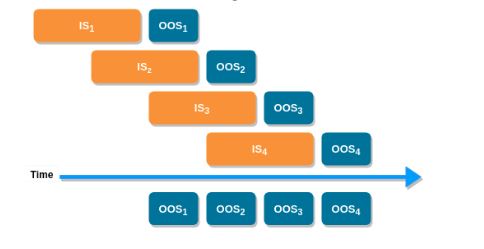
I started to describe the data-mining approach to trading system development with regard to how it diverges from the WF process here. I feel I may now have come full circle albeit with the one slight modification.
As I struggle to rationalize the Part 7 results (first link from above), I can shorten the incubation period or leave it unchanged in subsequent studies.
Perhaps I am suggesting a new fitness function altogether: percentage of OOS runs profitable.
Backtracking a bit, I think much of this evolved because I have yet to see validation data for the different stress tests. Such data is not forthcoming from the product developer who says in a training video, “at the end of the day, we are still competitors and I have to keep some things to myself.” This is data I will have to generate on my own.
Categories: System Development | Comments (0) | PermalinkMining for Trading Strategies (Part 7)
Posted by Mark on July 17, 2020 at 07:20 | Last modified: June 27, 2020 14:35Although my next study aimed to correct the mistake I made with the previous [long] study, I accidentally mined for short strategies. This was illuminating—as described in these final three paragraphs—but did not address the comparison I really wanted to make (see Part 6, sixth paragraph).
Given the fortuitous discovery I made from that short study, though, I proceeded to repeat the long study by switching around IS and OOS periods. I trained strategies on 2007-2011 and incubated from 2015-2019. I tested only 4-rule strategies expecting to find worse performance due to an inability to effectively filter on regime [which may have taken place in the previous study]:

Results are mixed. Beginning outperforms on Net PNL and Avg. Trade. End outperforms on PNLDD and PF. None of these differences are statistically significant.
This does not seem to be consistent with my theory about mutually exclusive regimes. That would be one regime controlling 2007-2011, a different regime controlling 2011-2015, and just one ruling 2015-2019.
In the face of a persistent long bias, such regimes would not exist: long strategies would be profitable whereas short strategies would not. As a general statement, this is true. Looking more closely, however, it certainly is not. 2007-2009 included a huge bear (benefiting shorts) while 2009 to (pick any subsequent year) benefits long strategies.
And if it’s tough to figure out equity regimes, then good luck finding anything of a related sort when it comes to CL or GC where words like “trend” and “mean reversion” don’t even begin to matter (based on my testing thus far).
Where to go from here?
- I should repeat the last study with 2-rule strategies to make sure I don’t get any significant differences there either.
- I could require a regime filter for the 4-rule strategies just in case none/few have been implemented.
- I need to better understand the short strategies. It’s one thing to find strategies that pass IS and OOS. It seems to be quite another to find strategies that do well on a subsequent OOS2. Performing well in OOS2 is what ultimately matters.
I have one other troubling observation to mention. Although the long strategies in all three studies (including that from Part 5) incubated profitably on average, performance does not begin to approach what we might require from OOS in any viable trading strategy. I did see flashes of brilliance among the 4-rule strategies (6, 9, and 10 strategies for each of three long studies posted PNLDD over 2.0 with a few excursions to 6 and one over 14!). On average, though, 203 top long strategies over eight years averaged a PF ~1.21 and PNLDD ~0.8 over four years to follow of a consensus bull market.
And don’t forget that we don’t have context around the 1.21/0.8 without comparable numbers for long entries matched for trade duration (Part 6, sixth paragraph).
Forget all the pretty pictures (see second paragraph here); if this is an accurate representation of algorithmic trading then those who say you’re not going to get rich trading equities certainly weren’t kidding!
Categories: System Development | Comments (0) | PermalinkWhat Percentage of New Traders Fail? (Part 5)
Posted by Mark on July 14, 2020 at 06:13 | Last modified: May 17, 2020 13:14Today I continue with excerpts from a Forex website forum discussion in 2013. The initial post, which tries to rebuke traditional wisdom, is Post #1 here. Forum content is unscientific and open to scrutiny. Do your own due diligence and buyer beware.
—————————
• Post #47, 4xp
> The simple fact is that more traders have to lose than win
> in order for the winners to make money… we are able to
> have leverage because of so many losers in the market.
> IMO, I believe the number is closer to 90% failure rate
> than 99% that many have already espoused.
>
> The reason forums like this one are so popular is because
> there are so many losers. Most people are not making any
> money trading, so they come here looking for and hoping to
> find something they can learn from. By the time you get
> here, you have the blind leading the blind. Many admit
> they are newbies or learning. Others want to pose as
> experienced traders because of an oversize ego, but they
> are really losers. Others come here because they have a
> web site, but they do not know how to trade, so they
> beguile newbies to head to their site. When it is all said
> said and done, it can be hard to discern the very few that
> are good traders because they are hiding behind the guise
> of their computer screen.
>
> When someone says you cannot beat the market, that is all
> rubbish. The reason the ~10% beat the markets is they are
> armed with and trade their methodology so they can beat
> the markets. The few that win consistently take personal
> responsibility for their actions rather than blaming the
> markets. The markets can only go up or down. You just
> have to have a methodology that discerns which direction
> it is going then jump on board.
>
> It is also no such thing that the markets are a zero-sum
> game. All of us can be winners, or all of us can be losers.
> I don’t concern myself with newbies coming up through the
> ranks becoming winners and then rob my pot. No chance!
Lots of good ideas here! Some are speculation (e.g. paragraphs 1 and 4), but they are interesting nonetheless.
In another post, 4xp goes on to write:
> People lose because they do not take time to learn. When
> I first started in 2004, I was working in a factory. I’d
> get home, then start learning about the markets. It took
> much experimentation and labor. I failed many times. Was
> it worth it! Well, let’s see. I wake up in the morning,
> go through my morning routine, which includes some quiet
> time and a trip to the coffee pot, then I make the long
> walk down the hallway to my home office, and report to
> work. Ahh, yes. It was worth it.
>
> Simply put, if you were training to be a doctor, you
> would have to go to school for 8 years, and pay all that
> money. Here, it depends on your learning curve and does
> not have to cost what a doctor pays. When you are
> finished and ready to enter the markets, you make more
> than the average doctor. But, yes, it take work and
> lots of time.
Five stars on the first paragraph!
With regard to the second paragraph, I disagree with making more than the average doctor. Not only does 4xp suggest it’s guaranteed, whether it’s even possible is highly dependent on starting capital level.
To be continued…
Categories: Financial Literacy | Comments (0) | Permalink