RUT Weekly Calendar Trade #5 (Part 3)
Posted by Mark on May 23, 2015 at 08:42 | Last modified: May 28, 2015 14:25Today I will finish analyzing my fifth weekly calendar trade.
Is there any reason not to hold this trade into expiration Thursday if necessary? My bias had been to close the trade by the close of expiration Wednesday. In theory, a big gap on the last day could land this trade heavily in the loss column. Is there a significant difference between a big gap on expiration Thursday and a big gap on expiration Wednesday, though?
I have no direct experience telling me to close the trade on expiration Wednesday. Until/if this happens, perhaps I should be willing to hold the position into the last trading day as long as I don’t violate max loss or any other rules. I am controlling total risk by keeping contract size small. Do I really have much to worry about?
Alternatively, I could choose to exit by the close of expiration Wednesday and just take whatever I can get at that time.
I certainly don’t believe I had any good reason to exit the trade when I did. My max loss was not threatened. The breakout turned me into an emotional trader.
I doubt I can understand this trade in the proper context until I’ve traded many more of them. This is the first time I had to make the third adjustment on expiration Monday. Perhaps I will find this to be an extremely rare event. If that is the case then closing for breakeven is not a big deal.
However, if I find that such a Monday adjustment happens more regularly then I believe it will pay to hold the trade longer. I closed for breakeven when I was just a few trading hours away from a 5-10% profit. When a trade goes bad, I expect the losers to hit in full force (max loss) every time. If I screw up winners by taking less than the profit target then I could be turning a perfectly viable trading plan into one that loses money.
Categories: Accountability | Comments (1) | PermalinkRUT Weekly Calendar Trade #5 (Part 2)
Posted by Mark on May 22, 2015 at 06:25 | Last modified: May 28, 2015 13:49Today I will analyze the weekly trade presented in my last post.
The market did get a bit crazy on the final day of the trade. I got out of the trade here:
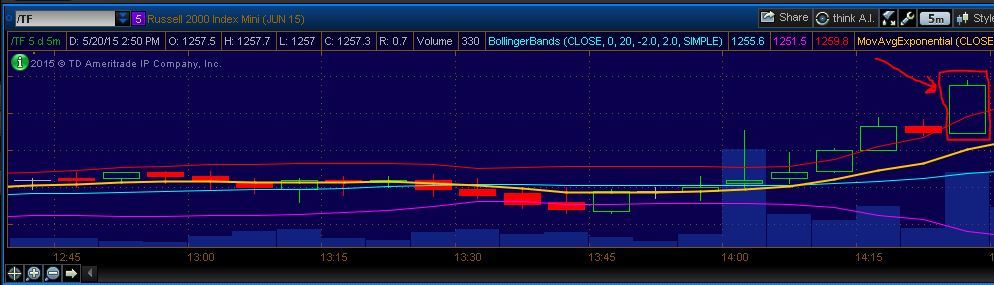
At the time, I felt lucky to get out of the trade with a profit of any sort.
One thing I’ve learned for my own trading is that the market is very good at sucking me in when it breaks up or down like this. I usually regret chasing the market at these times rather than waiting for it to settle down and pull back.
I can’t even remember how many times I have retrospectively thought, “if only I would have gotten up instead of trading, gotten a cup of coffee, and come back 30 minutes later…”
What happened in this instance? Look at the next 50 minutes:
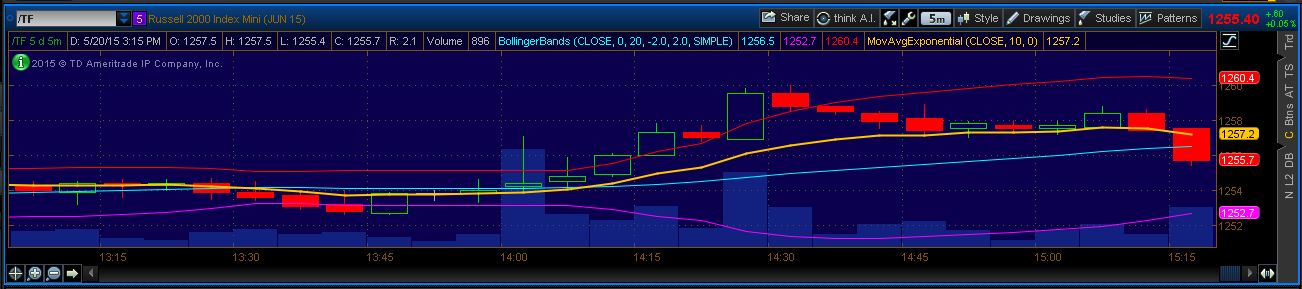
I definitely could have gotten out for a 5% profit by close or, had I held until Thursday, gotten out for the full 10%.
What’s the take-home message here?
The large negative gamma on this trade is something to beware so close to expiration.
On the other hand though, if I’m not willing to lose 15% on this trade then I can’t expect to make 10%. The trade was still 7-10 points from expiration breakeven when I closed it. I never saw the trade go down significantly on that Wednesday: it was profitable all day long up until the point I closed it…
…and wouldn’t you know it: the point I closed it ended up being the market high for the entire day!
This is typical of the way markets work and I am certain that I was not the only one screwed over by that breakout.
What’s the saying: “markets act to cause the maximum possible harm to the maximum number of traders?”
Yes indeed.
Categories: Accountability | Comments (1) | PermalinkRUT Weekly Calendar Trade #5 (Part 1)
Posted by Mark on May 21, 2015 at 07:51 | Last modified: May 28, 2015 13:21I opened my fifth weekly calendar trade Tuesday, May 12, at the 1230 strike. The market was at 1231 upon fill. I placed the order 0.05 off the midprice and caved 0.05 over several minutes.
After moving down, the market proceeded to rally over the next few trading days. On the morning of Monday, May 18, I rolled one 1230 calendar up to the 1255 strike with the market around 1247. This left breakevens at 1223 and 1260 with net position delta about zero.
The market moved sharply higher on this day and that afternoon with the market around 1256, I made a second adjustment by rolling the other 1230 calendar up to 1255. I did this as two trades and got seemingly poor execution on the 1255: placed the order at the midprice and caved 0.35 nine minutes later (filled 0.12 off the then mark). The 1230 calendar seemed to execute well (placed 0.025 off the midprice and filled immediately). The trade was now down over 10%.
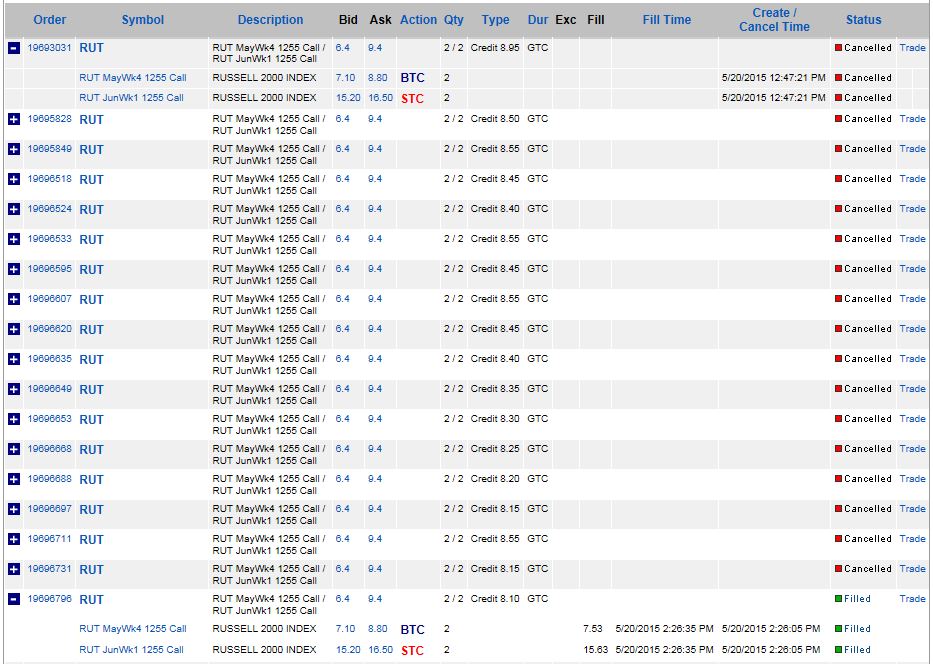
The market traded sideways into Wednesday afternoon. Being the second-to-last trading day, I watched closely for a sharp move that could really cause losses to build in a hurry. I had a GTC order working to close the trade for a 10% profit. Around noon, I lowered the GTC to the 5% profit level (if filled). You can see my working of the trade during the day here:
The bid/ask spread was 2.60-3.00 for most of the afternoon until I saw this at 2:05 PM:
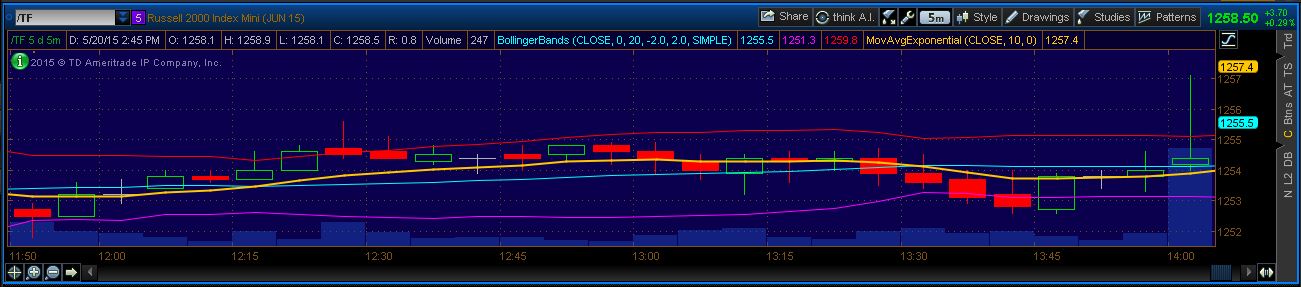
All hell was breaking loose right about then. The calendar spread got to be as wide as 6.00 (7.00 / 13.00)! At times, My working order was up to 0.45 off the mark and still not filled.
I finally did get filled for 8.10, which was 0.25 off the then mark. This gave me a profit of $10 on the trade.
I will analyze this trade in the next post.
Categories: Accountability | Comments (1) | PermalinkRUT Weekly Calendar Trade #4 (Part 2)
Posted by Mark on May 11, 2015 at 06:53 | Last modified: May 14, 2015 10:28As discussed in the last post, my weekly calendar trade was still down after Day 2 (5/6/15) but farther away from the downside adjustment point.
The market was up on Day 3 and the trade was profitable by noon. At the close, the market was at 1225 and somewhat comfortably within the adjustment points.
Friday was the big day with the jobs report to be announced at 8:30 AM. The market liked the report and opened around 1235. My contingent order to close was triggered and I got out with a profit of 8.5%.
I will say that I wasn’t entirely happy with this result because I’ve been aiming to close with a profit of 10% or better. In this case, I opened the trade for $6.70 and closed for $7.30.
Here’s how it should have gone:
Bought 2 @ $6.70 = $1,340
Add $8 for commissions on eight contracts: $1,348
Add 10% profit target: $1,348 * 1.1 = $1,483
Price per calendar = $1,483 / 200 = $7.415
I should have entered a contingent order to close for $7.42 or $7.45 (if I wanted to round up to the nearest nickel) rather than $7.30. Oh well… any win is much better than a loss!
I could look to get 8% on the trade if out by Friday. That would mean accepting a slightly lower profit to avoid the weekend risk. I don’t want to be taking losses much larger than 8% when it doesn’t go my way, however. My max loss has been 15% and my two losers closed for several percentage points worse than that simply due to slippage and fast market movement. This might or might not be viable depending on how much this trade wins.
In four weeks, I have thus far won on two of them. I’m down money overall, though.
We’ll see what next week brings.
Categories: Accountability | Comments (0) | PermalinkRUT Weekly Calendar Trade #4 (Part 1)
Posted by Mark on May 9, 2015 at 07:51 | Last modified: May 14, 2015 10:28I opened my fourth weekly calendar trade Tuesday morning (5/5/15) at the 1230 strike. This was a big down day for the market. I placed my original order around 9:45 AM for a 1235 put calendar. The market was quickly down to 1230 and I lowered the strike. I got filled about 10 minutes later with the market down to 1226 and I had caved a nickel to get that done (it filled 0.05 better than the then mark).
Before the day was out, the market had bottomed out near 1211! My downside breakeven was around 1205 and I had an alert in at 1208 to adjust. This time, I figured if an adjustment point was hit on the very first day then I would just exit the trade for a loss rather than trying adjusting and quite possibly being at max loss after the adjustment.
Psychologically, I was in no shape to adjust this trade anyway. My expectations are to average about +2% per week on this trade. In three weeks, I’ve lost 21%, made 10%, and lost 19%. I therefore expect to be “due” [it must be bad karma to even think that much less write it or say it] for a preponderance of winning trades to improve that average. We have possibly been through a very volatile time in the market recently: something that does happen every now and then.
With the market closing Tuesday at 1215, I survived Day 1.
Day 2 was mostly higher, which made for an easier day to hold the trade and watch paint dry. The market bottomed at 1211 on this day and it closed near 1220. The trade was down about $58 at the close, which was frustrating, but I felt comfortable being 10 points from the downside breakeven and still having 10 points of upside until I hit the short strike. The upside adjustment point was still over 20 points away.
I will conclude this trade summary in the next post.
Categories: Accountability | Comments (1) | PermalinkRUT Weekly Calendar Trade #3
Posted by Mark on May 1, 2015 at 06:44 | Last modified: May 14, 2015 10:27I opened my third weekly calendar trade Tuesday morning (4/28/15) at the 1255 strike. I paid 6.45, which I thought was an excellent price! I later realized this was lower than usual because it was a call calendar instead of put calendar. That shouldn’t make too much difference but if I’m getting used to prices in one (puts) then seeing prices in the other (calls) could throw me off.
The market really tanked yesterday. This trade had been up as much as 6% on Wednesday although I’m not sure I could have gotten executed there. Yesterday morning, the downside adjustment point was hit. I rolled one of the 1255 call calendars to a 1225 put calendar. Unlike my first weekly calendar trade where I was able to do this roll for just 0.06, this one cost 2.25. Again though, much of that was probably due to the difference in implied volatility between calls and puts.
The market continued lower yesterday and I eventually closed this trade for [more than] max loss: -19%. This was not as bad as my first loser, which was 21%. Still doesn’t make me feel any good, though.
The question remains: how often does this happen? No doubt the market is shaky this week. Certainly the market does seem much calmer when it’s doing the slow grind upward but it just so happens that in the three weeks I have been doing this trade, it’s looked ugly and more ugly. RUT fell 31 points during the course of this trade. In trade #1, the market fell only eight points from open to close but did a sharp reversal.
I’ll lick my wounds and get ready for next week.
Categories: Accountability | Comments (0) | PermalinkRUT Weekly Calendar Trade #2
Posted by Mark on April 25, 2015 at 13:56 | Last modified: May 14, 2015 10:27On Tuesday morning, April 21, I got filled at 7.25 in about 30 minutes. I caved 0.15 over that time and got filled 0.05 off the the mark. Breakeven points at expiration were 1248 and 1283.
The trade was never challenged. I had a contingent GTC order working to close for 8.09.
I watched the trade all day yesterday. At 3:50 PM, the market was 7.9 / 9.0, which is a mark of 8.45. My order was therefore 36 cents off the midprice and still not filled! I was a bit surprised.
At 3:58 PM, the market was 7.4 / 8.8, which is a mark of 8.1. I figured I surely wouldn’t be filled since my order would need to be at least 20 cents under the midprice if not more than 36 cents to be hit!
Then at 4:02 PM, What do I hear at 4:02 PM, after the regular session had ended: Ding! Ding!
Indeed, my order for 8.09 was filled! The market at that time showed 7.0 / 8.9, which is a mark of 7.95. My order got filled 14 cents better than the midprice! That is a shocker but, of course, I’ll take it any day.
Nothing should surprise me yet since I’m still observing and learning how these things work. This was only my second trade, after all. Once I have a larger sample size of experience then I can look back to determine what is unusual and what is not. Maybe I’ll see a handful of trades executed after the close like this. Who knows?
For this week though, 8.09 – 7.25 minus a few dollars for transaction fees gives me a return of 10.4% in four trading days.
I look forward to the next one!
Categories: Accountability | Comments (0) | PermalinkRUT Weekly Calendar Trade #1 (Part 3)
Posted by Mark on April 19, 2015 at 10:42 | Last modified: April 17, 2015 14:03Today I will continue and complete the postmortem on my first live weekly time spread.
In the last post I illustrated the differences in risk graphs. That’s huge and something I need to eventually figure out.
The final point is retrospective: should I have closed this trade at the first adjustment point? My profit target is 10% with a 15% max loss. In the backtesting I tried to do, if I was anywhere close to max loss at the adjustment point then I wanted to exit the trade. After slippage, I’d likely be at or beyond max loss after adjustment and it can only get [much] worse from there should the market continue moving against me.
The problem here was that I had no idea I was so close to max loss. It came fast (within one day) and the market did not seem to move a great deal to get there! Between OptionVue and my TOS account, I just did not have it modeled acceptably. I probably need to get this into my DDE spreadsheet and then maybe I can create an “after adjustment P/L” cell to project where I would be after 0.10 slippage is applied per leg (for example).
On this trade, I lost 21.2%!
However, in legendary terms, “I’LL BE BAHK” [phonetics mine].
This is why we trade small: to learn the nuances and how the trades work. I think this was a case of whipsaw; the market ran up forcing an adjustment and then ran down even harder. I was going to check before I went out this morning and had I been at the helm, I probably could have saved some of the loss. Market activity like this is just not going to work for this trade, however.
So was this a fluke occurrence or does it happen on a semi-regular basis?
Only time will tell.
Categories: Accountability | Comments (1) | PermalinkRUT Weekly Calendar Trade #1 (Part 2)
Posted by Mark on April 18, 2015 at 05:35 | Last modified: April 17, 2015 14:02I previously gave an overview of my first live weekly time spread. Today I want to run through a few more details.
Compare and contrast:
Figure 1
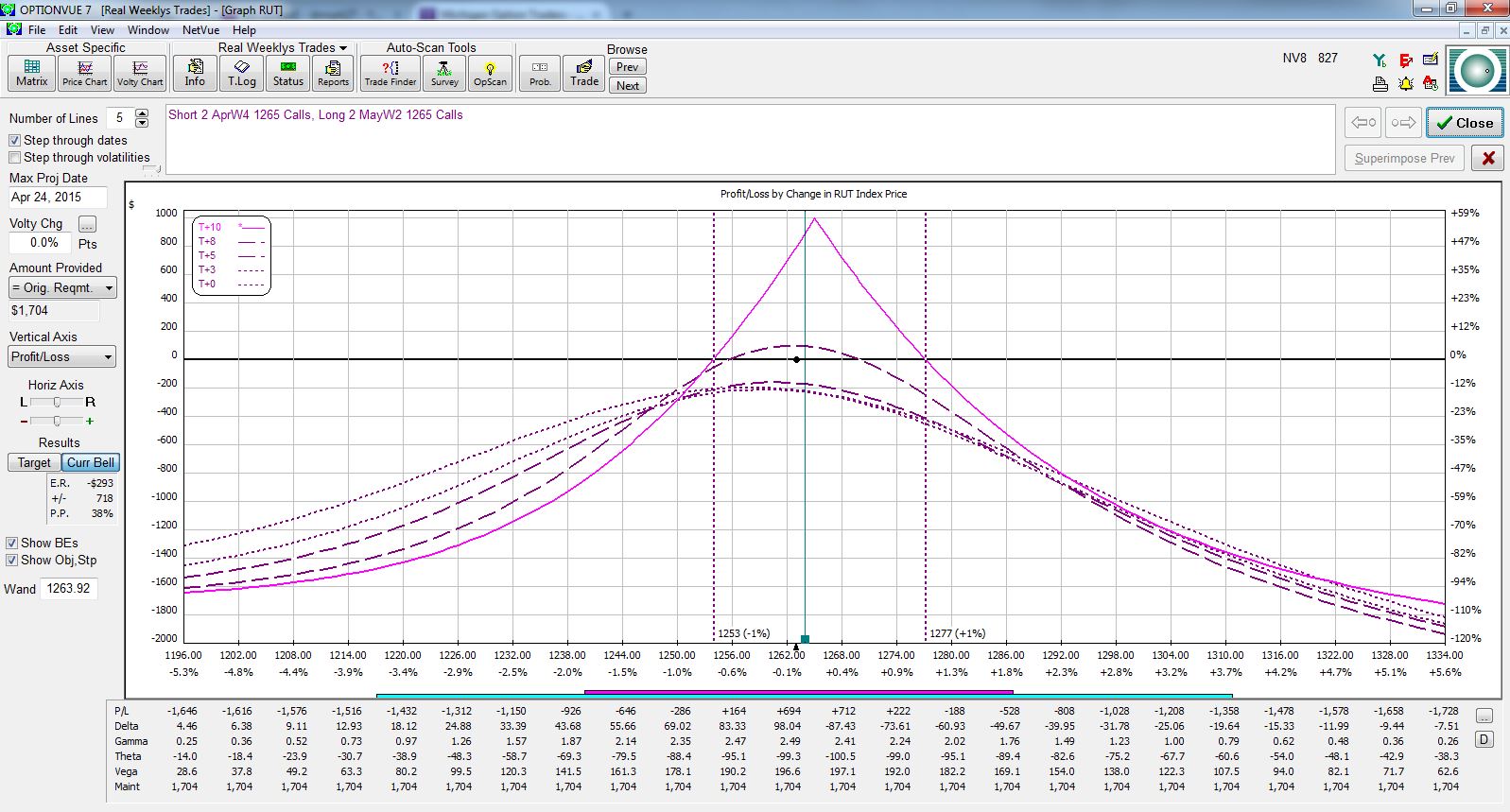
Figure 2
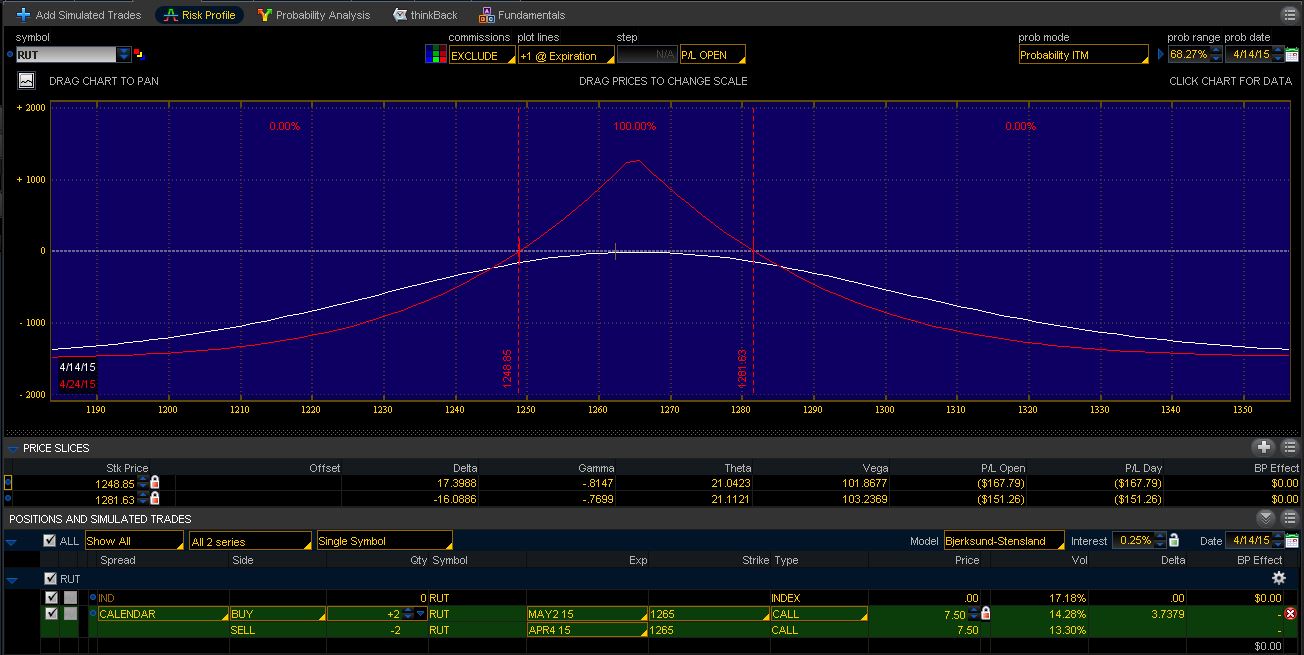
Figure 3
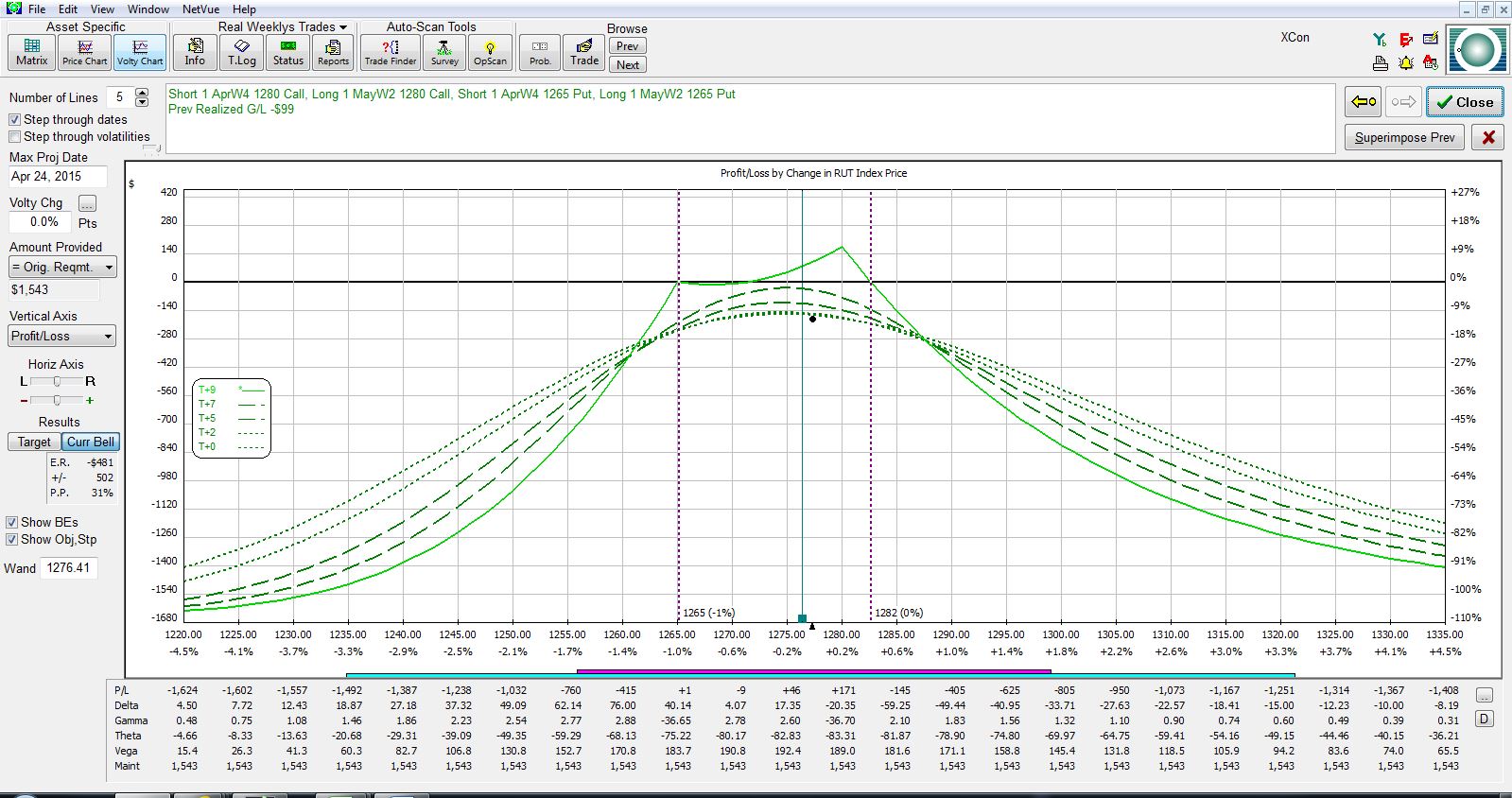
Figure 4
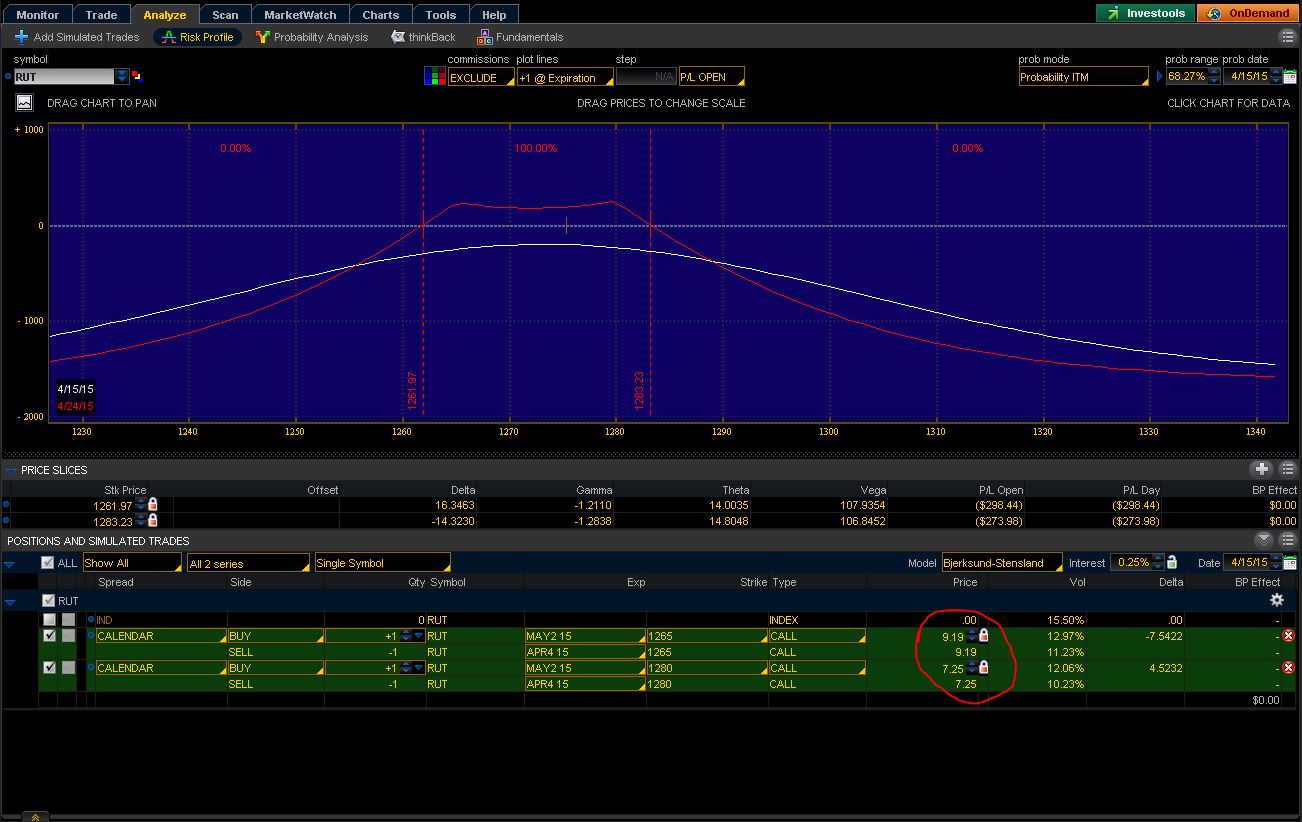
Which pictures portray the correct representation?! Figure 1 has breakevens of 1253/1277 whereas Figure 2 has breakevens of 1249/1281. Figure 3 has breakevens of 1265/1282 whereas Figure 4 has breakevens of 1262/1283. These differing breakevens can significantly affect when to adjust. In addition, the Figure 3 expiration graph is downright ugly! That’s a trade I might not even want to keep. Figure 4? That trade looks to have much more potential.
The only way to truly understand which risk graph is more likely to be accurate is to get a number of these trades under my belt. As the days go by, I’ll be able to see my live P/L and compare that to what the risk graphs tell me. The risk graphs might change over time too and morph into something better aligned with my P/L. Again, only by trading these and learning will I gain the necessary experience to understand.
It’s hard enough to figure this stuff out by trading it live. It might have been foolhardy to ever think I could backtest these with OptionVue, at least, given data in 30-minute increments. Maybe another tool offering finer data (like 5-minute increments) could give me a fighting chance to accurately represent.
I’ll “stick a fork in it” with my next post.
Categories: Accountability | Comments (1) | PermalinkRUT Weekly Calendar Trade #1 (Part 1)
Posted by Mark on April 17, 2015 at 12:45 | Last modified: April 17, 2015 12:45This is the week I decided to junk the backtesting and try a real one live!
On Tuesday, RUT opened down on the day. I entered an order to buy 2 @ 7.40, which would have been around the mark or a little better. RUT rallied to 1265 and I did not get filled over the next few hours.
I canceled that order and did get filled on a 1265 spread for 8.14. The order was placed at the midprice and sat for two hours before I caved 0.10 and got filled about nine cents off the mark.
The market rallied on Wednesday and around midday, I rolled one of the 1265 spreads to 1280. I did this for six cents but I was down nearly 15% on the trade when it was done. I caved about 0.20 off the midprice to do this: one dime off each spread.
Today, the market tanked out of the gate. I ran some errands and came back 30 minutes into the session to see the market around 1256. I entered an order to close the DC at the midprice around 10:01. The market fell over one point in a minute and I ended up caving 0.95 over two minutes. I got filled 0.08 off the then mark, which ended up being 0.43 off my original limit price and 0.52 better than the modified order I had submitted to close. My total loss on the trade was an ugly 21.2%.
Think about that slippage for a moment: 0.43! I suppose that’s not horrible. That is roughly 0.11 per leg, which is usually the worst I would include in backtesting. The long options here were pretty expensive too and those spreads are pretty wide. One of my short options was 1.50/2.50. That seems a bit absurd. In fast-moving markets those spreads will widen and I guess given that, it’s not horrible to lose only this much in slippage.
I’ll cover a few more details about this trade in my next post.
Categories: Accountability | Comments (2) | Permalink