Quality and Fundamentals (Part 4)
Posted by Mark on July 8, 2025 at 07:31 | Last modified: February 8, 2026 12:17In Part 3, I revised the overriding question for this mini-series from whether quality and/or fundamentals are important for stock analysis and what the difference may be to what matters most for the stock study [guide, or SSG]?
Once answered, I can address the limitations of the SSG methodology itself. One thing I know already is that the methodology is not well-suited to stocks failing visual inspection.
Let’s go back to something else mentioned in Part 3: earnings predictability. This is one component to the Manifest Investing Quality rating. Value Line also gives an earnings predictability score for stocks covered in its Standard Edition. I have come to see earnings predictability as related to 5- and 10-year R^2 metrics.
The latter point suggests earnings predictabilty really caters to “up, straight, and parallel.” Financial wisdom dictates past performance does not guarantee future results but visual inspection says if a company has not been consistent (linear) in the past then we’re not giving it a chance to disappoint in the future. Only companies that have been consistent growers in the past are legitimate candidates for stock selection. This seems intuitive enough but does it really hold water?
The following bar chart from Google AI gets me concerned:
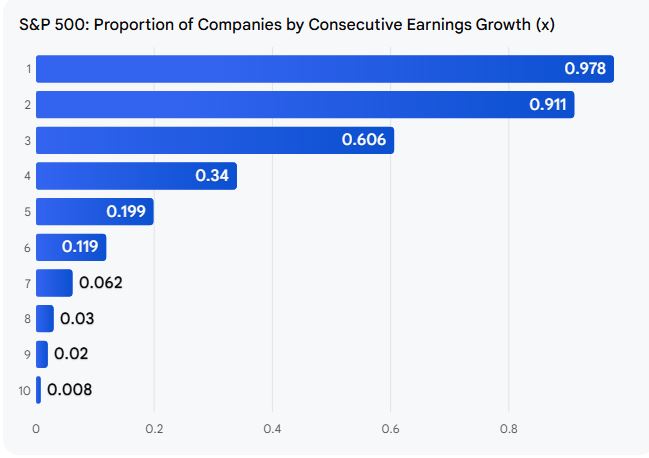
The number on the left (y-axis) is consecutive years of earnings growth. The chart shows that number inversely proportional to number (percentage) of S&P 500 companies. It therefore seems likely that the more consistent a company has been, the more likely it is to falter: the last thing we want because earnings decline often takes stock price with it.
The next big question is whether a faltering company is more likely to find its footing given a historical track record of consistent earnings growth. Once again, Google AI:
> Based on historical S&P 500 data, a company with a history of consistent
> earnings growth is slightly more likely to return to a path of consistent
> growth after an annual loss compared to companies without such a history.
> Specifically, companies with consistent past growth had a 58.3% probability
> of returning to consistent growth following a loss incident, while those
> without a consistent history had a 54.5% probability.
I am a bit skeptical for a few reasons. First, I don’t know if “history of consistent earnings growth” matches my concept. Also, it was unable to give me sample sizes for the 58.3% and 54.5% [I was hoping] nor was it able to give me a p-value on the difference [I did not expect]. Not seeing a larger difference may somewhat call into question the concept of quality management: a team with the secret sauce able to maintain the earnings consistency we seek. Certainly we wouldn’t want to be cherry-picking companies benefiting from random chance.
I will continue next time.
————————
A 90-day free trial to BetterInvesting® may be secured here (also see link under “Pages” section at top right of this page).
Quality and Fundamentals (Part 3)
Posted by Mark on July 3, 2025 at 07:34 | Last modified: February 6, 2026 16:48The question being addressed in this mini-series is whether quality and/or fundamentals are important for stock analysis and what the difference may be between them.
I left off with mention of value stocks: an exception to the high-quality growth stock variety. Value stocks can and do show sales+EPS growth that is more tempered than the latter and akin to larger, mature companies that fall short of the Part 2 criteria (9% / 10% / 10%).
Academics have done much research to suggest value investing may be superior to growth investing over ultra-long time horizons. As of early 2026 per Google AI, value wins over 50, 60, 70, and 80 years ~11.4% (all percentages annualized) to ~10.6%, ~11.3% to ~10.1%, ~11.9% to ~10.3%, and ~12.4% to ~10.5%, respectively. Research by Fama and French suggests that since 1927, value has outperformed growth by an average of 4.4%.
More recently, however, growth has outperformed. Growth wins over the last 5, 10, 20, and 30 years ~15.2% to ~11.9%, ~14.6% to ~9.2%, ~11.4% to ~8.1%, and ~11.8% to ~9.5%, respectively. That Fama and French paper (“Value versus Growth: the International Evidence”) was published in 1998.
Most recently, value is bouncing back. Since late October 2025 (roughly 14 weeks), value has outperformed growth (Russell indices) by a [non-annualized] total of 14%.
Thanks to Google AI for doing the research but at best [worst] I regard these numbers and conclusions as approximate [patently false]. To be more confident, I would need to know exactly what indices or data sets were used in the calculations to ensure validity of the comparison (and check for survivorship bias among other things). I would also want to see inferential statistics to know if differences between percentages are likely fluke or more indicative of practical significance.
The BetterInvesting® preference for high-quality growth (as opposed to low-P/E value stocks) backs the criticism of my EOG study discussed in Part 1 and the Learn to Earn presentation in Part 2. Manifest Investing also focuses on the same. They target stocks with double-digit (especially over 12-13%) sales growth and higher Quality. Their Quality rating—designed to identify sustainable, low-risk, and consistent growth firms—measures financial strength, management effectiveness, and earnings predictability. Management effectiveness involves improving earnings growth over time, consistent/increasing ROE, and acceptable/decreasing Debt-to-Capital.
Before delving forward next time into earnings predictability, let me dissect one point of confusion from the first paragraph. I think Manifest Investing (and one-half of this year’s Learn to Earn tandem) would say high-quality growth stocks are stocks with good fundamentals. With regard to the Quality rating, do I think a stock with good fundamentals can fail to be high quality? Yes. Do I think a stock with a high Quality rating can fail to have good fundamentals? Not so much. I will therefore continue to treat them differently with this question outstanding: what matters most for the stock study [guide, or SSG]?
————————
A 90-day free trial to BetterInvesting® may be secured here (also see link under “Pages” section at top right of this page).
Extracting Stock Prospects Using BetterInvesting Tools
Posted by Mark on June 30, 2025 at 07:07 | Last modified: January 18, 2026 12:06Looking for stocks to study? I always enjoy articles that include easy tips for finding prospects.
The BetterInvesting website makes hunting much simpler. Click “Find Great Stocks” to open a portal to a treasure trove. Click “Stock Screening” and see several predefined screens that may be checked periodically for new ideas. Select any predefined screen and click the second “Preview Data” button on any row to scroll quickly through the entire list with the “Next” and “Previous” buttons.
Here’s another way to make use of any article or presentation one may find.
Start by reading the article. Fellow Chapter Director Barbara Cobb alerted me to this on the Morningstar website.
Since Wide Economic Moat serves as a promising Quality filter, enter the first “Wide” Economic Moat ticker symbol into the white field below “Online Tools” on the BetterInvesting home page (in the field it says “Launch SSG — Enter Ticker Here”). Is the chart up, straight, and parallel to you? If so, add the ticker to a list. Close the browser tab showing the chart.
Continue by entering the next “Wide” Economic Moat ticker into the white field. Repeat until you’ve inspected them all.
I found nine of the 12 to be roughly up, straight, and parallel. That’s nine solid investment prospects for in-depth study in 10 minutes or less.
Categories: BetterInvesting® | Comments (0) | PermalinkQuality and Fundamentals (Part 2)
Posted by Mark on June 27, 2025 at 07:29 | Last modified: February 6, 2026 16:57In Part 1, I presented the critique of my EOG stock study and my rebuttal aided by Google AI. Today I want to go into further detail about “good fundamentals.”
My rebuttal basically argues that “up, straight, and parallel” makes for a quality stock and one worthy of study and potential investment. While discussed in many BetterInvesting® (BI) presentations, “up, straight, and parallel” does not really tell the whole story for BI.
At this juncture, I want to shout out a shameless plug for the BetterInvesting® South Florida Chapter “Learn to Earn” series. This is an online webinar taking place roughly five times per year between September and April. Registration is free for everyone and may be seen here.
In the January Learn to Earn webinar, Dr. Randall Buss succinctly defined a BI high-quality growth stock—otherwise known as a stock with good fundamentals. Here are the six criteria:
- Sales growth > 9% per year in a straight line
- Pretax profit growth > 10% per year in a straight line
- EPS growth > 10% per year in a straight line
- Pretax profit good to excellent relative to peers with nonnegative growth
- ROE > 15% per year
- Debt-to-Capital < 33% per year
Based on the above, I actually am not screening for “good fundmentals” when choosing what stocks to study. I look at the first three criteria without regard to magnitude. I look at the last three criteria for qualitative context but not for any concrete decision making. I personally believe Interest Coverage is more important than Debt-to-Capital and I look at M* and VL Financial Health, Capital Allocation, and Financial Strength ratings. I like to see companies that lead peer and industry averages but lack therein would not make for an instant cut.
What does make for an instant cut is lack of “up, straight, and parallel.” This amounts to failure of visual inspection.
I think what really matters here is largely unknown because we don’t have enough data to conclusively determine much less know what the future will hold. Investing the BI way, we want stocks that will realize 100% returns in five years (e.g. double in price if no dividend is paid).
Does a stock need to be high-quality growth to double in five years? I will continue next time with a long-standing debate in finance between growth and value stocks that calls into question whether high-quality growth is what we should even be looking for in the first place.
————————
A 90-day free trial to BetterInvesting® may be secured here (also see link under “Pages” section at top right of this page).
VEEV Stock Study (1-20-26)
Posted by Mark on June 24, 2025 at 06:47 | Last modified: February 6, 2026 16:48I recently did a stock study on Veeva Systems, Inc. (VEEV, $222.21). Previous stock studies are here and here.
M* writes:
> Veeva is the global leading supplier of cloud-based software
> solutions for the life sciences industry. The company’s best-of-
> breed offerings address operating and regulatory requirements
> for customers ranging from small, emerging biotechnology
> companies to departments of global pharmaceutical manufacturers.
> The company leverages its domain expertise to improve the
> efficiency and compliance of the underserved life sciences
> industry, displacing large, highly customized and dated
> enterprise resource planning systems that have limited
> flexibility. Its two main products are Veeva CRM, a customer
> relationship management platform for companies with a salesforce,
> and Veeva Vault, a content management platform that tackles
> various functions within any life sciences company.
Since 2018 [FY ends Jan 31; references to year at BI and Value Line (VL) incremented to align], this medium-size company has grown sales and EPS at annualized rates of 22.4% and 21.3%, respectively (earlier years excluded due to low base that otherwise further inflate EPS growth rate). Lines are up, straight, and parallel. Shares outstanding increase 7.5% (1.0% per year). VL gives an Earnings Predictability score of 95.
Since 2018, PTPM leads peer and industry averages while increasing from 23.1% to 33.5% (’25) with last-5-year mean of 27.3%. ROE leads peer and industry averages despite falling from 16.0% to 12.8% (’25) with last-5-year mean of 14.0%. Debt-to-Capital is less than peer and industry averages while ranging from 0% (’18 and ’19) to 2.7% (’21) with last-5-year mean of 1.7%.
Quick Ratio is 7.4 and Interest Coverage N/A (no long-term debt) per M* who assigns “Wide” Economic Moat, rates the company “Exemplary” for Capital Allocation, and gives an A grade for Financial Health (per BetterInvesting website). VL rates the company A for Financial Strength.
With regard to sales growth:
- YF gives ACE YOY 15.5% and 12.1% for ’26 and ’27, respectively (based on 24 analysts).
- Zacks gives ACE YOY 15.1% and 11.7% for ’26 and ’27, respectively (10 analysts).
- VL projects 13.1% annualized growth from ’25-’29.
- CFRA projects 15.4% YOY and 13.7% per year for ’26 and ’25-’27, respectively.
- M* offers a 2-year ACE of 13.8%. and projects 13.3% per year from ’25-’30 (Equity Report).
I am forecasting below the range at 11.0% per year.
With regard to EPS growth:
- MarketWatch projects 11.7% and 12.3% per year for ’25-’27 and ’25-’28, respectively (based on 33 analysts).
- Nasdaq.com gives ACE 6.3% YOY and 8.8%/year for ’27 and ’26-’28 (10 / 10 / 6 analysts for ’26 / ’27 / ’28).
- Seeking Alpha projects 4-year annualized growth of 18.9%.
- Finviz gives ACE 5-year annualized growth of 14.1% (8).
- LSEG estimates LTG at 12.7%.
- YF gives YOY ACE 20.3% and 8.2% for ’26 and ’27, respectively (29).
- Zacks gives YOY ACE 20.2% and 6.8% for ’26 and ’27 (11) along with 5-year annualized growth of 23.8%.
- VL projects 13.0% annualized growth from ’25-’29.
- CFRA projects growth of 20.3% YOY and 13.9% per year for ’26 and ’25-’27 along with 3-year CAGR of 14.0%.
- M* gives long-term growth ACE of 25.6% and projects 13.9% per year from ’25-’30 in Equity Report.
My 12.0% forecast is below the long-term-estimate range (mean of seven: 15.4%). Initial value is ’25 EPS of $4.32/share instead of 2026 Q3 EPS of $5.34 (TTM).
My Forecast High P/E is 48.0. Since 2018, high P/E ranges from 59.9 in ’25 to 133 in ’21 with a last-5-year mean of 94.7 and a last-5-year-mean average P/E of 71.1 (excluding ’22 low P/E upside outlier of 80.8). I am below the range but outside my comfort zone.
My Forecast Low P/E is 35.0. Since 2018, low P/E ranges from 35.5 in ’19 to 58.0 in ’20 (80.8 upside outlier in ’22 excluded) with a last-5-year mean of 47.4. I am forecasting below the range.
My Low Stock Price Forecast (LSPF) of $151.20 is default based on initial value above. This is 32.0% less than the previous close and 25.0% less than the 52-week low.
These inputs land VEEV in the HOLD zone with a U/D ratio of 2.0. Total Annualized Return (TAR) is 10.5%.
PAR (using Forecast Average—not High—P/E) of 7.3% is less than I seek for a medium-size company. If a healthy margin of safety (MOS) anchors this study, then I can proceed based on TAR instead.
To assess MOS, I compare my inputs with those of Member Sentiment (MS). Based on 135 studies done in the past 90 days (my study and 47 outliers excluded), averages (lower of mean/median) for projected sales growth, projected EPS growth, Forecast High P/E, and Forecast Low P/E are 12.0%, 13.9%, 55.5, and 42.0, respectively. I am lower across the board. VL [M*] projects a future average annual P/E of 35.0 [17.6, which once again seems unreasonably low] that is less than MS (48.8) and less than mine (41.5).
MS high / low EPS are $9.47 / $4.70 versus my $7.61 / $4.32 (per share). My high EPS is less due mainly to a lower growth rate. VL (M*) high EPS of $10.75 ($9.17) is greater than (in the middle of) both.
MS LSPF of $179.90 implies a Forecast Low P/E of 38.3 versus the above-stated 42.0. MS LSPF is 8.9% less than the default $4.70/share * 42.0 = $197.40 that results in more conservative zoning. MS LSPF is still 19.0% greater than mine, however.
MOS is robust in the study because my inputs are near or below historical/analyst/MS averages/ranges. Also backing this assessment is MS TAR exceeding mine by 6.2% per year and a higher LSPF.
With regard to valuation, PEG is 1.2 and 3.2 per Zacks and my projected P/E: slightly overvalued (2.3 per M*). Relative Value [(current P/E) / 5-year-mean average P/E] is quite low at 0.61. “Quick and Dirty DCF” has stock undervalued by 39%.
Per U/D, VEEV is a BUY under $204/share. BetterInvesting TAR criterion would be met [365.3 / ((14.87 / 100 ) +1 ) ^ 5] ~ $183 given a forecast high price ~$366 (no dividend).
A 90-day free trial to BetterInvesting® may be secured here (also see link under “Pages” section at top right of this page).
Categories: BetterInvesting® | Comments (0) | PermalinkINTU Stock Study (1-19-26)
Posted by Mark on June 19, 2025 at 07:03 | Last modified: January 19, 2026 16:23I recently studied Intuit, Inc. (INTU, $545.25).
M* writes:
> Intuit serves small and midsize businesses with accounting
> software QuickBooks and online marketing platform
> Mailchimp. The company also operates retail tax filing
> tool TurboTax, personal finance platform Credit Karma,
> and a suite of professional tax offerings for accountants.
> Founded in the mid-1980s, Intuit enjoys a dominant
> market share for small-to-midsize business accounting
> and self-serve tax filing in the US.
Over the past decade, this large-size company has grown sales and EPS at annualized rates of 17.8% and 16.0%, respectively. Lines are up, straight, and parallel except for EPS dip in ’22. Shares Outstanding increase 6.8% (0.7% per year). Five-year EPS R^2 is 0.87 and Value Line (VL) gives an Earnings Predictability score of 95.
Over the past decade, PTPM leads peer and industry averages while ranging from 20.0% in ’22 to 28.6% in ’20 with last-5-year mean of 23.0%. ROE leads peer and industry averages despite decreasing from 62.8% (’16) to 19.0% (’25) with last-5-year mean of 16.2%. Debt-to-Capital is less than peer and industry averages while ranging from 10.4% in ’19 to 46.3% in ’16 with last-5-year mean of 26.2%.
Quick Ratio is 1.3 and Interest Coverage 22.2 per M* who assigns “Wide” Economic Moat and gives an A grade for Financial Health (per BetterInvesting website). VL rates the company A for Financial Strength (and reports Interest Coverage over 14).
With regard to sales growth:
- YF gives YOY ACE 12.6% for both ’26 and ’27 (based on 31 analysts).
- Zacks gives YOY ACE 12.2% and 12.1% for ’26 and ’27, respectively (7 analysts).
- VL projects 12.8% annualized growth from ’25-’29.
- CFRA projects 12.5% YOY and 12.3% per year for ’26 and ’25-’27, respectively.
- M* gives 2-year ACE of 12.2% and projects 12.8%/year from ’25-’30 in Equity Report.
My 11.0% forecast is below the range.
With regard to EPS growth:
- MarketWatch projects 14.5% and 14.3% per year for ’25-’27 and ’25-’28, respectively (based on 34 analysts).
- Nasdaq.com gives ACE 14.2% YOY and 16.9%/year for ’27 and ’26-’28 (8 / 8 / 2 analysts for ’26 / ’27 / ’28).
- Seeking Alpha projects 4-year annualized growth of 14.2%.
- Finviz gives ACE 5-year annualized growth of 14.4% (7).
- LSEG estimates LTG at 14.2%.
- Argus projects 5-year annualized growth of 11.0%.
- YF gives YOY ACE 15.2% and 13.9% for ’26 and ’27, respectively (33).
- Zacks gives YOY ACE 14.8% and 14.3% for ’26 and ’27 (9) along with 5-year growth of 14.2%/year.
- VL projects 13.2% annualized growth from ’25-’29.
- CFRA projects growth of 15.0% YOY and 14.5% per year for ’26 and ’25-’27 along with 3-year CAGR of 16.0%.
- M* gives long-term growth ACE of 16.1% and projects 15.1%/year from ’25-’30 in Equity Report.
My 10.0% forecast is below the long-term estimate range (mean of eight: 12.2%). Initial value is ’25 EPS of $13.67/share instead of 2026 Q1 EPS of $14.63 (TTM).
My Forecast High P/E is 36.0. Over the past 10 years, high P/E increases from 38.5 to 59.5 (’25) with a last-5-year mean (excluding ’22 upside outlier of 98.5) of 64.0 and a last-5-year-mean average P/E of 53.2. I am below the range.
My Forecast Low P/E is 25.0. Over the past 10 years, low P/E increases from 26.2 to 39.0 (’25) with a last-5-year mean of 42.4. I am forecasting below the range.
My Low Stock Price Forecast (LSPF) is $405.00. Default based on initial value given above ($341.80) seems unreasonably low at 37.3% less than previous close and 35.8% less than 52-week low. My arbitrary selection [that effectively raises my Projected Low P/E to 29.6] is 25.7% and 24.0% less, respectively.
Over the past 10 years, Payout Ratio (PR) decreases from 39.5% (’16) to 30.4% (’25) with a last-5-year mean of 34.1%. I am forecasting below the range at 30.0%.
These inputs land INTU in the HOLD zone with a U/D ratio of 1.8. Total Annualized Return (TAR) is 8.6%.
PAR (using Forecast Average—not High—P/E) of 5.2% is less than I seek for a large-size company. If a healthy margin of safety (MOS) anchors this study, then I can proceed based on TAR instead.
To assess MOS, I compare my inputs with those of Member Sentiment (MS). Based on 111 studies in the past 90 days (my study and 44 other outliers excluded), averages (lower of mean/median) for projected sales growth, projected EPS growth, Forecast High P/E, Forecast Low P/E, and PR are 12.0%, 13.9%, 50.0, 37.7, and 33.9% respectively. I am lower across the board. VL [M*] projects a future average annual P/E of 33.5 [15.9: once again unreasonably low] that is less than MS (43.9) and greater than mine (30.5).
MS high / low EPS are $27.73 / $14.24 versus my $22.02 / $13.67 (per share). My high EPS is less due mainly to a lower growth rate. VL (M*) high EPS of $33.05 ($31.40) soars above both.
MS LSPF of $493.20 implies a Forecast Low P/E of 34.6 versus the above-stated 37.7. MS LSPF is 8.1% less than the default $14.24/share * 37.7 = $536.85 resulting in more conservative zoning. MS LSPF is 21.8% greater than mine, however.
MOS is robust in the study because my inputs are near or below historical/analyst/MS averages/ranges. Also backing this assessment is MS TAR exceeding mine by 8.5% per year (possibly a bit high) and a much higher LSPF.
With regard to valuation, PEG is 1.7 and 3.4 per Zacks and my projected P/E, respectively: slightly overvalued (2.6 per M*). Relative Value [(current P/E) / 5-year-mean average P/E] is low at 0.70. “Quick and Dirty DCF” has stock undervalued by 31%.
Per U/D, INTU is a BUY under $502/share. BI TAR criterion would be met [792.7 / ((14.07 / 100 ) +1 ) ^ 5] ~ $410 given a forecast high price ~$793.
A 90-day free trial to BetterInvesting® may be secured here (also see link under “Pages” section at top right of this page).
Categories: BetterInvesting® | Comments (0) | PermalinkTGLS Stock Study (1-16-26)
Posted by Mark on June 16, 2025 at 07:45 | Last modified: January 16, 2026 12:34I recently studied Tecnoglass, Inc. (TGLS, $53.82).
M* writes:
> Tecnoglass Inc is a manufacturer of hi-spec architectural glass
> and windows for residential and commercial construction industries,
> operating through its direct and indirect subsidiaries. Its product
> offerings include tempered glass, laminated glass, thermo-acoustic
> glass, sliding windows, projecting windows, guillotine windows,
> sliding doors, loating facades, automatic doors, bathroom dividers,
> and commercial display windows, among others. The company has
> one operating segment, Architectural Glass and Windows, which is
> also its reporting segment. Geographically, the company generates
> maximum revenue from its customers in the United States,
> followed by Colombia, Panama, and other regions.
Since 2016, this small-size company has grown sales and EPS at annualized rates of 15.5% and 44.0%, respectively. Lines are mostly up, straight, and parallel except for sales dip in ’20, EPS decline (large) in ’17, and EPS dips in ’20 and ’24. Shares outstanding increase 55.1% (5.6% per year). Five- (10-) year EPS R^2 is 0.79 (0.70) and Value Line (VL) gives an Earnings Predictability score of 50.
I don’t love that 2016 EPS is not eclipsed until 2021. Looking at the 2017 10-K doesn’t help me understand the severe decline. Google AI does not explain the decline either (nor why it takes five years to rebound):
> The ES Windows acquisition by Tecnoglass (TGLS) was effective in
> the fourth quarter of 2016, and the financial results were
> retroactively adjusted to show the impact on EPS from that point
> forward. The company adjusted its full year 2016 and 2015 financial
> results as if the acquisition had occurred on January 1, 2015.
Since 2016, PTPM trails peer and industry averages despite climbing from 12.9% to 25.3% (’24) with last-5-year mean of 23.7%. ROE leads peer and industry averages while ranging from 4.6% in ’17 to 49.9% in ’22 with last-5-year mean of 31.0%. Debt-to-Capital exceeds peers and the industry despite falling from 63.7% to 14.8% (’24) with last-5-year mean of 33.5%.
Quick Ratio is 1.2 and Interest Coverage 72 per M* who assigns “Narrow” [quantitative] Economic Moat and gives a B grade for Financial Health (per BetterInvesting website). VL rates the company B++ for Financial Strength (and reports Interest Coverage over 25).
With regard to sales growth:
- YF gives YOY ACE 10.0% and 10.7% for ’25 and ’26, respectively (based on 5 analysts).
- Zacks gives YOY ACE 10.1% and 11.0% for ’25 and ’26, respectively (3 analysts).
- VL projects 9.5% annualized growth from ’24-’29.
- CFRA (quantitative report) offers no annualized ACE (tracking).
My 9.0% forecast is below the range.
With regard to EPS growth:
- MarketWatch projects 6.8% and 10.5% per year for ’24-’26 and ’24-’27, respectively (based on 4 analysts).
- Nasdaq.com reports ACE 11.9% and 8.2% per year for ’25-’27 and ’25-’28 [4 / 2 / 1 analyst(s) for ’25 / ’27 / ’28].
- Seeking Alpha projects 4-year annualized growth of 22.0%.
- Finviz gives ACE 5-year annualized growth of 8.5% (4).
- YF gives YOY ACE 4.0% and 9.0% for ’25 and ’26, respectively (5).
- Zacks gives YOY ACE 3.3% and 9.6% for ’25 and ’26 along with 5-year annualized growth of 22.0% (4).
- VL projects 9.1% annualized growth from ’24-’29.
- CFRA (quantitative report) offers no annualized ACE (tracking).
My 8.0% forecast is below the long-term estimate range [mean of four is 15.4% and mean of three is 13.2% in case the 22.0% represents data duplication (not sure why it would since they are completely different sources but I find it suspicious)]. Initial value is ’24 EPS of $3.43/share rather than 2025 Q3 EPS of $3.85 (TTM).
My Forecast High P/E is 14.0. Since 2016, high P/E ranges from 10.0 in ’22 to 77.1 in ’17 with a last-5-year mean of 17.9 and a last-5-year-mean average P/E of 12.2. I am near bottom of the 9-year range (only ’22 is less).
My Forecast Low P/E is 4.0. Since 2016, low P/E ranges from 4.1 in ’20 to 34.4 in ’17 with a last-5-year mean of 6.6. I am forecasting below the range.
My Low Stock Price Forecast (LSPF) is $37.00. Default ($13.70) based on initial value given above seems unreasonably low at 74.5% less than previous close and 69.1% less than 52-week low. My (arbitrary) selection is 31.3% and 16.5% less, respectively [and effectively raises Forecast Low P/E to 10.8].
Since 2016, Payout Ratio (PR) ranges from 8.6% in ’22 to 331% in ’17 with a last-5-year mean of 12.7%. I am forecasting below the range at 8.0%.
These inputs land TGLS in the HOLD zone with a U/D ratio of 1.0. Total Annualized Return (TAR) is 6.1%.
PAR (using Forecast Average—not High—P/E) of -2.5% is unthinkable for an investment candidate. If a healthy margin of safety (MOS) anchors this study, then I can proceed based on TAR albeit still well below what I seek in a small-size company.
To assess MOS, I compare my inputs with those of Member Sentiment (MS). Based on 64 studies in the past 90 days (my study and 32 outliers excluded), averages (lower of mean/median) for projected sales growth, projected EPS growth, Forecast High P/E, Forecast Low P/E, and PR are 10.9%, 10.6%, 17.9, 6.9, and 12.7% respectively. I am lower across the board. VL projects a future average annual P/E of 14.0 that is greater than MS (12.9) and greater than mine (9.0).
MS high / low EPS are $6.27 / $3.85 versus my $5.04 / $3.43 (per share). My high EPS is less due mainly to a lower growth rate. VL high EPS of $5.30 is in the middle.
MS LSPF of $34.40 implies a Forecast Low P/E of 8.9 versus the above-stated 6.9. MS LSPF is 29.5% greater than the default $3.85/share * 6.9 = $26.57 resulting in more aggressive zoning. MS LSPF is 7.0% less than mine, however.
MOS is robust in the study because my inputs are near or below historical/analyst/MS averages. Also supporting this assessment is MS TAR exceeding mine by 10.8% per year [perhaps too much].
With regard to valuation, PEG is 0.6 and 1.6 per Zacks and my projected P/E, respectively [M* has 0.23, which I think is shockingly low]. Relative Value [(current P/E) / 5-year-mean average P/E] is elevated at 1.2. “Quick and dirty DCF” says overvalued by 41% due overwhelmingly to projected CapEx.
This stock is nowhere near a buy point for me right now. I don’t pay attention to qualitative concerns like “allegations linking senior management to cartel-related activity [that] influence investor sentiment” (per VL). Quantitatively, it’s still up over 700% since 2020 despite selling off over the past year.
Per U/D, TGLS is a BUY under $45.40/share. BI TAR criterion would be met [70.6 / ((14.27 / 100 ) +1 ) ^ 5] ~ $36 given a forecast high price ~$71.
A 90-day free trial to BetterInvesting® may be secured here (also see link under “Pages” section at top right of this page).
Categories: BetterInvesting® | Comments (0) | PermalinkEME Stock Study (1-15-26)
Posted by Mark on June 13, 2025 at 06:43 | Last modified: January 18, 2026 11:52I recently studied EMCOR Group, Inc. (EME, $660.73).
M* writes:
> EMCOR Group Inc is a specialty contractor in the United States
> and a provider of electrical and mechanical construction and
> facilities services, building services, and industrial services.
> Its services are provided to a broad range of commercial,
> technology, manufacturing, industrial, healthcare, utility, and
> institutional customers through approximately 100 operating
> subsidiaries… Geographically, its key revenue is derived from
> the United States.
Over the past decade, this large-size company has grown sales and EPS at annualized rates of 8.1% and 22.1%, respectively. Lines are mostly up, straight, and narrowing except for sales+EPS dip in ’20. Shares outstanding decrease 26.1% (linearly 3.3% per year). 10-year EPS R^2 is 0.73 and Value Line (VL) gives an Earnings Predictability score of 80.
Over the past decade, PTPM leads peer and industry averages while climbing from 4.1% (’15) to 9.5% (’24) with last-5-year mean of 5.9%. ROE leads peer and industry averages while climbing from 11.0% (’15) to 35.7% (’24) with last-5-year mean of 21.7%. Debt-to-Capital is less than peer and industry averages while falling from 17.8% (’15) to 10.6% (’24) with last-5-year mean of 16.8%.
Quick Ratio is 1.1 and Interest Coverage 365 (Dec 2024) per M* who assigns “Narrow” [quantitative] Economic Moat and gives a B grade for Financial Health (per BetterInvesting website). VL rates the company B++ for Financial Strength.
With regard to sales growth:
- YF gives YOY ACE 15.0% and 6.4% for ’25 and ’26, respectively (based on 9 analysts).
- Zacks gives YOY ACE 15.0% and 5.9% for ’25 and ’26, respectively (2 analysts).
- VL projects 7.3% annualized growth from ’24-’29.
- [First time that I’ve seen] CFRA (quantitative report) offers no annualized ACE.
- M* gives 2-year ACE of 9.9% per year.
My 5.0% forecast is below the range.
With regard to EPS growth:
- MarketWatch projects 15.1% and 13.4% per year for ’24-’26 and ’24-’27, respectively (based on 10 analysts).
- Nasdaq.com reports ACE 8.6% YOY and 7.2% per year for ’26 and ’25-’27 (3 / 3 / 2 analysts for ’25 / ’26 / ’27).
- Seeking Alpha projects 4-year annualized growth of 29.0%.
- Finviz gives ACE 5-year annualized growth of 12.6% (6).
- YF gives YOY ACE growth of 17.9% and 9.4% for ’25 and ’26, respectively (6).
- Zacks gives YOY ACE growth of 17.3% and 8.6% for ’25 and ’26, respectively (3).
- VL projects 10.8% annualized growth from ’24-’29.
- [First time that I’ve seen] CFRA (quantitative report) offers no annualized ACE.
My 10.0% forecast is below the long-term estimate range (mean of only three: 17.5%). Initial value is ’24 EPS of $21.52/share rather than 2025 Q3 EPS of $24.87 (TTM).
My Forecast High P/E is 20.0. Over past 10 years, high P/E ranges from 16.3 in ’19 to 24.7 in ’24 (excluding upside outlier of 39.0 in ’20) with a last-5-year mean of 20.1 and a last-5-year-mean average P/E of 16.3. I am near the last-5-year mean to avoid study from being INVALID [otherwise I would choose 16.0].
My Forecast Low P/E is 9.0. Over past 10 years, low P/E falls from 14.6 in ’15 to 9.7 in ’24 with a last-5-year mean of 12.4. I am forecasting below the range.
My Low Stock Price Forecast (LSPF) is $320.00. Default ($193.70) based on initial value given above is unreasonably low at 70.7% less than previous close and 39.6% less than 52-week low. My (arbitrary) selection is 51.6% and 0.3% less, respectively.
Over the past 10 years, Payout Ratio (PR) ranges from 4.3% in ’24 to 13.3% in ’20 with a last-5-year mean of 7.4%. I am forecasting below the range at 4.0%.
These inputs land EME in the SELL zone with a U/D ratio of 0.1. Total Annualized Return (TAR) is 1.2%.
PAR (using Forecast Average—not High—P/E) of -5.0% is unthinkable for an investment candidate. If a healthy margin of safety (MOS) anchors this study, then I can proceed based on TAR but even that is far below than the risk-free rate (T-Bills).
To assess MOS, I compare my inputs with those of Member Sentiment (MS). Based on 53 studies in the past 90 days (my study and 30 other outliers excluded), averages (lower of mean/median) for projected sales growth, projected EPS growth, Forecast High P/E, Forecast Low P/E, and PR are 9.0%, 11.1%, 23.4, 12.4, and 7.4% respectively. I am lower across the board. VL projects a future average annual P/E of 18.0 that is greater than MS (17.9) and greater than mine (14.5).
MS high / low EPS are $40.42 / $23.95 versus my $34.66 / $21.52 (per share). My high EPS is less due mainly to a lower growth rate. VL high EPS of $35.90 is in the middle.
MS LSPF of $315.00 implies a Forecast Low P/E of 13.2 versus the above-stated 12.4. MS LSPF is 6.1% greater than the default $23.95/share * 12.4 = $296.98 resulting in more aggressive zoning. MS LSPF is 1.6% less than mine, however.
MOS is moderate in the study because my growth rates are below historical/analyst/MS averages. Also supporting this assessment is MS TAR exceeding mine by 7.5% per year. I had to increase my forecast P/E range in order to keep the study valid, though.
With regard to valuation, PEG is 2.4 per my projected P/E [M* has 0.46—quite puzzling since they currently rate stock one star and say it trades at a 22% premium]. Relative Value [(current P/E) / 5-year-mean average P/E] is extremely rich at 1.6. “Quick and dirty DCF” says overvalued by 14%.
Although EME comes up on the BetterInvesting A-list stock screen (meeting criteria for quality and growth), it is well extended from a buy point. I clearly see this in looking at the price chart but I wanted to get some idea when it might be a decent candidate for the future.
Per U/D, EME is a BUY under $413/share. BI TAR criterion would be met [693.2 / ((14.67 / 100 ) +1 ) ^ 5] ~ $350 given a forecast high price ~$693.
A 90-day free trial to BetterInvesting® may be secured here (also see link under “Pages” section at top right of this page).
Categories: BetterInvesting® | Comments (0) | PermalinkRPM Stock Study (1-14-26)
Posted by Mark on June 10, 2025 at 06:44 | Last modified: January 15, 2026 12:24I recently studied RPM International Inc. (RPM, $111.68).
M* writes:
> RPM International Inc. manufactures and sells a variety of paints,
> coatings, and adhesives. The firm organizes itself into four
> segments based on product type. The construction products
> group sells coatings, roofing, insulation, and other products to
> distributors, contractors, and end consumers globally. The
> performance coatings group produces coatings that are used in
> construction and industrial applications like floorings and
> corrosion control. The consumer group sells paint, finishes,
> and similar products to individual consumers through hardware
> and craft stores. The specialty products group sells a line of
> products ranging from niche applications of the other groups
> to marine finishes, to edible food colorings.
Over the past decade, this medium-size company has grown sales and EPS at annualized rates of 5.5% and 12.4%, respectively (references to year on BI website incremented by 1 to align with FY ending 5/31). Lines are mostly up, straight, and parallel except for sales dip in ’20 and EPS dips in ’17 (large due to non-recurring $188.3 million impairment charge related to the Kirker nail enamel business and a $12.3 million non-recurrent charge for exiting a business in the Middle East per Google AI), ’19, ’22, and ’23. Shares outstanding decrease 6.2% (0.65% per year). Five- (10-) year EPS R^2 is 0.71 (0.71) and Value Line (VL) gives an Earnings Predictability score of 90.
Over the past decade, PTPM trails industry averages but is about even with peers while ranging from 4.9% in ’17 to 10.9% in ’21 with last-5-year mean of 10.1%. ROE leads peer and industry averages while ranging from 14.2% in ’17 to 32.4% in ’21 with last-5-year mean of 26.6%. Debt-to-Capital is greater than peer and industry averages while ranging from 49.0% in ’24 to 68.8% in ’20 with last-5-year mean of 55.6%.
Quick Ratio is 1.2 and Interest Coverage 8.5 per M* who assigns “Narrow” [quantitative] Economic Moat and gives a B grade for Financial Health (per BI website). VL rates the company A for Financial Strength and reports Interest Coverage of 9.2.
With regard to sales growth:
- YF gives YOY ACE 5.1% and 3.9% for ’26 and ’27, respectively (based on 14 analysts).
- Zacks gives YOY ACE 5.3% and 3.7% for ’26 and ’27 respectively (6 analysts).
- VL projects 2.7% annualized growth from ’25-’29.
- CFRA projects 6.0% YOY and 4.5% per year for ’26 and ’25-’27, respectively.
- M* gives 2-year ACE of 4.6% per year.
My 2.0% forecast is below the range.
With regard to EPS growth:
- MarketWatch projects 7.6% and 6.1% per year for ’25-’27 and ’25-’28, respectively (based on 19 analysts).
- Nasdaq.com reports ACE 13.0% YOY and 10.4% per year for ’27 and ’26-’28 (8 / 7 / 4 analysts for ’26 / ’27 / ’28).
- Seeking Alpha projects 4-year annualized growth of 8.1%.
- Finviz gives ACE 5-year annualized growth of 7.6% (1).
- LSEG estimates LTG at 7.2%.
- YF gives YOY ACE 0.6% contraction and 13.8% growth for ’26 and ’27, respectively (14).
- Zacks gives YOY ACE growth of 1.5% and 13.0% for ’26 and ’27 along with 5-year annualized growth of 7.8% (7).
- VL projects 3.8% annualized growth from ’25-’29.
- CFRA projects growth of 5.7% YOY and 8.2% per year for ’26 and ’25-’27 along with 3-year CAGR of 8.0%.
- M* gives long-term annualized growth ACE of 10.0%.
My 4.0% forecast is near bottom of the long-term estimate range (mean of six: 7.4%). Initial value is ‘2026 Q2 EPS of $5.19/share (TTM) rather than ’25 EPS of $5.35.
My Forecast High P/E is 19.0. Over past 10 years, high P/E ranges from 19.6 in ’16 to 41.5 in ’17 with a last-5-year mean of 26.8 and a last-5-year-mean average P/E of 22.8. I am below the range.
My Forecast Low P/E is 14.0. Over past 10 years, low P/E ranges from 14.0 in ’16 to 34.0 in ’17 with a last-5-year mean of 18.8. I am forecasting at bottom of the range.
My Low Stock Price Forecast (LSPF) is $78.00. Default ($72.70) based on initial value given above is excessively low at 34.9% less than previous close and 23.7% less than 52-week low. My (arbitrary) selection is 30.2% and 18.2% less, respectively.
Over the past 10 years, Payout Ratio (PR) ranges from 37.2% in ’25 to 86.4% in ’17 with a last-5-year mean of 40.3%. I am forecasting below the range at 37.0%.
These inputs land RPM in the SELL zone with a U/D ratio of 0.2. Total Annualized Return (TAR) is 3.4%.
PAR (using Forecast Average—not High—P/E) of 0.8% is unthinkable for an investment candidate. If a healthy margin of safety (MOS) anchors this study, then I can proceed based on TAR instead but even that is less than the risk-free rate (T-Bills).
To assess MOS, I compare my inputs with those of Member Sentiment (MS). Based on only 36 studies in the past 90 days (my study and 8 other outliers excluded), averages (lower of mean/median) for projected sales growth, projected EPS growth, Forecast High P/E, Forecast Low P/E, and PR are 4.3%, 8.0%, 25.8, 17.9, and 40.3% respectively. I am lower across the board. VL projects a future average annual P/E of 22.5 that is greater than MS (21.9) and greater than mine (16.5).
MS high / low EPS are $7.83 / $5.28 versus my $6.31 / $5.19 (per share). My high EPS is less due to a lower growth rate. VL high EPS of $6.20 undercuts both.
MS LSPF of $85.00 implies a Forecast Low P/E of 16.1 versus the above-stated 17.9. MS LSPF is 10.1% less than the default $5.28/share * 17.9 = $94.51 resulting in more conservative zoning. MS LSPF is still 9.0% greater than mine, however.
MOS is robust in the study because my inputs are near or below historical/analyst/MS averages/ranges. Also supporting this assessment is MS TAR exceeding mine by 11.3% per year (too much, actually) and a higher LSPF.
With regard to valuation, PEG is 2.7 and 5.2 per Zacks and my projected P/E, respectively: both overvalued. Relative Value [(current P/E) / 5-year-mean average P/E] is fair at 0.94.
Per U/D, RPM is a BUY under $88.50/share. BI TAR criterion would be met [119.9 / ((12.97 / 100 ) +1 ) ^ 5] ~ $65 given a forecast high price ~$120.
A 90-day free trial to BetterInvesting® may be secured here (also see link under “Pages” section at top right of this page).
Categories: BetterInvesting® | Comments (0) | PermalinkQuality and Fundamentals (Part 1)
Posted by Mark on June 5, 2025 at 07:29 | Last modified: February 6, 2026 16:49My recent stock study on EOG garnered some feedback. In particular, I was told EOG has poor fundamentals and future studies on weak companies should require additional investment rationale. For me, this begs the question whether quality and/or fundamentals are important for stock analysis and what the difference may be between them.
I almost want to splash water on my face or pinch myself to make sure I’m actually writing about this. While a new topic for the blog, it is quite relevant to stock analysis: something I have now done over 450 times.
I will begin by including my rebuttal to the critic:
—————————
> The most important thing I’m looking for when deciding whether to do an SSG
> is “up, straight, and parallel.” Some need data excluded in order to rise to this
> level. Especially because many [stocks] can’t be cleaned no matter what, I
> think the [visual inspection] filter does a pretty good job…
>
> Before even looking at my [EOG study done six weeks earlier], I asked Google
> AI “why does EOG have such poor fundamentals?” I phrased the question to
> assume the worst because I find the AI tool to have some built-in confirmation
> bias. Here is the response:
>
> https://share.google/aimode/oQuiE6JHpLI4Vc7qp
>
> In fact, [despite bias to the contrary] Google AI says EOG has “solid
> operational fundamentals!”
>
> In looking closer at my [study], I do detail the process (i.e. “offer rationale”).
> It’s certainly not uncommon that we exclude early years of historical data
> (’15-’16 have negative EPS, which I explain). It’s also not uncommon to
> exclude a COVID-19 year as I explain.
>
> My fourth paragraph addresses management metrics; I’d say leading industry
> averages in all three [PTPM, ROD, and debt-to-capital] is pretty good.
> Furthermore, VL gives an A grade for Financial Strength, Interest Coverage
> is 35, and M* rates the company “Exemplary” for Capital Allocation.
>
> Not only do I think EOG has decent fundamentals, I also think I did ample
> job to explain why the data exclusion might be questionable. I actually do
> this consistently with comments like “consider XYZ only for a speculative
> position rather than a full core holding…”
>
> I have always believed one of the more interesting and advantageous facets
> to public sharing of SSGs is how relaxed the criteria are. That allows
> for participation by beginners in addition to veterans who may be interested
> to study an occasional stock for educational purposes only. Stock studies
> offer much to learn for analysts and the audience.
I will continue in a future post.
————————
A 90-day free trial to BetterInvesting® may be secured here (also see link under “Pages” section at top right of this page).