Options are Better than Stock (Part 3)
Posted by Mark on September 9, 2016 at 06:42 | Last modified: August 4, 2017 08:20I believe I am already done if I were simply trying to argue that options are less risky than stock.
I have shown the naked put position to outperform long stock if the underlying trades down, sideways, or up “a little.” In the previous example, AAPL stock could trade up over 10% in one year and still lose to the naked put. I also argued for higher consistency of returns with naked puts over long stock. This means lower standard deviation of returns and lower volatility of returns. In this case, it also meant lower maximum drawdown for the option position.
All this suggests option strategies are a better choice for a large segment of stock investors. Options are more suitable for growth investors. Options are also more suitable for income investors given the non-refundable premium collected up-front.
I would say neither options nor stocks are suitable for “safety investors” who are most concerned with capital preservation. This may include the elderly and people in retirement. This does include the extremely risk-averse. For this group, Treasuries, highly rated corporate bonds, or certificates of deposit would probably be a better fit. I think the option position can lose less than the stock position but when the market gets really ugly both can lose significantly.
The one category more suitable for stock than options would seem to be speculation. This involves stock selection with the hope of hitting a home run rather than singles and the occasional double. In the following graph, the blue line represents long stock and the red line represents a covered call position:
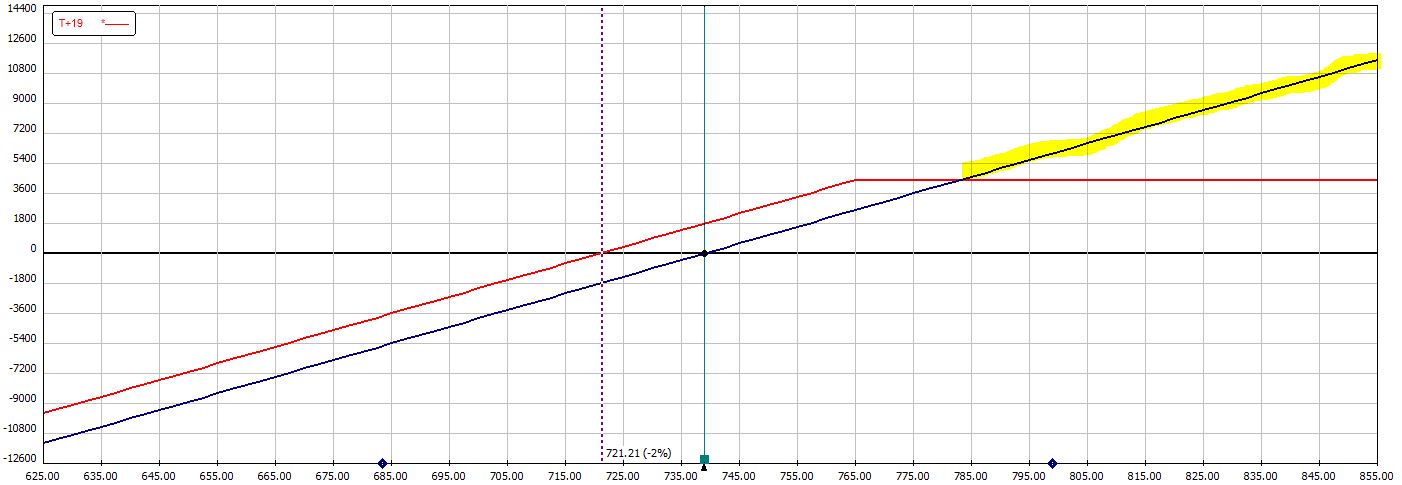
The yellow highlighting indicates that when the market races higher, the stock can outperform. The option position has limited upside potential whereas the stock has unlimited upside potential. This is a reason why many people like to buy stocks. For some it is like the lottery: people hope to see their shares double, triple in price—or more.
I could argue that options (e.g. long calls) also outperform stocks to the upside. Unfortunately, though, I cannot implement options in such a way to outperform in bearish, sideways, and mildly bullish conditions and also outperform in strongly bullish ones. And if I implement options to outperform in strongly bullish conditions then I would underperform were the market to trade slightly higher or sideways (although I would outperform were the market to move significantly lower).
I will wrap all this up in the next post.
Categories: Financial Literacy | Comments (0) | PermalinkOptions are Better than Stock (Part 2)
Posted by Mark on September 8, 2016 at 05:06 | Last modified: July 26, 2016 11:16As discussed in Part 1, I have taken a defensive posture on the stock versus options debate in the past. As seen in recent articles by Perry Kaufman and Craig Israelsen, today I am going to implement a more anecdotal approach. When studied this way, options very much seem like a better trading and investment vehicle than stock.
First, let’s revisit my comparison of long shares versus a covered call (CC) position from a 2013 blog post. The following graph plots the PnL of AAPL stock (blue line) and a CC position (purple line) 365 days after trade inception when the option expires. Stock dividends ($1,040) are included:
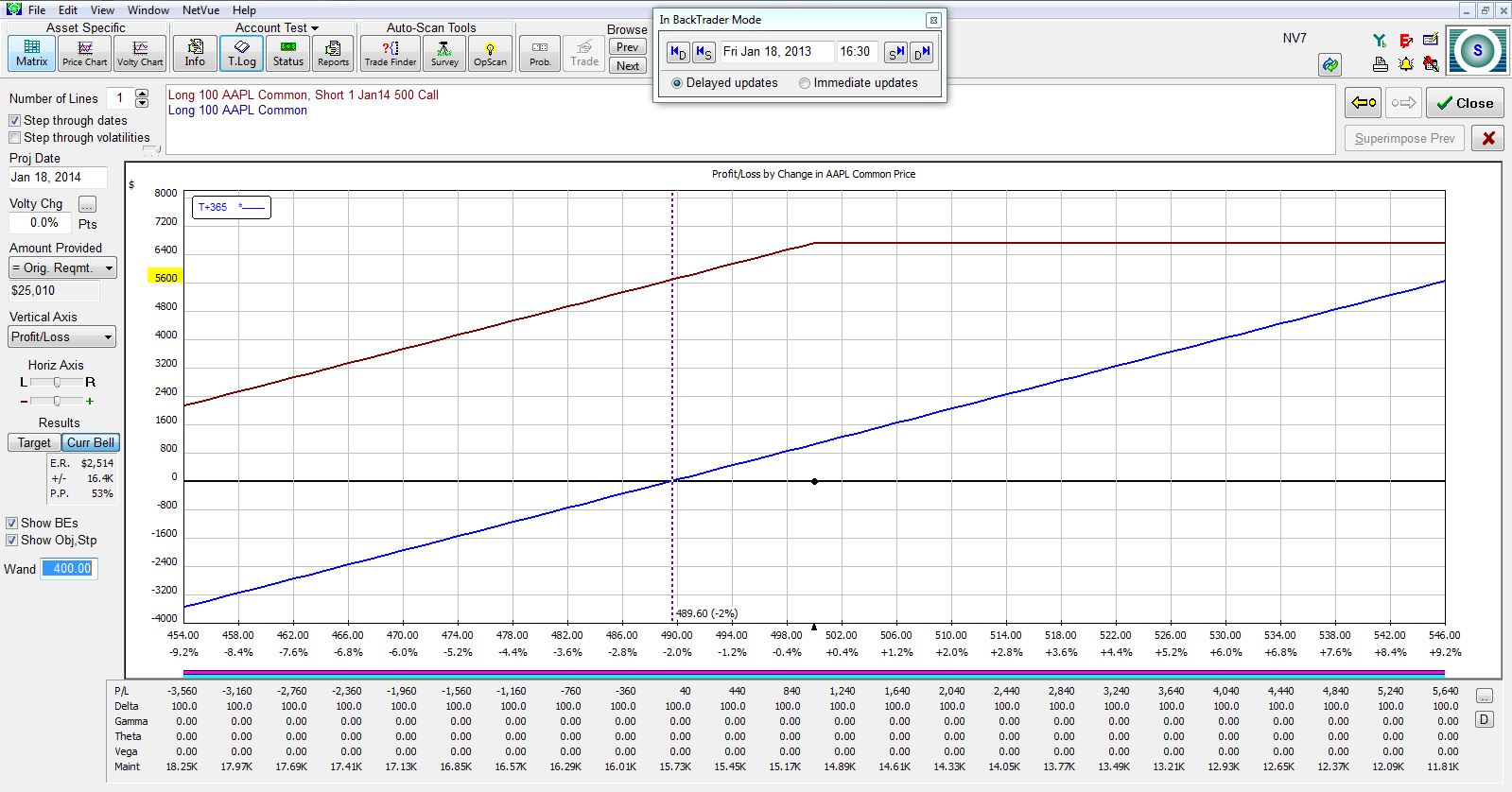
The vertical, dotted line shows breakeven for the stock position after 365 days if the stock price falls. At this zero profit level, the CC shows a profit of $5,600, which is the profit from selling the call at trade inception. The CC also outperforms farther to the downside and to the upside through an underlying price increase of over 10%.
Second, I refer to the common interpretation of risk as potential maximum loss. To compare these positions when the market falls, we can shift the graph to the right:
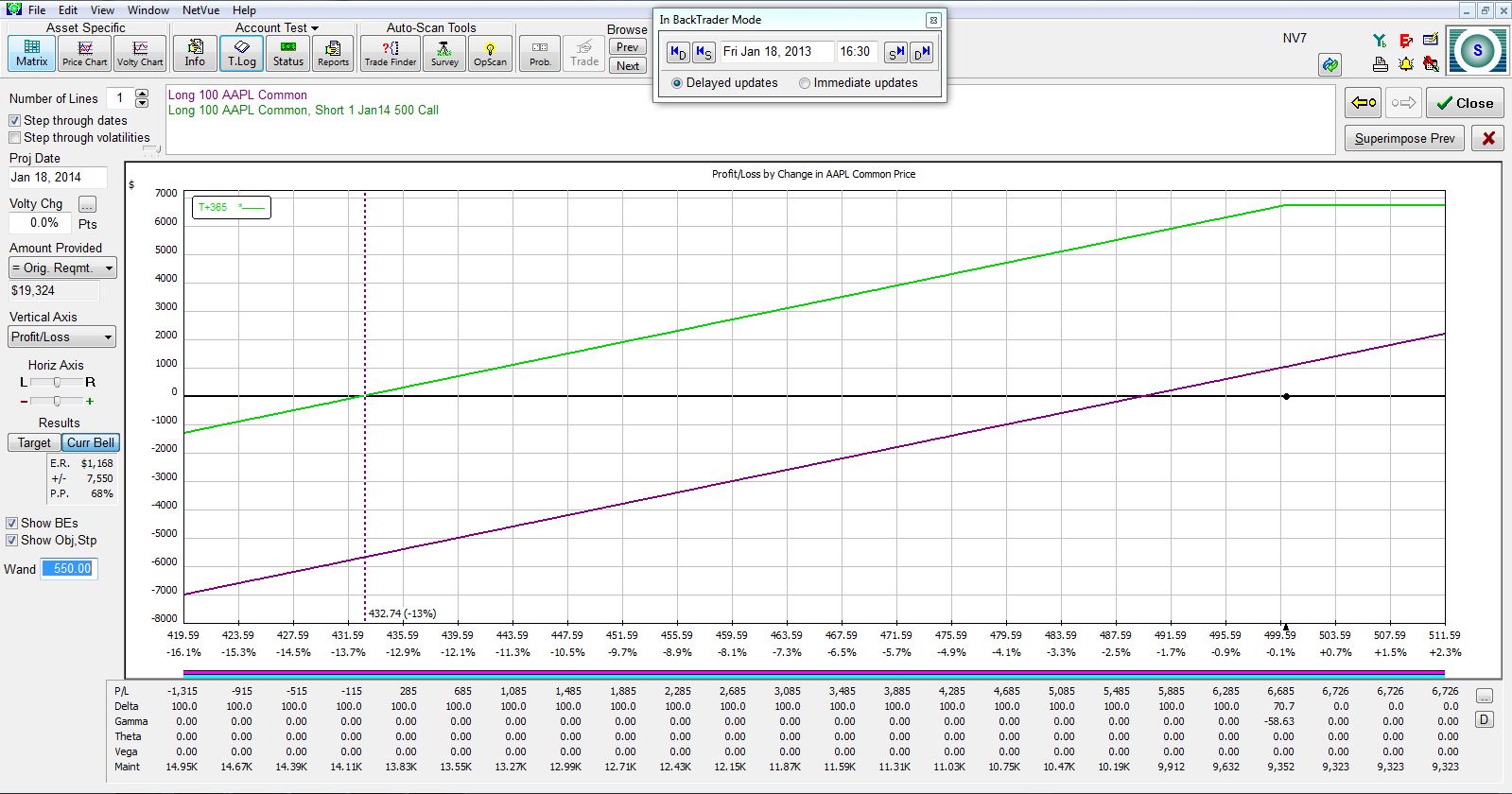
The CC outperforms by the $5,600 mentioned above and this difference persists to a stock price of zero because the CC owner collects that non-refundable premium at trade inception.
Third, although a CC includes long stock, derivatives theory dictates that a CC is synthetically equivalent to a naked put. I illustrated this with graphs shown here. This is not anecdotal: this is universal.
Taken together, the first three points above argue for option superiority over long stock when the latter trades up a little, sideways, or down.
My fourth piece of evidence is anecdotal study of risk as volatility of returns. I cited studies here and here suggesting that returns are similar between stock and option positions with volatility 33% lower using the latter. Furthermore, my preliminary backtesting has shown lower maximum drawdowns for the naked put positions relative to long stock.
I will continue discussion in the next post.
Categories: Financial Literacy | Comments (2) | PermalinkOptions are Better than Stock (Part 1)
Posted by Mark on September 6, 2016 at 06:09 | Last modified: July 24, 2016 12:22Options folk enjoy debate about things like which trading strategy is best and which adjustment is best. Almost unilaterally when I hear a discussion like this setting up, an immediate answer pops to mind: neither is better or worse—they each have their pros and cons. I feel options are a better vehicle to trade than underlying stock but because of my reluctance to proclaim superiority, I rarely communicate this to others.
In 2014, I made the case for options with a six-part blog series. In Part 1, I wrote:
> I actually believe that trading options is better than
> trading stocks or futures. This would be very, very
> difficult to prove, though. When it gets down to the
> trading system, whether discretionary or systematic,
> it would be extremely difficult to convince anyone
> that options are unequivocally better.
For this reason I took a defensive posture with option trading. I suggested the financial industry represents option trading as making a “deal with the devil.” I then attempted to inject reasonable doubt to weaken that claim. I explained why options are not “too risky” and I went on to offer some advantages of trading options.
In this blog series, I am taking a more aggressive approach: options are a superior investment/trading vehicle to stock. I will make the argument with covered calls/naked puts, which I have blogged about at length.
Pay close attention because the implications of option superiority are significant and wide-ranging. For starters, it may rarely be in one’s best interest to own long stock shares without a hedge. To the extreme, perhaps the vast majority of the financial industry as we know it (e.g. financial/investment advisers) is completely wrong.
Let’s take this one step at a time.
Categories: Financial Literacy | Comments (0) | PermalinkWhere Do I Start?
Posted by Mark on July 19, 2016 at 05:16 | Last modified: May 25, 2016 10:30The following question was posted in an investment group I follow:
> I was hoping someone might be kind enough to meet with
> me for dinner or drinks and show me the basics. I’m
> looking to get started investing but I have no idea where
> to start so it would be really great to get some advice.
Anyone who knows me would not be surprised to see me jump at the opportunity to talk about investing WHILE BEING TREATED TO DINNER AND DRINKS. Are you kidding me? I could talk about this stuff all day long for free and enjoy it. Dinner and drinks is just “icing” (figuratively, of course, since dessert does not seem to be included).
But then I got to thinking: what exactly is she asking for and does the question even make sense?
I know one thing: regardless of the teaching, any pupil may or may not make money in the markets. This theme runs extensively through my writings. In a recent post, for example, I quoted Garrett Baldwin who basically said consistent and accurate forecasting of future prices does not exist. For the same reason, nobody can guarantee profits.
This leads me to believe that education may be the only guarantee anyone can make in this space. I can teach her about stocks and investment vehicles: what they are, what it means to trade them, and how to trade them. I can teach her how to do the math to determine whether she is profitable. None of this guarantees she will make money, though: a singular fact that should be part of any introductory education.
For this reason, clarifying her question might be helpful. If she is looking for hints about my Holy Grail trading system or hoping to get me to spill my secret altogether over one too many beers then she will be disappointed. I think many people believe the Holy Grail does exist and finding it is just a matter of getting the proper education. If only it were that easy…
This is certainly not to say that education has no value. Some people search endlessly for the Holy Grail. They attend a plethora of investment seminars, buy “education” packages, and subscribe to black box trading systems. These are the people who never got the memo about the nonexistent Holy Grail and for them, this one lesson alone could have saved countless sums of time and money.
Categories: Financial Literacy | Comments (0) | PermalinkForecasting and Accountability
Posted by Mark on June 6, 2016 at 07:15 | Last modified: April 26, 2016 09:45From an article in the April 2016 Modern Trader magazine on oil price forecasting, Garrett Baldwin wrote:
> At the heart of it is the incapability of the human mind to wrap itself
> around the sheer size and factors that go into this global market. When
> something is this large with this many moving parts, we try valiantly to
> find shortcuts or justify one specific variable. Each day, a headline
> says that oil prices fell because of whatever factor an energy journalist
> can point to that day.
>
> It’s over-simplification at best, and malpractice at worst… And it’s
> clear that no one has a clue what oil prices will hit by the end of the
> year because of so many factors beyond our grasp. No one is suggesting
> that forecasting should be abolished, but history has shown that when
> it comes to accurately predicting oil prices, all bets are off. Are we
> willing to admit we’re just not good at this?
> …
> Right now, oil prices are hovering below $30 per barrel, a level that
> was deemed impossible just a few years ago. I remember sitting in a
> lecture with a prominent economics professor not long ago. He told
> the room that we wouldn’t see oil under $100 per barrel in our
> lifetime again. He somehow still has tenure.
>
> In the end, I still argue the real problem is that there is no
> accountability. People are allowed to make any prediction they want,
> and it is quickly lost in the 24-hour news cycle. When the prediction
> doesn’t come true, the blame falls on some unforeseen variable.
The article was on oil prices but it certainly is good information to know about financial forecasting in general. Baldwin’s words are consistent with those of Bob Veras in Doomsday Forecasting (a Primer): “nobody, including those who reported your alarmist views, will check up on your track record.” The lack of accountability allows anyone to forecast anything.
Personally, I believe the fault should not fall on the forecasters but rather on the readers who try to make use of the information. Forecasting is not actionable, period. That is why I categorized this post under “financial literacy.” Once I can identify content as a forecast, I can dismiss it and move on.
Categories: Financial Literacy | Comments (1) | PermalinkDay Trader Meetup Review (Part 2)
Posted by Mark on April 29, 2016 at 06:36 | Last modified: March 4, 2016 11:48Last time I praised the organizer of this new Meetup for being a humble, normal guy. Despite his best intentions, we were not spared from blind ego supplied by someone else in attendance.
Like Mr. Know-It-All and our friend DY, let me introduce you to WM. Before the meeting, he posted on the website, “Everyone should check out J M Hurst. He discovered how the market works by using electrical engineering math.”
The Meetup started with the organizer having everyone introduce themselves. WM began by taking 5-10 minutes to explain how Hurst has figured out the markets with his engineering math. He said this works for all markets including stocks, commodities, futures, and currencies: “if you analyze the data then you will see for yourself!”
Since my turn was next, I looked WM squarely in the eye and said “I tend to be skeptical so we will probably do some arguing later on.”
For 30 minutes out of the two hours, we did just that. I started by asking WM whether he is making good money with Hurst’s methods. He said no. I asked if WM’s level of sophistication is sufficient to understand the complex math behind Hurst’s methods. He said no. I asked if WM could reliably predict the future price move on some random charts by applying Hurst’s methods. He hemmed and hawed then failed at several attempts.
WM tried to defend himself by saying “I don’t understand Hurst’s teachings but I have no doubt that a group of us can combine our efforts and make great money.” My blood was boiling and I couldn’t help but raise my voice in talking to him because I felt he wasted so much of our time.
WM reminded me of entrepreneurs appearing on “Shark Tank” with outrageous valuations for their pre-revenue companies. Revenue is proof the product can sell. Without revenue there is little value. Unless WM had been successful making money the Hurst way, we have no reason to think anyone can. Why is he trying to sell it as the Holy Grail? How would he know?!
I am a fool destined for the poorhouse if I have blind faith in matters related to trading and investing.
Categories: Financial Literacy | Comments (1) | PermalinkAccuracy of the Expected Move (Part 2)
Posted by Mark on April 21, 2016 at 06:54 | Last modified: March 31, 2016 05:19I previously reprinted a post from a trading forum along with my response from last year.
The original poster says the ATM straddle is a poor estimate for the Expected Move. What irked me was that he provided no data to support this claim. Had he done a large number of trades? Had he studied it? In case he did, I asked in my response who had done the backtesting on it. He did not respond.
Tasty Trade offers a specific definition of Expected Move: 85% of the value of the front month at-the-money (ATM) straddle OR the arithmetic mean of ATM straddle and the nearest OTM strangle. How do they know that is what people expect, though? They really don’t and they really can’t. It’s not like they surveyed a large sample of people to find out what size move is expected.
A deeper understanding of options does offer some association between the name and the definition. The straddle/strangle will profit on a move in either direction greater than its original price. If traders, in general, think the move will be larger (smaller) than the cost of the straddle/strangle then they will buy (sell) it. The net result of these supply/demand pressures will be the price. Theoretically speaking, then, one could say it reflects what size move traders are expecting.
In the past, I heard more discussion about “implied move.” I have no reservations about the word implied. “Expected” is potentially a misnomer because it connotes some intelligence is explicitly regarding this as likely to happen. We don’t know why traders are buying or selling those options, though, or how many of them even have anything to do with the straddle/strangle itself: they may be components of different positions.
Going back to the top, whether the Expected Move has any predictive value is a completely different question that lends itself to backtesting. Tasty Trade has since done some backtesting to suggest the actual move is usually smaller than Expected. This would be an instance of “herd instinct” and why it might pay to be contrarian.
Categories: Financial Literacy | Comments (1) | PermalinkAccuracy of the Expected Move (Part 1)
Posted by Mark on April 18, 2016 at 07:19 | Last modified: March 23, 2016 08:51Last year, the following post appeared in a trading forum I follow:
> Using ATM straddles to estimate expected moves is
> very inaccurate, to say the least. I remember seeing
> this in some “beginner’s tips and shortcuts”
> resources years ago.
>
> For those interested in a more accurate, but still a
> quick-and-dirty estimation:
> https://www.tastytrade.com/tt/learn/expected-move
>
> You could always go more advanced and use a tool
> like Hoadley’s and GARCH(1,1) model. Or just use TOS
> IV numbers and Analyze tab to keep it simple.
I responded with the following:
> I don’t mean to sound critical but I think you
> bring up a couple good points worthy of
> discussion.
>
> Who knows how good either ATM straddles or
> any other formula is to estimate expected moves?
> In other words, who has done the research to
> study it?
>
> I’m guessing there are traders who have
> backtested this. I am not aware of backtesting
> data targeted for the public domain before
> Tasty Trade (TT). TT studies actual vs.
> expected moves all the time. I’m not sure if
> they’ve looked at ATM straddles vs. any other
> approach (like average of ATM straddle and one
> strike OTM strangle), though.
>
> A separate question from what is a good estimate
> is what is the expected move? The answer to
> this is whatever “most people” (or the “loudest
> talking heads”) regard as the expected move.
> In most cases, I think this is terminology that
> many people throw around casually without
> precisely defining. In most cases too, I think
> most people hear the term and think they
> understand even though they probably don’t
> because the definitions aren’t given.
>
> There’s a lot of crap in the Financial
> [trading/education] space that is neither
> actionable nor reliable. I believe we’re
> even bombarded with such information in
> this forum. That’s not to say forums like this
> aren’t worth reading though. Between the
> cracks, people do offer up some really good
> ideas every now and then.
I will conclude next time with a bit more commentary on this subject.
Categories: Financial Literacy | Comments (1) | PermalinkState of Mind (Part 3)
Posted by Mark on March 14, 2016 at 07:31 | Last modified: February 6, 2016 10:50I could definitely use a research team with whom to work. Aside from cash, do I have anything to offer them in return?
I could never pay someone to do research for me. I don’t feel I’m at the point where I can hire employees and even if I had some, I don’t know the payoff would justify the cost. Besides, it would be hard to pay someone to do backtesting for me. I might hire a statistical guru to help me analyze results but that is something different altogether.
In exchange for helping me with research, I could teach fundamentals of trading but never a guaranteed system or strategy. I don’t believe I have such a guaranteed trading system, for one. Also, as I have been discussing, I don’t think it makes sense to teach or sell someone a discretionary trading strategy since it will fail at some point if it hasn’t already. I would say the same thing about a systematic trading system because I believe those break too.
How little it seems I have to show for working so hard over the last eight years to master this craft!?
Probably more than anything else, I feel I know a lot about what I don’t know, which I believe is requisite for success. I hardly believe I am the only person who got into trading with belief in the hype of making 6% or more per month. I think aiming for returns like that would cause me to go bust pretty quick.
Maybe this is simply an affirmation of the old maxim “if it seems too good to be true then it probably is.” The slippery slope is how we define “too good.” That’s one place I might be able to help.
Categories: Financial Literacy | Comments (0) | PermalinkOn Discretionary Trading (Part 3)
Posted by Mark on March 8, 2016 at 06:49 | Last modified: February 2, 2016 06:55A recent option trading Meetup frustrated me immensely because of discretionary trading and the Lemming Effect.
I wrote about this group previously and described the source of my frustration named DY. According to another member, DY “loves to hear himself talk.” He says “I have nobody else to talk options with.” He doesn’t talk options with us either—he lectures. The last Meetup featured a financial adviser presenting on covered call investing. DY eventually took over the show by telling us that he:
- was approached by a publisher to write a book on options
- trades options on NFLX simply because he has already made so much money on it
- does 15-20 trades per week
DY then started talking about his short-term weekly trades. The organizer fell prey to the Lemming Effect and redirected her attention. Over the next 10 minutes, she asked DY a series of questions about his trading strategy and how he does it.
I think most discretionary traders are profitable for a variable amount of time [until they aren’t] and they usually represent as if they “get it.” Outsiders perceive them as experts and try to learn the discretionary trading approach. In most cases, I believe the strategy will eventually fail and leave the lemmings locked out on the cold doorstep.
I can either work to emulate another trading approach or I can work to learn about trading system development and develop my own system. If I do the latter then I can at least see what’s coming, have context for what to expect, and make tweaks when needed. If I copy someone else then I have no context and maybe only their claims about historical performance. When it stops working I am lost since my “teacher” may be gone or have moved onto something else entirely.
Regardless of how any individual trades and what validation steps have [not] gone into developing that approach, I believe people should first learn about option theory and fundamentals. After that, people should understand the philosophy and steps behind trading system development. This involves education about critical thinking and statistical analysis.
Categories: Financial Literacy | Comments (0) | Permalink