Weekly Iron Condor Trade #3
Posted by Mark on July 15, 2015 at 07:13 | Last modified: July 16, 2015 11:18On June 17, 2015, I placed my third weekly iron condor (IC) trade. I placed this order $0.025 better than the midprice at 10:56 and caved $0.05 after one minute (filled at the then mark).
The market traded up over the next few days but then pulled back, which allowed the trade to expire worthless.
This position made 5.4% in eight trading days.
Categories: Accountability | Comments (0) | PermalinkWeekly Iron Condor Trade #2
Posted by Mark on July 13, 2015 at 06:57 | Last modified: July 16, 2015 11:09On June 10, 2015, I placed my second weekly iron condor (IC) trade. I placed this order at the midprice at 10:52 and caved $0.05 after two minutes (filled $0.075 better than the mark).
The market traded relatively sideways over the next nine trading days and this trade expired worthless.
This position made 5.4% in eight trading days.
Categories: Accountability | Comments (0) | PermalinkWeekly Iron Condor Trade #1 (Part 2)
Posted by Mark on July 10, 2015 at 06:33 | Last modified: July 2, 2015 10:12I previously described my trading plan for a new weekly iron condor (IC) strategy. I also explained how the put vertical was closed for a loss on June 5, which was the first time I attempted the strategy. I threw the challenge flag and after further review, THE CALL ON THE FIELD WAS REVERSED!
I can assure you that does not happen too often.
Unfortunately while I lived to see another day, the contingent order to close was again triggered at 1:30 PM on Monday. This order was based on a spread midprice > $1.70. Once I received e-mail notification for the trade just a couple minutes later, I logged into my account only to see a mark of $1.20 for the spread and the order filled at $1.15.
What?!
I had a second challenge flag ready to throw.
I called my brokerage and spoke with another trading desk representative. He said he has seen the bid/ask spreads widen dramatically for just a few moments on numerous occasions. For this reason he advised me to never set a contingent order based on spread price. I protested, saying this would make sense during the first 15 minutes of the day when chaos abounds (Friday’s occurrence). This should never happen in a relatively calm period like we were having on Monday. I once again asked for time and sales to see what the spread price was at the time this order was triggered.
I saw the report. This time, the call on the field was confirmed.
The customer service rep suggested rather than entering a contingent order based on spread price, I should calculate how low or high the market would need to move to cause the spread to hit max loss. I could then set alerts so I would know something needed to be done.
This trade lost 2.3% (based on gross margin) in 10 days.
Categories: Accountability | Comments (0) | PermalinkWeekly Iron Condor Trade #1 (Part 1)
Posted by Mark on July 7, 2015 at 05:53 | Last modified: July 2, 2015 10:00On June 3, 2015, I did my first weekly iron condor (IC) trade. The idea is to sell the 4-legged beast with 8-10 days to expiration around a 0.05 delta. I want to collect $0.40 per vertical spread.
My primary exit is to let the trade expire.
The only adjustment on this position is to close the distressed 15-point vertical if its premium reaches two times the credit generated by the whole trade. If I collect $0.40 per vertical spread then I will close either side if it reaches $1.60.
In theory, this is a high probability trade. If I sell a 0.07 (aggressive approximation) delta then the probability of touching is 28%. For calculation purposes, I will consider “touching” to be a loss but in reality I think the chance of losing is greater since I don’t believe touching is required to hit max loss. To account for that, I will consider a loss to be two times the average win.
Based on these assumptions, expectancy would be:
(0.80 * 0.72) + (-1.60 * 0.28) = 0.128
Since there is overlap of two trades on Wednesday through Friday, the weekly ROI is 0.417% on 30 points gross margin. This is 22.19% annualized.
If I were always able to close the losing vertical spread for 2x then my theoretical loss on the trade would only be $0.80 instead of $1.60. This would double the projected annualized return. I am taking a wait-and-see approach until I see how often it actually loses.
I will set a contingent limit order to close when a vertical spread reaches $1.60.
Given this trading plan, on June 3, 2015, I placed a JunWk2 2180/2165/2035/2020 IC for $0.85 credit.
At 9:35 on June 5, my contingent order to close the put spread fired. I called the trade desk and contested this trade because from what I could see, the spread was nowhere near the trigger price. I requested the time and sales report to verify. They could not get me this by EOD (customer service rep said the quotes provider “blew him off” despite repeated requests to get the information) so he told me to resell the spread. I did this after market close and the brokerage reimbursed me the difference.
Weekly IC trade #1 lived on…
Categories: Accountability | Comments (1) | PermalinkRUT Weekly Calendar Trade #10
Posted by Mark on July 2, 2015 at 06:28 | Last modified: July 2, 2015 08:51I opened my tenth weekly calendar trade Tuesday, June 16, at the 1260 strike. The market was 1261.61 at the time of fill. I placed the order at the mid and caved $0.10 over 16 minutes to get filled $0.15 off the then mark.
Two days later with the market just over 1280, I rolled one of the 1260 put calendars to a 1285 call calendar for a $0.20 debit. Later that day with the market at 1285, I rolled the other 1260 calendar to 1285 for a $0.65 debit. This would be my last adjustment for the position, which was now down 12%.
In two days, I had basically closed the initial trade and reopened another 25 points higher. For this trade to turn out well, the market pretty much had to stay calm for days.
On Tuesday, June 23, the position was down 3% and just a couple points away from the upper expiration breakeven. To have a chance at a profitable outcome, I figured I would have to hold into the last two days. As I have done previously in this case, I closed one of the calendars to decrease risk in case Wednesday were to welcome me with a big gap opening.
The market traded lower on Wednesday and my contingent order to close was triggered at 1:32 PM with the market at 1285. This position made about 10% in nine days.
Categories: Accountability | Comments (0) | PermalinkRUT Weekly Calendar Trade #9
Posted by Mark on June 19, 2015 at 06:40 | Last modified: June 17, 2015 11:47I opened my ninth weekly calendar trade Tuesday, June 9, at the 1250 strike. The market was at 1249 upon fill. I placed the order $0.05 off the midprice and caved another nickel after one minute. I got filled $0.05 off the then mark.
On the very next day, the market zoomed higher. I rolled one calendar to a 1275 call calendar with the market at 1268. The trade seemed to be down 15% in short order but the trade was now centered.
The market then traded sideways. My contingent order to close was triggered around 1:00 PM on Tuesday, June 16. This trade made about 12% in eight days.
Categories: Accountability | Comments (0) | PermalinkRUT Weekly Calendar Trade #8
Posted by Mark on June 10, 2015 at 07:05 | Last modified: June 10, 2015 10:19I opened my eighth weekly calendar trade Tuesday, June 2, at the 1250 strike. The market was at 1251 upon fill. I placed the order at the mid and got filled immediately.
Here was the market price action during this trade:
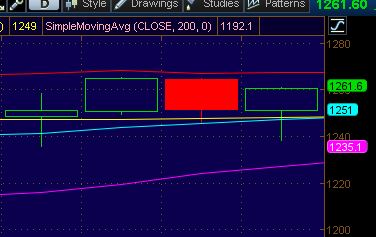
With the market moving sideways, this position was like manna from heaven. I closed the position Friday morning. This trade made ~10% in four trading days.
Thus far, eight trades have seen me profit on six and lose on two. My average return is +0.57%, which is better than losing!
Categories: Accountability | Comments (0) | PermalinkRUT Weekly Calendar Trade #7 (Part 2)
Posted by Mark on June 8, 2015 at 05:44 | Last modified: June 10, 2015 09:43I have been reviewing my JunWk1 calendar trade. Having made two adjustments and holding into the day of trading, how did this turn out?
Let me point out one key detail about holding this trade into expiration Thursday: my risk was significantly lowered. The last trading day is exceedingly dangerous for a trade like this because negative gamma can increase exponentially. In looking at the risk graph, I thought I could achieve my 10% profit target with just one calendar in place. I therefore closed the second put calendar rather than rolling it. This halved my gamma and were the market to make a huge gap move to put the calendar at max loss, I would have already closed one of the calendars for a reasonable price.
On expiration Thursday, my contingent order to close was triggered around 11:10. This position gained 10% in nine days.
This trade demonstrated some important points about profit target calculation. I will talk about that in my next post.
Categories: Accountability | Comments (1) | PermalinkRUT Weekly Calendar Trade #7 (Part 1)
Posted by Mark on June 5, 2015 at 06:18 | Last modified: June 5, 2015 12:35I opened my seventh weekly calendar trade Tuesday, May 26, at the 1240 strike. I placed the order at the mid and caved $0.25 over six minutes to get filled.
The market bottomed out at 1233 before moving sharply higher on Wednesday. At that time I rolled one 1240 calendar to a 1260 call calendar. I placed this order $0.90 over the midprice and was filled one minute later $0.39 off the then mark.
This was horrible execution and quite honestly, I’m still not sure how best to handle it. With trades like these, I’m looking at a 4-legged beast on my brokerage platform with the bid and ask straddling zero. The way it gets displayed, I sometimes have trouble calculating the midprice and determining an initial limit order.
At the close, this position was centered but down about 15%. Let’s look at some EOD risk graphs starting with 5/27:
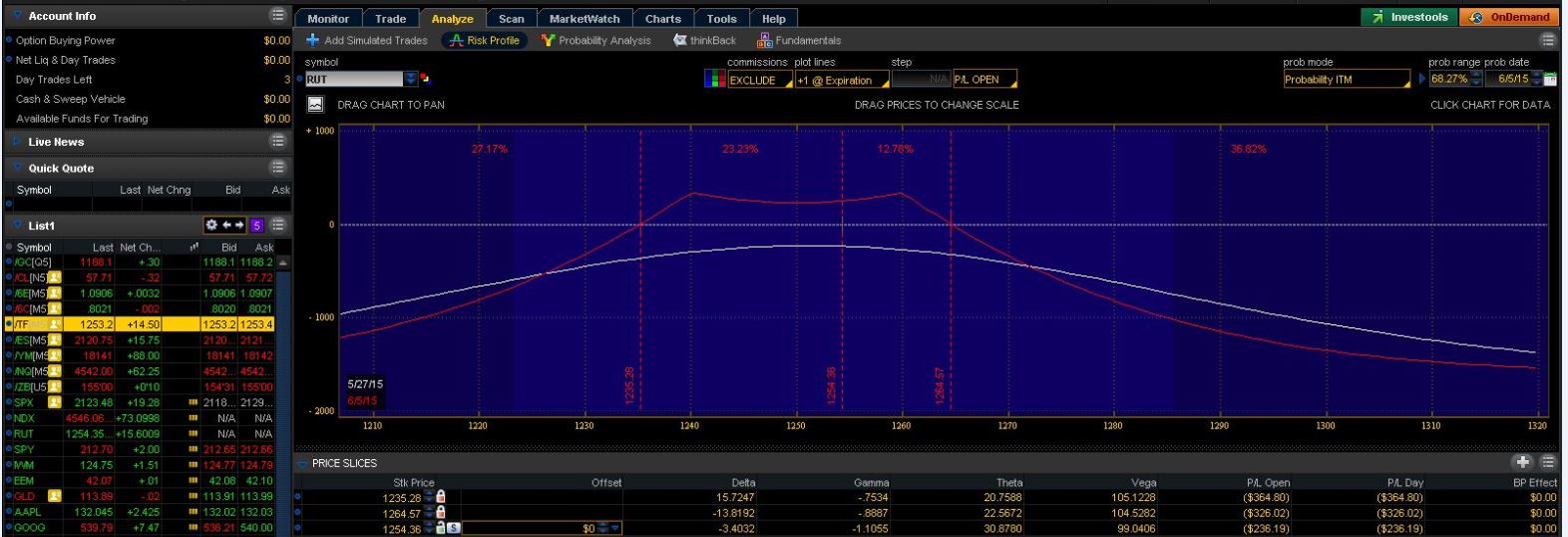
Trade down about $236. On 5/28:
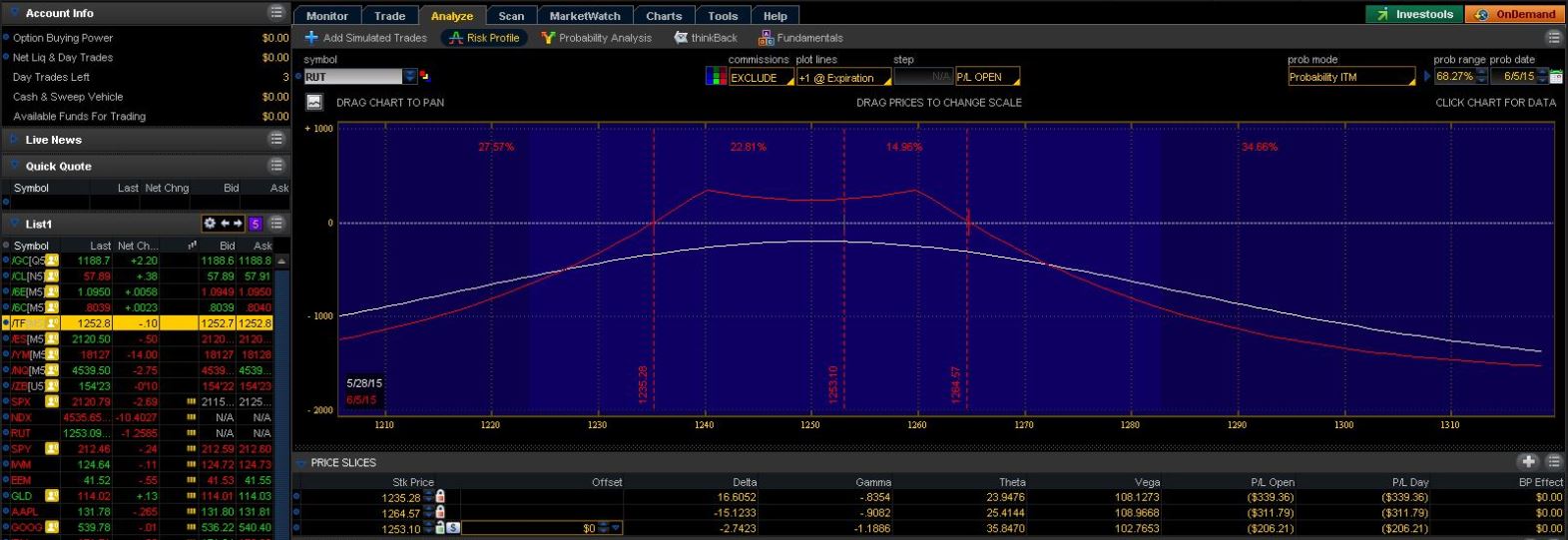
Trade down about $206. On 5/29:
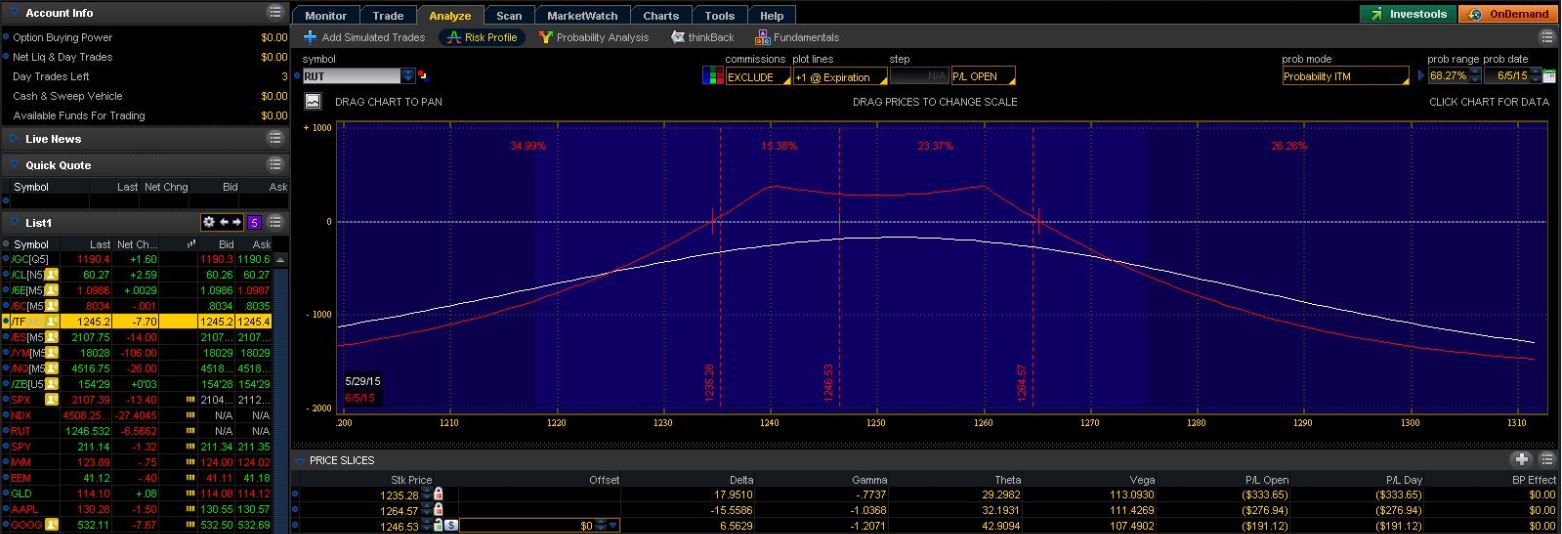
Trade down about $191. On 6/1:
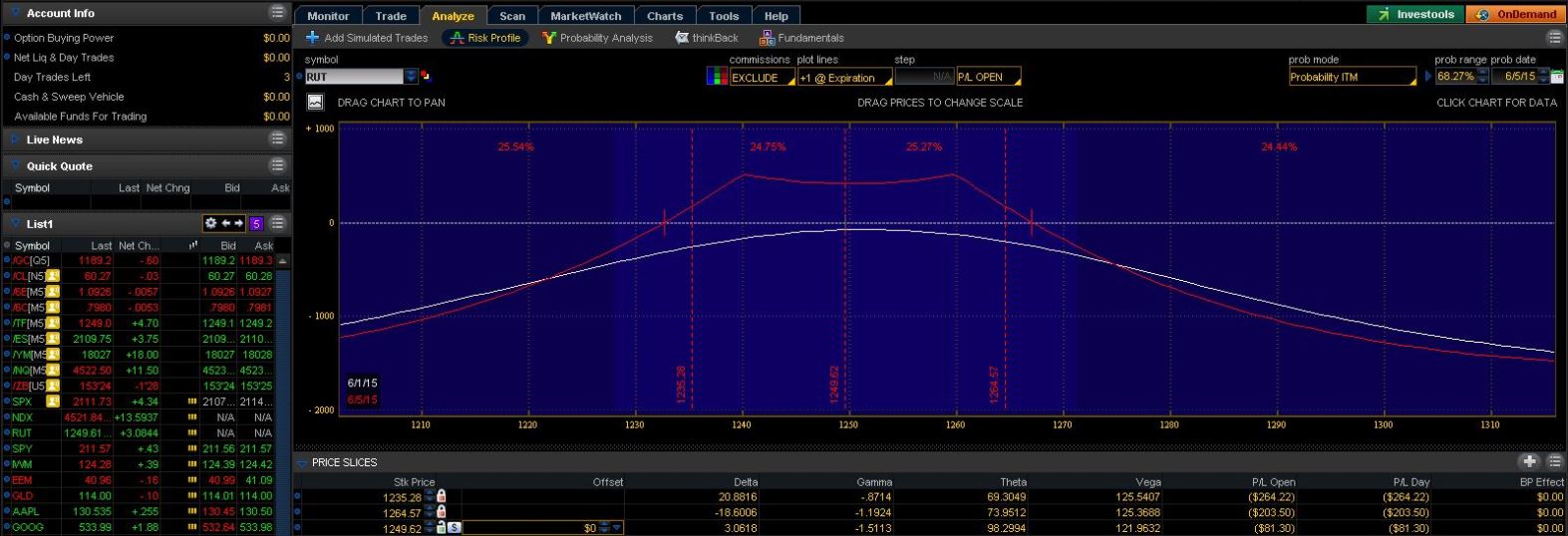
Trade down about $81. On 6/2:
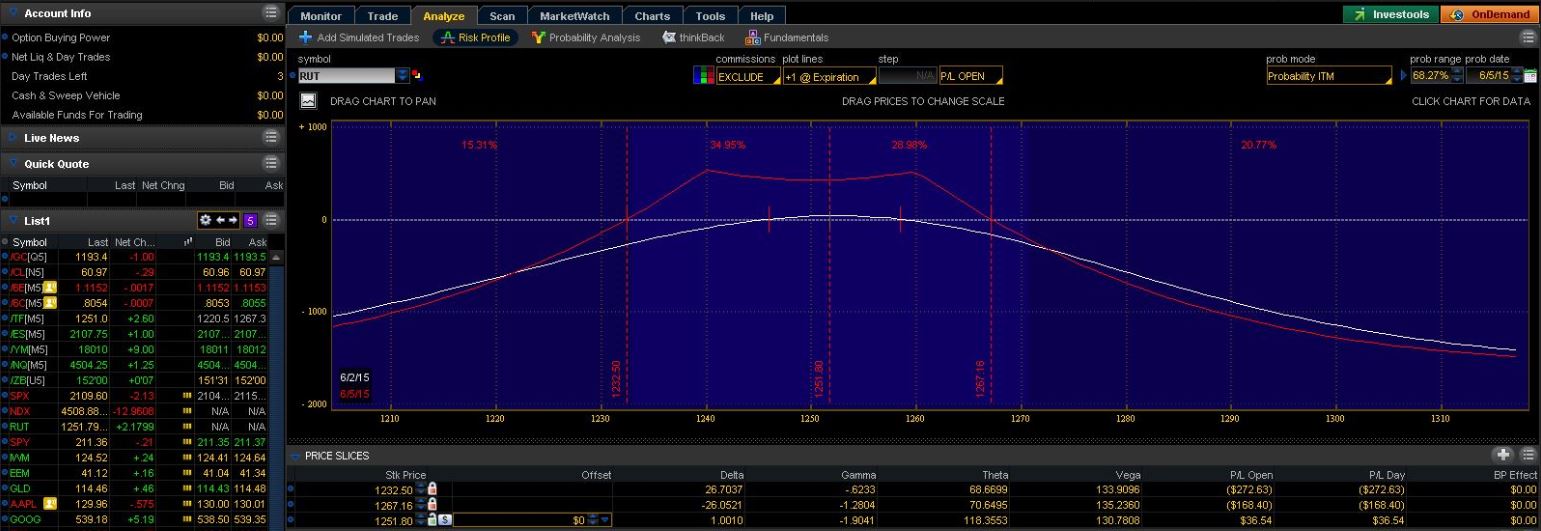
Trade up about $36.
The market rallied on 6/3 and hit my upper strike. By the time I closed the put calendar, the market was at 1261.43 (yet more slippage!). This seemed to be a very late adjustment being Wednesday of expiration week. Two trades ago, I debated whether this weekly calendar should be held into Thursday at all. Consequent to that discussion, I decided I really had no experience with this yet so I should be willing to try it a few times if necessary to see what happens.
At EOD of 6/3:
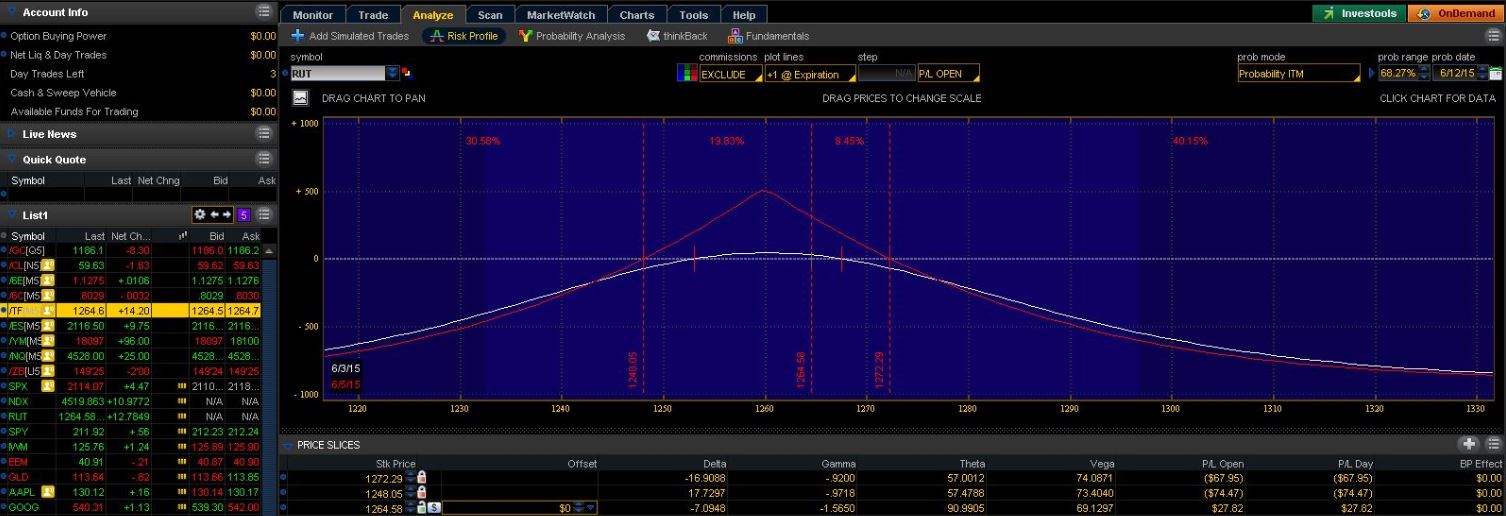
Trade up about $27.
Thursday would be the last day of trading before expiration. Like Game 7 of a Stanley Cup Playoffs series, the drama builds. For all the marbles:
I’ll show you what happened in my next post.
Categories: Accountability | Comments (1) | PermalinkRUT Weekly Calendar Trade #6
Posted by Mark on May 26, 2015 at 07:30 | Last modified: June 5, 2015 08:54I opened my sixth weekly calendar trade Tuesday, May 19, at the 1255 strike. The market was right around 1255 upon fill. I placed the order at the mid and caved $0.10 over 10 minutes to get filled.
Here was the price action during this pre-Memorial Day week:
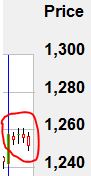
With the market trading sideways, this position was like manna from heaven. I closed the trade Friday morning. The market only gained two points in three days and the trade profited 8.5%.
I believe the long holiday weekend gave this trade an advantage. With the market to be closed the following Monday, I anticipated Friday to see nearly four days of time decay rather than three. I consider this difference to be significant since the trade is only placed with 10 DTE.
Categories: Accountability | Comments (0) | Permalink