VRT Stock Study (2-19-26)
Posted by Mark on August 5, 2025 at 07:01 | Last modified: February 19, 2026 11:07I recently did a stock study on Vertiv Holdings Co. (VRT, $243.21).
M* writes:
> Vertiv has roots tracing back to 1946 when its founder, Ralph Liebert,
> developed an air-cooling system for mainframe data rooms. As computers
> started making their way into commercial applications in 1965, Liebert
> developed one of the first computer room air conditioning, or CRAC,
> units, enabling the precise control of temperature and humidity. The
> firm has slowly expanded its data center portfolio through internal
> product development and the acquisition of thermal and power
> management products like condensers, busways, and switches. Vertiv
> has global operations today; its products can be found in data
> centers in most regions throughout the world.
Since 2018, this large-size company is all over the place [M* states it went public in 2020 despite price bars showing on the BetterInvesting® website for the two years prior]. Sales are positive since first recording any in 2020. EPS crosses zero four times, however. To sufficiently clean up the chart, I have to exclude 2017-2022 leaving a brief 3-year data history. Over that time, sales and EPS grow at annualized rates of 22.1% and 69.3%, respectively, with lines up, mostly straight, and parallel. Value Line (VL) gives Earnings Predictability score of 30 and Stock Price Stability score of only 10.
VRT is #6 on the “Top 40 Stocks Purchased by Investment Clubs” [in the past month] stock screen as of 2/10/26 (nod to the BetterInvesting® Weekly Update email). Personally, I do not think the stock passes visual inspection and would move on. M* writes, “spending on data centers has become more volatile and less predictable. Estimating Vertiv’s growth is therefore a highly erroneous exercise.” It also writes, “Vertiv’s financial history is somewhat limited given that it has changed ownership a number of times between public and private entities.” In case so many clubs are onto something here, I will proceed with the study. To be safe, perhaps give only speculative consideration for this stock with non-core position sizing.
Since 2023, PTPM leads industry averages while increasing from 7.8% to 17.0% (’25). ROE increases from 26.5% to 37.2% (’25). Debt-to-Capital decreases from 60.8% to 45.0% (’25). Three years seems very brief and too short for meaningful peers/industry comparison.
Quick Ratio is 1.12 and Interest Coverage is 21.2 per M* who assigns “Narrow” Economic Moat and gives a B grade for Financial Health (per BetterInvesting® website). VL rates the company B++ for Financial Strength.
With regard to sales growth:
- YF gives YOY ACE 46.1% and 28.9% [both percentages equal to below] for ’26 and ’27 (based on 22 analysts).
- Zacks gives YOY ACE 34.0% and 24.0% for ’26 and ’27, respectively (8 analysts).
- VL projects 11.8% annualized growth from ’24-’29.
- CFRA projects 32.8% YOY and 28.3% per year for ’26 and ’25-’27, respectively.
- M* offers a 2-year ACE of 25.9% and projects 16.6% per year from ’25-’30 (Equity Report).
I am forecasting below the range at 11.0% per year.
With regard to EPS growth:
- MarketWatch projects 39.3% and 34.2% per year for ’25-’27 and ’25-’28, respectively (based on 27 analysts).
- Nasdaq.com gives ACE 23.3% and 24.1%/year for ’26-’28 and ’26-’29 [7 / 8 / 1 analyst(s) for ’26 / ’28 / ’29].
- Seeking Alpha projects 4-year annualized growth of 32.2%.
- Finviz gives ACE 5-year annualized growth of 33.4% (9).
- LSEG estimates LTG at 31.4%.
- YF gives YOY ACE 46.1% and 28.9% for ’26 and ’27, respectively (22) [something seems amiss as both equal to above].
- Zacks gives YOY ACE 46.9% and 30.2% for ’26 and ’27 (7) along with 5-year annualized growth of 31.0%.
- VL projects 40.5% annualized from ’24-’29 (most recent report is Dec ’25, however, and 2025 full-year earnings have since been announced. I will use VL’s $4.10 estimate for 2025 to get 14.3% instead).
- CFRA projects 43.8% YOY and 39.3% per year for ’26 and ’25-’27 along with 3-year CAGR of 28.0%.
- M* gives long-term ACE of 26.1% and projects 16.2% from ’25-’30 in Equity Report (using ’29 would give 29.4% but I am using the lesser).
My 14.0% forecast is below the long-term-estimate range (mean of seven: 26.4%). Initial value is ’25 EPS of $3.41/share.
My Forecast High P/E is 40.0. Over past three years, high P/E is 42.2, 114, and 59.4. The last-3-year mean average P/E is 46.0. I am just below the range.
My Forecast Low P/E is 15.0. Over past three years, low P/E is 10.0, 34.6, and 15.7. I am forecasting just below the median.
My Low Stock Price Forecast (LSPF) is $60.00. Default ($51.20) based on initial value from above seems unreasonably low at 78.9% less than the previous close but only 4.5% less than the 52-week low. My [arbitrary] selection is 75.3% less than the previous close and 11.9% greater than the 52-week low. My effective Forecast Low P/E is therefore $60.0 / $3.41 = 17.6.
Over the past three years, Payout Ratio (PR) is 2.1%, 8.8%, and 5.1%. I am forecasting below the range at 2.0%.
These inputs land VRT in the SELL zone with a U/D ratio of 0.1. Total Annualized Return (TAR) is 1.6%.
PAR (using Forecast Average—not High—P/E) of -5.7% is unthinkable as an investment candidate. If a healthy margin of safety (MOS) anchors this study, then I can proceed based on TAR but even that is far below the risk-free rate (T-bills).
To assess MOS, I compare my inputs with those of Member Sentiment (MS). Based on 114 studies done in the past 90 days (65 outliers including mine excluded), averages (lower of mean/median) for projected sales growth, projected EPS growth, Forecast High P/E, Forecast Low P/E, and PR are 17.8%, 25.0%, 59.9, 31.1, and 4.7% respectively. I am lower across the board. VL [M*] projects a future average annual P/E of 32.0 [20.7 and 27.4 in ’29 and ’30, respectively] that is less than MS (40.5) and greater than mine (effectively 28.8).
MS high / low EPS are $7.13 / $2.65 versus my $6.57 / $3.41 (per share). My high EPS is less due to a lower growth rate. VL [M*] high EPS of $7.00 [$8.88 for ’30] is in the middle [soars above both].
MS LSPF of $87.30 implies a Forecast Low P/E of 32.9 versus the above-stated 31.1. MS LSPF is 5.9% greater than the default $2.65/share * 31.1 = $82.42 that results in more aggressive zoning. MS LSPF is a whopping 45.5% greater than mine.
MOS is robust in the study because my inputs are near or below historical/analyst/MS averages/ranges. Also backing this assessment are MS TAR exceeding mine by a gaudy 17.4% per year and a much greater LSPF.
With regard to valuation, PEG is 1.3 and 4.5 per Zacks and my projected P/E: diametrically opposed. I find it interesting that both Zacks and M* (0.8) do not find the stock overvalued although in a different section M* has it at two stars and overvalued by 32%. Based on a mere 3-year history, Relative Value [(current P/E) / 5-year-mean average P/E] is extremely high at 1.55. “Quick and Dirty DCF” calculates stock overvalued by ~28%.
This is a volatile stock with an inconsistent track record and unpredictable service/product demand as suggested by M*. I do believe lower quality can be offset by larger MOS, however, and this study has it.
Per U/D, VRT is a BUY under ~$110/share. BetterInvesting® TAR criterion would be met [262.8 / ((14.77 / 100 ) +1 ) ^ 5]
~ $132 given a forecast high price ~$263.
A 90-day free trial to BetterInvesting® may be secured here (also see link under “Pages” section at top right of this page).
Categories: BetterInvesting® | Comments (0) | PermalinkV Stock Study (2-17-26)
Posted by Mark on July 31, 2025 at 07:27 | Last modified: February 17, 2026 10:09I recently did a stock study on Visa Inc. (V, $314.08). Previous studies are here and here.
M* writes:
> Visa is the largest payment processor in the world. In fiscal 2025, it
> processed almost $17 trillion in total volume. Visa operates in over
> 200 countries and processes transactions in over 160 currencies. Its
> systems are capable of processing over 65,000 transactions per second.
Over the past decade, this large-size company has grown sales and EPS at annualized rates of 10.6% and 16.7%, respectively [FY ends Sep 30]. Lines are mostly up, straight, and parallel except for sales+EPS dip in ’20. Shares outstanding decrease 24.1% (3.0% per year). Value Line (VL) gives an Earnings Predictability score of 95.
Over the past decade, PTPM leads peer and industry averages while increasing from 53.1% to 60.5% (’25) with last-5-year mean of 64.0%. ROE trails peer and industry averages despite increasing from 17.6% to 52.2% (’25) with last-5-year mean of 44.5%. Debt-to-Capital is far less than peer and industry averages despite increasing from 32.5% to 39.9% (’25) with last-5-year mean of 36.7%.
Quick Ratio is 0.73 and Interest Coverage is 42.1 per M* who assigns “Wide” Economic Moat, rates the company “Standard” for Capital Allocation, and gives an A grade for Financial Health (per BetterInvesting® website). VL rates the company A++ for Financial Strength and points out current cash on hand nearly covers long-term debt.
V is #3 on the “Top 40 Stocks Purchased by Investment Clubs” stock screen as of 2/10/26 (nod to the BetterInvesting® Weekly Update email).
With regard to sales:
- YF gives YOY ACE 12.0% and 13.1% [both percentages equal to below] for ’26 and ’27 (based on 34 analysts).
- Zacks gives YOY ACE 11.3% and 10.2% for ’26 and ’27, respectively (13 analysts).
- VL projects 7.8% annualized growth from ’25-’29.
- CFRA projects 2.0% YOY and 11.1% per year for ’26 and ’25-’27, respectively.
- M* offers a 2-year ACE of 10.8% and projects 10.5% per year from ’25-’30 (Equity Report).
I am forecasting below the range at 7.0% per year.
With regard to EPS:
- MarketWatch projects 12.3% and 12.5% per year for ’25-’27 and ’25-’28, respectively (based on 40 analysts).
- Nasdaq.com gives ACE 13.1% and 12.9%/year for ’26-’28 and ’26-’29 [17 / 9 / 1 analyst(s) for ’26 / ’28 / ’29].
- Seeking Alpha projects 4-year annualized growth of 13.1%.
- Finviz gives ACE 5-year annualized growth of 12.6% (8).
- LSEG estimates LTG at 13.1%.
- Argus projects 5-year annualized growth of 20.0%.
- YF gives YOY ACE 12.0% and 13.1% for ’26 and ’27, respectively (38) [something seems amiss as both equal to above].
- Zacks gives YOY ACE 11.9% and 13.3% for ’26 and ’27 (15) along with 5-year annualized growth of 13.6%.
- VL projects 7.7% annualized growth from ’25-’29.
- CFRA projects growth of 12.9% YOY and 13.1% per year for ’26 and ’25-’27 along with 3-year CAGR of 13.0%.
- M* gives long-term growth ACE of 14.2% and projects 13.1% from ’25-’30 in Equity Report.
My 8.0% forecast is near bottom of the long-term-estimate range (mean of eight: 13.4%). Initial value is ’25 EPS of $10.20/share instead of 2026 Q1 EPS $10.66 (TTM).
My Forecast High P/E is 30.0. Over the past 10 years, high P/E ranges from 30.1 in ’24 to 44.9 in ’21 with last-5-year mean of 35.2 and a last-5-year-mean average P/E of 30.4. I am below the range.
My Forecast Low P/E is 23.0. Over the past 10 years, low P/E ranges from 21.1 in ’23 to 31.8 in ’21 with last-5-year mean of 25.6. I am forecasting near bottom of the range (only ’23 is less).
My Low Stock Price Forecast (LSPF) of $234.60 is default based on initial value above. This is 25.3% less than the previous close and 21.5% less than the 52-week low.
Over the past 10 years, Payout Ratio (PR) ranges from 18.7% in ’18 to 24.5% in ’20 with a last-5-year mean of 22.1%. I am forecasting below the range at 18.0%.
These inputs land V in the HOLD zone with a U/D ratio of 1.7. Total Annualized Return (TAR) is 8.0%.
PAR (using Forecast Average—not High—P/E) of 5.5% is less than I seek from a large-size company. If a healthy margin of safety (MOS) anchors this study, then I can proceed based on TAR instead albeit still less than desired.
To assess MOS, I compare my inputs with those of Member Sentiment (MS). Based on 563 studies done in the past 90 days (191 outliers including mine excluded), averages (lower of mean/median) for projected sales growth, projected EPS growth, Forecast High P/E, Forecast Low P/E, and PR are 10.3%, 11.9%, 32.4, 24.8, and 21.9% respectively. I am lower across the board. VL [M*] projects a future average annual P/E of 28.0 [17.0, which once again seems unreasonably low] that is [much] less than MS (28.6) and greater [much less] than mine (26.5).
MS high / low EPS are $18.14 / $10.21 versus my $14.99 / $10.20 (per share). My high EPS is less due to a lower growth rate. VL [M*] high EPS of $15.45 [$17.70] is in the middle.
MS LSPF of $257.20 implies a Forecast Low P/E of 25.2 versus the above-stated 24.8. MS LSPF is 1.6% greater than the default $10.21/share * 24.8 = $253.21 that results in more aggressive zoning. MS LSPF is 9.6% greater than mine.
MOS is robust in the study because my inputs are near or below historical/analyst/MS averages/ranges. Also backing this assessment are MS TAR exceeding mine by 5.0% per year and a greater LSPF.
With regard to valuation, PEG is 1.8 and 3.4 per Zacks and my projected P/E: slightly overvalued (2.2 per M* for ’25). Relative Value [(current P/E) / 5-year-mean average P/E] is fair at 0.97. “Quick and Dirty DCF” has stock overvalued by 7.1%.
Per U/D, V is a BUY under ~$288/share. BetterInvesting® TAR criterion would be met [449.7 / ((14.27 / 100 ) +1 ) ^ 5]
~ $231 given a forecast high price ~$450.
A 90-day free trial to BetterInvesting® may be secured here (also see link under “Pages” section at top right of this page).
Categories: BetterInvesting® | Comments (0) | PermalinkAAPL Stock Study (2-15-26)
Posted by Mark on July 28, 2025 at 07:21 | Last modified: February 17, 2026 09:07I recently did a stock study on Apple Inc. (AAPL, $255.78).
M* writes:
> Apple is among the largest companies in the world, with a broad portfolio
> of hardware and software products targeted at consumers and businesses.
> Apple’s iPhone makes up a majority of the firm sales, and Apple’s other
> products like Mac, iPad, and Watch are designed around the iPhone as the
> focal point of an expansive software ecosystem. Apple has progressively
> worked to add new applications, like streaming video, subscription
> bundles, and augmented reality. The firm designs its own software and
> semiconductors while working with subcontractors like Foxconn and
> TSMC to build its products and chips. Slightly less than half of Apple’s
> sales come directly through its flagship stores, with a majority of
> sales coming indirectly through partnerships and distribution.
Over the past decade, this mega-size (> $100B annual revenue) company has grown sales and EPS at annualized rates of 8.2% and 16.1%, respectively [FY ends Sep 30]. Lines are mostly up, straight, and parallel except for sales dips in ’19 and ’23 and EPS dips in ’19 and ’24. Shares outstanding decrease 31.8% (4.2% per year). Five-year EPS R^2 is 0.72 and Value Line (VL) gives an Earnings Predictability score of 85.
Over the past decade, PTPM trails peer/industry [lines have identical morphology and practically overlay each other for all three metrics] averages while ranging from 24.4% in ’20 to 31.9% in ’25 with last-5-year mean of 30.7%. ROE also trails peer/industry averages despite increasing from 35.0% to 167% (’25) with last-5-year mean of 155% (far above industry standards due to aggressive share buyback program per GoogleAI). Debt-to-Capital is less than peer/industry averages despite increasing from 40.4% to 57.2% (’25) with last-5-year mean of 65.9%.
Quick Ratio is 0.85 and Interest Coverage N/A per M* who assigns “Wide” Economic Moat, gives an A grade for Financial Health (per BetterInvesting® website), and rates the company “Exemplary” for Capital Allocation [I’m surprised M* is complimentary of share buyback program because doing so over a long time horizon while having VL Price Growth Persistence score of 100 implies costly expense for much of it: something M* detests]. VL rates the company A+ for Financial Strength.
With Interest Coverage unspecified, Cash Coverage Ratio may be calculated as an alternative metric. For 2025, GoogleAI has (CF from Operations) / Total Debt = $111.48B / $98.65B = 1.13: company generates more cash in one year to theoretically pay down its entire debt load.
AAPL is #2 on the “Top 40 Stocks Purchased by Investment Clubs” stock screen as of 2/10/26 (nod to the BetterInvesting® Weekly Update email for alerting me).
With regard to sales growth:
- YF gives YOY ACE 13.8% and 9.5% [both percentages equal to below] for ’26 and ’27 (based on 37 analysts).
- Zacks gives YOY ACE 10.8% and 7.3% for ’26 and ’27, respectively (11 analysts).
- VL projects 6.3% annualized growth from ’25-’29.
- CFRA projects 11.6% YOY and 9.6% per year for ’26 and ’25-’27, respectively.
- M* offers a 2-year ACE of 8.3%. and projects 7.7% per year from ’25-’30 (Equity Report).
I am forecasting below the range at 6.0% per year.
With regard to EPS growth:
- MarketWatch projects 12.1% and 10.3% per year for ’25-’27 and ’25-’28, respectively (based on 51 analysts).
- Nasdaq.com gives ACE 2.6% and 13.8%/year for ’26-’28 and ’26-’29 [14 / 5 / 1 analyst(s) for ’26 / ’28 / ’29].
- Seeking Alpha projects 4-year annualized growth of 10.6%.
- Finviz gives ACE 5-year annualized growth of 11.2% (20).
- LSEG estimates LTG at 12.5%.
- Argus projects 5-year annualized growth of 13.0%.
- YF gives YOY ACE 13.8% and 9.5% for ’26 and ’27, respectively (38) [something likely amiss as both equal to above].
- Zacks gives YOY ACE 12.7% and 10.5% for ’26 and ’27 (13) along with 5-year annualized growth of 13.3%.
- VL projects 11.4% annualized growth from ’25-’29.
- CFRA projects growth of 14.6% YOY and 12.0% per year for ’26 and ’25-’27 along with 3-year CAGR of 10.0%.
- M* gives long-term growth ACE of 13.1% and projects 13.1% [puzzling duplication] from ’25-’30 in Equity Report.
My 10.0% forecast is below the long-term-estimate range (mean of eight: 12.3%). Initial value is ’25 EPS of $7.46/share instead of 2026 Q1 EPS $7.91 (TTM).
My Forecast High P/E is 27.0. Over the past 10 years, high P/E increases from 14.9 to 34.9 (’25) with last-5-year mean of 32.8 and a last-5-year-mean average P/E of 27.4. I am below the latter (and high P/E for each of last six years).
My Forecast Low P/E is 16.0. Over the past 10 years, low P/E increases from 10.8 to 22.7 (’25) with last-5-year mean of 22.0. I am forecasting below the last six years.
My Low Stock Price Forecast (LSPF) is $169.20. Default ($126.60) based on initial value above is unreasonably low at 50.5% less than the previous close and 25.2% less than the 52-week low. My (arbitrary) selection is the 52-week low itself: 33.8% less than the previous close.
Over the past 10 years, Payout Ratio (PR) has fallen from 26.2% to 13.7% (’25) with a last-5-year mean of 15.0%. I am forecasting below the range at 13.0%.
These inputs land AAPL in the HOLD zone with a U/D ratio of 0.8. Total Annualized Return (TAR) is 5.3%.
PAR (using Forecast Average—not High—P/E) of 0.8% is unthinkable as an investment candidate. If a healthy margin of safety (MOS) anchors this study, then I can proceed based on the 5.3% TAR albeit still lower than I seek for a mega-size company.
To assess MOS, I compare my inputs with those of Member Sentiment (MS). Based on 485 studies done in the past 90 days (159 outliers including mine excluded), averages (lower of mean/median) for projected sales growth, projected EPS growth, Forecast High P/E, Forecast Low P/E, and PR are 7.4%, 10.0%, 32.4, 21.9, and 15.0% respectively. I am equal on EPS growth and lower on the rest. VL [M*] projects a future average annual P/E of 31.0 [20.6] that is greater than MS (27.2) and greater [less] than mine (21.5).
MS high / low EPS are $12.28 / $7.30 versus my $12.01 / $7.46 (per share). VL [M*] high EPS of $11.50 [$12.39] is less [greater] than both.
MS LSPF of $169.20 implies a Forecast Low P/E of 23.2 versus the above-stated 21.9. MS LSPF is 5.8% greater than the default $7.30/share * 21.9 = $159.87 that results in more aggressive zoning. MS LSPF is equal to mine.
MOS is robust in the study because my inputs are near or below historical/analyst/MS averages/ranges. Also backing this assessment is MS TAR exceeding mine by 3.4% per year.
With regard to valuation, PEG is 2.3 and 2.9 per Zacks and my projected P/E: slightly overvalued (2.0 per M*). Relative Value [(current P/E) / 5-year-mean average P/E] is elevated at 1.18. “Quick and Dirty DCF” has stock undervalued by 11%.
Per U/D, AAPL is a BUY under $208/share. BetterInvesting® TAR criterion would be met [324.3 / ((14.37 / 100 ) +1 ) ^ 5]
~ $165 given a forecast high price ~$324.
A 90-day free trial to BetterInvesting® may be secured here (also see link under “Pages” section at top right of this page).
Categories: BetterInvesting® | Comments (0) | PermalinkIncident Report Aug 2024 (Part 2)
Posted by Mark on July 25, 2025 at 07:49 | Last modified: February 17, 2026 17:32I left off with reasons for encouragment in the midst of my August 2024 debacle. Also deserving of gratitude is the realization that even a return to making minimum theta can land me with a with decent YTD PnL despite a negative relative return.
Getting back to the meat of this incident report, when I look back I will see I could have escaped with no worse than a 10-15% drawdown rather than 25% or more. Better yet, I could have had my powder dry and ready to go instead of emotionally reeling and licking my wounds on the sidelines when Mr. Market chose to make a sudden reversal.
The following are indicators that I absolutely must monitor every single day (preferably in the form of a checklist):
- SD moves in the last five trading days: when we hit three then it’s time to do something.
- Spot VIX: when I see a solid close above the last several months then it’s time to do something.
- VIX term structure (as I have been doing): when it goes into backwardation then it’s time to do something. This may be too late for preliminary adjustments, though. Two grey areas worthy of future discussion include spot VIX rising into the term-structure range and partial backwardation.
- Daily ATR(14): when I see a move above the last few months then it’s time to do something.
- IV of option inventory: when any position increases 30-50% (relative not absolute), it may be time to do something. One caveat is the natural increase as expiration approaches making these positions okay to let expire if the underlying change (open) is positive. Otherwise don’t be shy: keep a clean kitchen and close the damn thing.
- NLV: be on notice when I see a bigger drop then I’ve seen in days. When I see the biggest weekly drop in the last few (several?) months then it’s time to say bye! Close positions or cut NPD and live to fight another day. Buying front-month protection for margin relief may be considered as an alternative to closing positions. If I am to close, perhaps managing winners and/or profitable contracts can be done first.
- When I feel myself hoping [not a financial strategy] for a market reversal, then it’s a huge red flag to get out.
As a final note, bonds created a new/different experience by limiting my cash balance. I may have BTC more on the Friday beforehand given additional buying power. Instead, I was forced to explore bond sales with less than one week to maturity [must phone brokerage directly for an institutional bid since this cannot be done online]. I could have done this within 30 minutes to get a bid but did not know or end up doing so.
In the future, look to raise cash at an earlier opportunity based on indicator(s) above to lessen risk to remaining balance should the hoping go awry [as it usually seems to do].
I do not monetize this blog and it is free for you to read. I can only imagine, though, how much this single post could be worth to traders of all experience levels…
Categories: Accountability | Comments (1) | PermalinkIncident Report Aug 2024 (Part 1)
Posted by Mark on July 22, 2025 at 06:54 | Last modified: February 16, 2026 16:24I have vowed to complete much unpublished content pertaining to catastrophic losses. I’m not talking general, theoretical terms like this mini-series defining what a catastrophic loss is, either.
I am talking about the detailed incident reports I aim to do after a horrendous drawdown in order to learn and prevent future recurrence. Unfortunately, the aftermath usually leaves me numb, paralyzed, and wanting to do ANYTHING BUT any sort of postmortem. I’d rather run and hide, bury my head in a pillow, and stay that way for a very long time. As discussed in these final three paragraphs, it’s demoralizing and depressing. Grief isn’t just for friends, family, loved ones, and pets. It’s for material and financial loss as well.
Today I will complete the first part of two such incident reports. The draft was written 10/9/24 about a recent losing incident. That would have been an acceptable delay except that I’m only finalizing it now: a full 18 months later. In any case, as you read keep in mind the writing is about an event two months earlier.
———————————
I’m sorry to report that August 2024 is my latest episode of catastrophic loss. August (perhaps starting mid-July? I’ll look back to see) has been ugliness in the making with VIX jumping from ~14 to 36 (65 intraday) at its worst point.
I meant to compose this entry the weekend of Aug 10, but I always seem to have trouble sitting down to document such bad news. Maybe it’s the impeding discussion of failure. The previous one was 2022 or 2023 and the delay was long. In this instance, enough time has passed such that I feel I know exactly what I’m going to write. I’ll be interested to compare this incident report with the last and I won’t be surprised if there are many overlaps. I had the plan then. I didn’t follow it. I still have the plan. I need to follow it. I can’t tolerate more sudden, extreme equity drops. It’s an emotional setback that takes a tremendous psychological toll. The current episode wiped almost six months of gains in very short order.
On the positive side, things could have been worse. I closed 25-33% of my total position on a Friday rather than waiting to see because the market was not yet fully into backwardation (surely other indicators were already firing, though). It’s important to acknowledge my own progress and celebrate the small wins. Another being my latest equity trough [hopefully] a stairstep higher than the previous meaning I did not give back all the gains. Despite still underperforming since the early part of 2019—which does not at all make for a good feeling—I should celebrate and take a victory lap.
I will continue next time.
Categories: Accountability, Option Trading | Comments (1) | PermalinkQuality and Fundamentals (Part 7)
Posted by Mark on July 17, 2025 at 07:30 | Last modified: February 12, 2026 11:15Hello end of the tunnel! Today I conclude my series on Quality vs. fundamentals and what matters most for the SSG.
Two big conclusions stated last time answer the questions I set out to explore. First, the difference between high-quality stocks and good fundamentals may only be magnitude of [sales / EPS] growth and/or management metrics (i.e. PTPM, ROE, and Debt-to-Capital). Second, stocks with good earnings predictability—historically up, straight, and parallel—are necessary for the SSG methodology.
The reason I couldn’t end with Part 6 was Neff’s inclusion of “solid forecasted earnings growth.” This may not meet the BetterInvesting® criteria for high-quality growth stocks (not to mention high-flying P/E’s), but it’s certainly not “very little growth” as mentioned in the penultimate paragraph.
My prompt for Google AI was “can value investing involve low-quality stocks?” As it turns out, this concept dates all the way back to Benjamin Graham.
While contemporary value investing often prioritizes [high-] quality growth at a reasonable price, original Graham principles include strategies for buying “low-quality” or distressed assets if the price is sufficiently low to provide a significant margin of safety [MOS in my stock studies]. This is known by some as “deep value [cigar butt] investing.”
The relationship between quality and value typically falls into two distinct categories. Deep value involves buying stock in companies that may be low-quality or even in “retrogression” if they trade below net current asset [liquidation] value. Here, investors disregard traditional quality metrics in favor of extreme price discounts. The other category includes turnaround situations. In this case, investors look to buy stock in companies of low quality due to temporary setbacks, poor management, or industry cycles with hopes of return to higher quality status.
The risk of value trap applies to both categories where a stock appearing cheap based on metrics like P/E or P/B is actually fairly priced due to its deteriorating business.
The following performance graph provided does not include statistical [inferential] analysis for significance or more than 11 recent years but it’s a start:
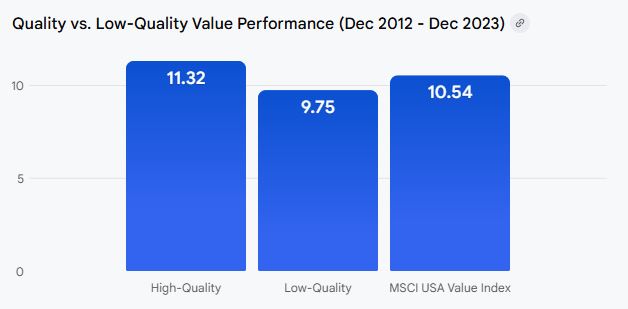
Although value investing with lower-quality stocks can provide return, the return may be lower and underperform benchmarks.
Different value investing philosophies treat “quality” differently:
- Traditional / modern value (Buffett / Munger) emphasizes high-quality companies with economic moats [competitive advantage] and eschews low-quality companies altogether.
- Graham’s defensive criteria recommend a minimum quality level such as S&P Earnings / Dividend Rating > B and at least 10 years of positive earnings.
- Deep value / contrarian specifically targets out-of-favor or distressed companies labeled by some as “junk.”
To help avoid value traps (permanently impaired low-quality stocks), heed these warning signs:
- Inconsistent profits in the form of frequent losses or “one-time” charges that recur.
- Companies with more debt than equity (or high Debt-to-Capital) are often considered lower quality and higher risk.
- “Cheap” prices in a dying / declining industry (e.g., legacy retail).
- Low share prices (especially < $5.00) can lead to reduced liquidity and higher volatility making recovery more difficult.
Onward and upward my fellow investors!
————————
A 90-day free trial to BetterInvesting® may be secured here (also see link under “Pages” section at top right of this page).
Quality and Fundamentals (Part 6)
Posted by Mark on July 14, 2025 at 07:28 | Last modified: February 10, 2026 11:24Now with a brighter light at end of the tunnel, let’s begin today by addressing the topic sentence from first paragraph Part 5.
The difference between high-quality [growth] stocks [numbered Learn to Earn criteria here and Manifest Investing criteria penultimate paragraph here] may only be magnitude of growth/sales and/or management metrics (i.e. PTPM, ROE, and Debt-to-Capital). Necessary for the SSG methodology are stocks with good earnings predictability: also known as R^2 and historically “up, straight, and parallel.”
Per my rebuttal in Part 1, I do not believe a company needs to be of high-quality in order to be a solid investment candidate.
In my view, much of the latter boils down to whether value investing is a viable approach. Performance numbers from Part 2 are supportive along with the new (Sep 2025) CEO of BetterInvesting® Wayne A. Thorp, CFA. Thorp has a long history of teaching and analyzing the value strategies found in John Neff on Investing (1999). In his previous AAII work, Thorp developed the video education series “Fundamental Stock Screen Strategies” detailing Neff’s methodology.
Thorp’s interpretation of Neff’s value approach emphasizes identifying stocks with specific fundamental characteristics:
- Low price-earnings (P/E) ratios
- Total Return ratio: (Estimated Earnings Growth + Dividend Yield) / (P/E). Neff seeks double the market average.
- Solid forecasted earnings growth
- Value investing is unfashionable, but Thorp points out Neff significantly outperforms S&P 500 over long periods.
While at AAII in Feb 2025 (also see “From the CEO” in Dec 2025 BetterInvesting® Magazine), Thorp published insights arguing that growth and value investing are not mutually exclusive in support of a “Growth at a Reasonable Price” mindset (GARP—term also used at BetterInvesting®). This curriculum is a core part of the AAII Essential Investing video course.
So whether “high-quality” (meeting the magnitude thresholds) or not, value can be successful. Google AI, Wayne Thorp, and John Neff (I just finished reading) all agree on this. Paul Merriman, of the Merriman Financial Education Foundation would also agree since he has done much work/advocacy for small-cap value.
Finally, value stocks may pose good entry diversification to high-quality growth stocks. I often see latter in the BUY zone only when the market has a pullback or following some company-specific bad news (even a rare poor/disappointing quarter or more). Value stocks are likely less impacted by bad news since they are soured upon already. I’ve seen cases where companies with very little growth hang out near or in the BUY zone for long periods of time waiting for a surprising upside catalyst.
I feel good about using the SSG methodology to study both high-quality growth and value stocks alike.
————————
A 90-day free trial to BetterInvesting® may be secured here (also see link under “Pages” section at top right of this page).
Quality and Fundamentals (Part 5)
Posted by Mark on July 11, 2025 at 11:35 | Last modified: February 9, 2026 14:57I continue today with my mini-series on the difference between high-quality stocks and solid fundamentals and what is necessary for the SSG methodology.
The second half of Part 4’s penultimate paragraph goes too far to imply that a history of consistent earnings [and/or sales since both ultimately go together] may actually be dangerous for picking good stocks. The bar chart suggests most companies have their day of reckoning but let’s remember the difference between concrete definition for Google AI and natural subjectivity inherent in the visual inspection. The first paragraph of my rebuttal mentions some stocks have data excluded to pass visual inspection [with many others being so inconsistent that even select omissions cannot save them]. Data exclusion is often due to nonrecurring items and makes good sense. Perhaps more importantly, over the course of 10 years many companies will have a slight YOY earnings dip(s) or more severe declines while still being “up, straight, and parallel” overall. The bar chart allows for none of this accomodation.
I also do believe some CEOs and management executives have the secret sauce when it comes to operating a company with consistent growth. Such laudable past performance likely continues into the future and a reckoning doesn’t mean an abrupt end to positive and consistently increasing numbers. The greatest stock market winners continue their runs for many years.
I think all of this is to say what matters most for the SSG methodology is historical consistency and the ability to pass visual inspection. We base studies on long-term growth estimates but for companies with low earnings predictability, the only confidence regarding said estimates is in their likelihood to be wrong and/or to fluctuate wildly over time.
To some degree, the SSG needs Quality [of which earnings predictability is a component] stocks but let’s realize magnitude is not part of the Part 3 discussion about consistently growing earnings. The door therefore remains open to value [low P/E] stocks as well as high-quality growth stocks [more likely to be high fliers].
And yes, companies can have good track records of growth and still be value stocks. They may be in mature or “unsexy” industries (e.g. utilities or consumer staples) that get overlooked. Given a long history of consistent [high] growth (earnings and dividends), they are [high-] quality value stocks due to a low P/E or P/B (book) relative to peers or the broader market. When a high-quality growth company has a temporary setback (e.g. bad earnings report, management change, out-of-favor industry) and suffers a stock correction, it may become a promising value play if the long-term growth story remains intact.
I will continue next time.
————————
A 90-day free trial to BetterInvesting® may be secured here (also see link under “Pages” section at top right of this page).
Quality and Fundamentals (Part 4)
Posted by Mark on July 8, 2025 at 07:31 | Last modified: February 8, 2026 12:17In Part 3, I revised the overriding question for this mini-series from whether quality and/or fundamentals are important for stock analysis and what the difference may be to what matters most for the stock study [guide, or SSG]?
Once answered, I can address the limitations of the SSG methodology itself. One thing I know already is that the methodology is not well-suited to stocks failing visual inspection.
Let’s go back to something else mentioned in Part 3: earnings predictability. This is one component to the Manifest Investing Quality rating. Value Line also gives an earnings predictability score for stocks covered in its Standard Edition. I have come to see earnings predictability as related to 5- and 10-year R^2 metrics.
The latter point suggests earnings predictabilty really caters to “up, straight, and parallel.” Financial wisdom dictates past performance does not guarantee future results but visual inspection says if a company has not been consistent (linear) in the past then we’re not giving it a chance to disappoint in the future. Only companies that have been consistent growers in the past are legitimate candidates for stock selection. This seems intuitive enough but does it really hold water?
The following bar chart from Google AI gets me concerned:
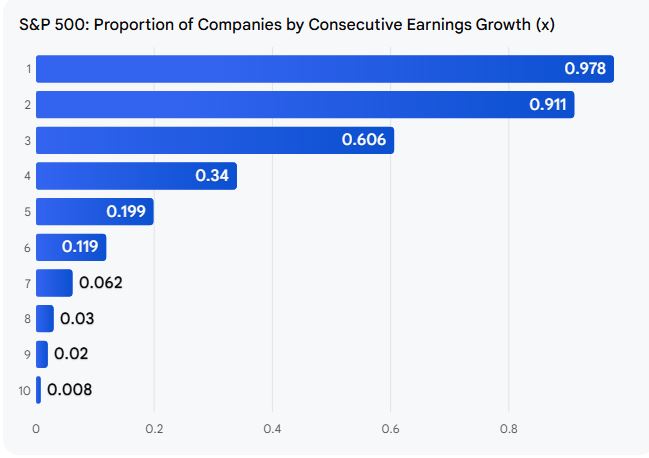
The number on the left (y-axis) is consecutive years of earnings growth. The chart shows that number inversely proportional to number (percentage) of S&P 500 companies. It therefore seems likely that the more consistent a company has been, the more likely it is to falter: the last thing we want because earnings decline often takes stock price with it.
The next big question is whether a faltering company is more likely to find its footing given a historical track record of consistent earnings growth. Once again, Google AI:
> Based on historical S&P 500 data, a company with a history of consistent
> earnings growth is slightly more likely to return to a path of consistent
> growth after an annual loss compared to companies without such a history.
> Specifically, companies with consistent past growth had a 58.3% probability
> of returning to consistent growth following a loss incident, while those
> without a consistent history had a 54.5% probability.
I am a bit skeptical for a few reasons. First, I don’t know if “history of consistent earnings growth” matches my concept. Also, it was unable to give me sample sizes for the 58.3% and 54.5% [I was hoping] nor was it able to give me a p-value on the difference [I did not expect]. Not seeing a larger difference may somewhat call into question the concept of quality management: a team with the secret sauce able to maintain the earnings consistency we seek. Certainly we wouldn’t want to be cherry-picking companies benefiting from random chance.
I will continue next time.
————————
A 90-day free trial to BetterInvesting® may be secured here (also see link under “Pages” section at top right of this page).
Quality and Fundamentals (Part 3)
Posted by Mark on July 3, 2025 at 07:34 | Last modified: February 6, 2026 16:48The question being addressed in this mini-series is whether quality and/or fundamentals are important for stock analysis and what the difference may be between them.
I left off with mention of value stocks: an exception to the high-quality growth stock variety. Value stocks can and do show sales+EPS growth that is more tempered than the latter and akin to larger, mature companies that fall short of the Part 2 criteria (9% / 10% / 10%).
Academics have done much research to suggest value investing may be superior to growth investing over ultra-long time horizons. As of early 2026 per Google AI, value wins over 50, 60, 70, and 80 years ~11.4% (all percentages annualized) to ~10.6%, ~11.3% to ~10.1%, ~11.9% to ~10.3%, and ~12.4% to ~10.5%, respectively. Research by Fama and French suggests that since 1927, value has outperformed growth by an average of 4.4%.
More recently, however, growth has outperformed. Growth wins over the last 5, 10, 20, and 30 years ~15.2% to ~11.9%, ~14.6% to ~9.2%, ~11.4% to ~8.1%, and ~11.8% to ~9.5%, respectively. That Fama and French paper (“Value versus Growth: the International Evidence”) was published in 1998.
Most recently, value is bouncing back. Since late October 2025 (roughly 14 weeks), value has outperformed growth (Russell indices) by a [non-annualized] total of 14%.
Thanks to Google AI for doing the research but at best [worst] I regard these numbers and conclusions as approximate [patently false]. To be more confident, I would need to know exactly what indices or data sets were used in the calculations to ensure validity of the comparison (and check for survivorship bias among other things). I would also want to see inferential statistics to know if differences between percentages are likely fluke or more indicative of practical significance.
The BetterInvesting® preference for high-quality growth (as opposed to low-P/E value stocks) backs the criticism of my EOG study discussed in Part 1 and the Learn to Earn presentation in Part 2. Manifest Investing also focuses on the same. They target stocks with double-digit (especially over 12-13%) sales growth and higher Quality. Their Quality rating—designed to identify sustainable, low-risk, and consistent growth firms—measures financial strength, management effectiveness, and earnings predictability. Management effectiveness involves improving earnings growth over time, consistent/increasing ROE, and acceptable/decreasing Debt-to-Capital.
Before delving forward next time into earnings predictability, let me dissect one point of confusion from the first paragraph. I think Manifest Investing (and one-half of this year’s Learn to Earn tandem) would say high-quality growth stocks are stocks with good fundamentals. With regard to the Quality rating, do I think a stock with good fundamentals can fail to be high quality? Yes. Do I think a stock with a high Quality rating can fail to have good fundamentals? Not so much. I will therefore continue to treat them differently with this question outstanding: what matters most for the stock study [guide, or SSG]?
————————
A 90-day free trial to BetterInvesting® may be secured here (also see link under “Pages” section at top right of this page).