Posted by Mark on March 25, 2013 at 01:01 | Last modified: July 25, 2013 12:05
Yesterday I mentioned that all trader/investor meetups in my area have been organized by people with commercial interests.
In this regard, a “Meet & Greet/Business Card Exchange” (see here) would be useful for the organizer because every attendee is a potential new customer. While it sounds like fun people and good cheer, the event threatens to distract me from the real focus unless it provides something more. At the risk of sounding repetitive, my real focus pertains to the laborious work mentioned here. Mr. Market doesn’t give one iota about networking or good cheer. It’s actually a little-known secret that Mr. Market will eagerly take my money if I mistake too much good cheer for a means to consistent profit.
Can I find someone able to help me become a better trader through this networking event?
The deck is already stacked against me in finding other traders with whom to work (see here). This particular event was a joint production of Power Trader Investment Group (PTIG) and Metro Detroit Business Networking Group (MDBNG). Only two people RSVP’d from the former and one of these was the organizer (of both groups). Recall that I already attended a PTIG meetup (as described here), which provided little more than yummy chocolate chip cookies. The organizer runs a subscription web site. If he were interested in anything more than my business then he would be have been trying to get inside my head like everyone does (and vice versa) to find out what I know about trading rather than simply representing himself as a professional guru. This leaves just one RSVP from PTIG: a beginner I already met.
I believe any serious traders involved in MDBNG would be involved in PTIG. Why waste time associating with a variety of entrepreneurs when you could associate specifically with traders? Since PTIG didn’t help me and MDBNG probably lacks traders, I estimated the potential utility of this Meet & Greet as slim-to-none.
Categories: optionScam.com | | Permalink
Posted by Mark on March 21, 2013 at 05:31 | Last modified: July 25, 2013 12:04
As you may recall from Part 1, this thread was inspired by an invitation to a “Meet & Greet/Business Card Exchange” through the Power Traders Investment Group (PTIG). Part 5 summarized my take on the laborious effort required to become a successful trader over the long-term. I do not believe participation in the former qualifies as part of the latter.
In Part 1, I mentioned that for many years, meetups have been used by IBD as a marketing tool. I believe the main goal of all trader/investor meetups to be sales and marketing rather than helping me to become a better trader.
I recently attended a meetup of the PTIG that provided no actionable trade ideas and no new networking contacts. I met a handful of new people who were beginners or hobby traders but no other full-time traders. We analyzed some charts and talked some technical analysis but everything was evident only in retrospect or subject to curve-fitting (i.e. fallacy of the well-chosen example). To be fair, we did not go around the room and have everyone share their leading trade idea(s). We were not asked. All discussion was led by the organizer: a kind gentleman who provided cookies, veggies, dip, and who runs a subscription trading web site. By his own admission, he has recently become interested in “internet marketing:” a subject I hope to revisit later.
All trader/investment Meetup groups in my area have some for-profit bias. Michigan Options Traders is a Meetup group organized and sponsored by a company that promotes itself as “the stock idea network.” Michigan Market Traders is a Meetup group organized and sponsored by a trader education program. The Detroit Area Day Traders Meetup Group was organized by “an independent Registered Investment Advisor offering a diverse blend of quantitative investment strategies.”
I will continue the discussion tomorrow.
Categories: optionScam.com | | Permalink
Posted by Mark on March 20, 2013 at 05:13 | Last modified: July 25, 2013 12:02
Parts 2 and 3 of this series included thoughts and experiences of an advanced option student on the road to full-time trading. I was somewhat appalled in reading them and you can see my response here.
I went on to cite Malcolm Gladwell’s book Outliers and the “10,000-hour rule.” This is consistent with my experience of working 50-60 hours per week over the first four years.
Trading for a living requires a tireless devotion toward learning the craft. One does not become a pharmacist, a physician, or a lawyer overnight. Any professional discipline requires years of study. Human greed makes it difficult to ignore the plethora of advertisements offering fool’s gold like “great money investing that takes just a couple hours per week.” This is optionScam.com. It’s not going to happen. It’s not reality. If you fall for the sales pitch then you can expect to lose money in the pursuit each and every time.
Learning how to trade is easily stated and hard to do. Follow the suggestions given here. Do hundreds of backtested and paper trades. Execute tens upon hundreds of small, live trades. Monitor these trades. Analyze them. Think hard about how they are working and what leads to different outcomes. Think about generalities and apply tenets of System Development as I have discussed in numerous blog posts. When you see something, is it curve-fit and specific to that trade or is it robust and applicable to different types of environments?
Do all this and you will have your hands full. I can guarantee that you won’t be thinking about other things to occupy your time or about how to be perceived as busy (absurdly suggested here). Your brain will hurt many times over from analyzing and studying everything there is to know and putting yourself in a good position to succeed over the long-term.
Tomorrow I will return to the beginning.
Categories: optionScam.com | | Permalink
Posted by Mark on March 15, 2013 at 07:50 | Last modified: July 25, 2013 12:01
I recently came across a thread in an option education forum where a beginning student asked for thoughts and experiences of full-time traders. He wanted to know how to bridge the gap from traditional job to trading as a business. You can read the response of an advanced student here and here.
After reading this response, I followed-up with some feedback of my own:
> I have to say that I was rather shocked to read your post. Here’s a very
> important question: are you looking to trade for a living or to trade as a
> hobby?
>
> In my opinion when you graduate, you are ready to start trading real
> money in small size. You will not be ready to trade large or come
> anywhere close to replacing a full-time income. In order to do that,
> you need to do *many* live trades. You should also spend generous
> time backtesting in order to see how trades work and how they may
> be adjusted. While not as valuable as live trades because your
> emotions won’t be involved, I believe backtesting is extremely
> valuable when done properly and a practical way to augment your
> trading experience.
>
> Backtesting, paper trading, and live trading in small size can easily
> take full-time devotion–and by this I do mean at least 40 hours per
> week. This says nothing for additional study/learning about other
> topics like technical analysis, stocks and futures, trading system
> development, money management… this list could go on.
>
> No insult intended but if you don’t feel you have enough to fill
> your time then I believe you just aren’t working hard enough. In
> my opinion, the thousands of hours many traders spend tracking
> trades is the only portal to trading for a living.
>
> If you want to trade as a hobby and make some small change here
> and there then it’s another story altogether.
Categories: optionScam.com | | Permalink
Posted by Mark on March 12, 2013 at 07:21 | Last modified: July 25, 2013 11:59
This blog mini-series was inspired by an invitation I received to a “Meet & Greet/Business Card Exchange” extended to traders. My last post introduced some thoughts and experiences of an advanced student directed toward a beginning student in an option education program. Please review the contents here.
His response concluded as follows:
> We can easily live on my wife income alone but her family sees me not working and
> staying at home. They ask about me. We have decided not to tell them about my
> learning to trade options. It could be opening a can of worms. It stresses her out.
>
> I have thought about finding a job to keep myself busy and to look good to the
> family but I don’t want to get back into my old profession of telecom… they bleed
> you dry. I would be frustrated and not be able to apply myself to trading as I am
> now. I have even thought about applying to an Edward Jones or Merrill Lynch
> but I don’t think that I will do anything at these places other than get on the
> phone or hit the streets to bring in clients rather than learning to trade.
> I have even thought about selling cars at a dealership just to keep busy.
>
> I wish I could find a job that could supplement my learning to trade options,
> but not hinder my current trading.
>
> Hence, the other side of the fence is not as green as you might think.
Rarely do I read something in a forum and feel inspired to follow-up publicly. I certainly did in this case, though.
I will give my response in the next post.
Categories: optionScam.com | | Permalink
Posted by Mark on March 7, 2013 at 02:50 | Last modified: July 25, 2013 11:58
This blog mini-series was inspired by an invitation I received for a “Meet & Greet/Business Card Exchange” (see here). The issue I want to address is whether or not this can make me a better option trader.
I recently came across a thread in a trading forum inquiring about full-time trading as a business. The original poster was a beginning student of the option education program hoping one day to quit his full-time job and trade for a living. The following response (slightly edited for clarity) is from an advanced student in the program:
> I am in the position that you want. I am on the other side of the fence where from your
> point of view the grass looks like a lush green field.
>
> My wife is involved with her family business and is bringing home the bacon while I am
> learning to trade. When I first started with the curriculum, I was able to apply myself
> full-time. Now that I am [near graduation]… I am concentrating on my paper trading
> and applying different trade strategies… I am trading my paper account as if it were
> real money…
>
> It’s a little harder now to apply myself full-time to trading…. 40 hours/week is a lot of
> time to allocate to trading. My trades are chugging along and I am keeping up with my
> due diligence.
>
> When I first started, my wife would ask what I was doing. I told her about the classes
> I was taking. I was busy. When my wife asks now, I tell her everything is going fine
> but she can sense that I am not as busy as I used to be.
>
> My wife also asks, “When will you start trading real money?”
>
>”Soon,” I say.
I will post the rest of this response tomorrow.
Categories: optionScam.com | | Permalink
Posted by Mark on March 4, 2013 at 04:58 | Last modified: July 25, 2013 11:41
After one week away on an awe-inspiring vacation to the Caribbean, I opened my e-mail to the subject line “Join 81 Power Traders at ‘Meet & Greet/ Business Card Exchange.'” Such is the inspiration for this blogging mini-series. In the posts that follow, I will discuss numerous concepts in hopes that at the end of the road, everything will converge on a few robust ideas that constitute optionScam.com.
I will begin by introducing meetups. As stated on its web site:
> Meetup is the world’s largest network of local groups. Meetup makes it easy for
> anyone to organize a local group or find one of the thousands already meeting up
> face-to-face. More than 9,000 groups get together in local communities each day,
> each one with the goal of improving themselves or their communities.
The “Meet & Greet” invitation arrived courtesy of Power Traders Investment Group: a meetup to which I currently belong. I first learned about Meetup.com years ago through Investors Business Daily, which has devoted resources to marketing itself through a network of local meetups in different cities across the country (emphasis mine; please remember the exact wording).
One reason [stock/option] trading is a very difficult proposition is the social isolation traders often experience. This originally made the prospect of networking with other traders through [Meetup] groups very promising. Until 2007, I practiced as a pharmacist, which never offered any time for a dull moment. Suddenly with full-time trading, I had nary a wayward sound in my physical space to distract me from the computer screen.
Five years later, I now find the prospect of [Meetup] groups more aligned with optionScam.com. In my next post I will begin to explain why.
Categories: optionScam.com | | Permalink
Posted by Mark on February 26, 2013 at 05:24 | Last modified: July 25, 2013 11:40
As mentioned here, I was 29 posts behind my twice-weekly goal on September 8 of last year. With the exception of a couple weeks at the beginning of January, I have pretty much posted every trading day since. As of today, I am roughly 14 posts ahead of schedule.
With a target length of 300 words per post, I will aim to post twice weekly going forward. This blog keeps me on track with my goals and is a way to keep me accountable in lieu of a manager or supervisor that I used to have in my corporate days as a pharmacist.
Categories: Accountability | | Permalink
Posted by Mark on February 25, 2013 at 06:01 | Last modified: February 13, 2013 05:19
In http://www.optionfanatic.com/2013/02/21/2012-performance-evaluation-part-9/, I disclosed a third flaw in my preceding analysis showing potential utility for a LF.
The corrected equity curves and performance results are shown below:
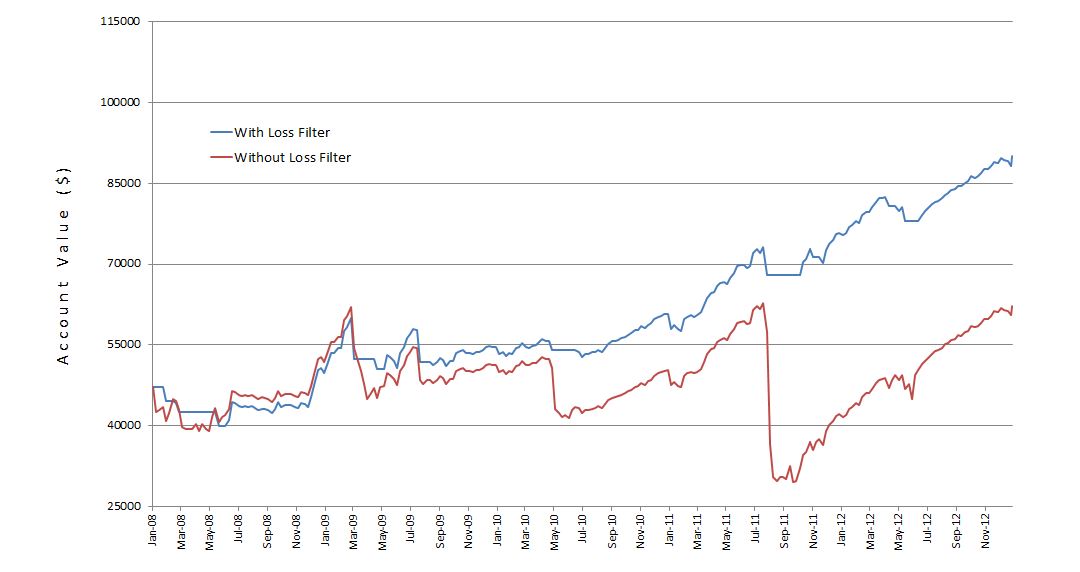
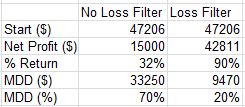
The methodology is still worth researching but a 90% profit is nowhere close to 143%.
I am categorizing this post as optionScam.com (http://www.optionfanatic.com/2012/04/21/optionscam-com/) because I have found deception to be commonplace among newsletter and trader education/mentorship offerings. You should understand the theory behind a proposed system and review the results to see if they are consistent with general tenets of the theory. Furthermore, you should not fall for the “one good example” that might be cherry picked from a population of losers. You should always be thinking about other possible combinations, market environments, and trade situations to evaluate whether an exemplar successful in one situation is likely to be successful in others.
I outperformed with this analysis by going beyond human nature to detect an honest mistake and I believe this is exactly what we need to do as traders to be successful. I really cannot emphasize that enough. Human nature is falling prey to the confirmation bias, as written here:
> The reason confirmation bias can be so deadly to a human is because… we tend to look only
> for information that supports our pre-held beliefs… not only could we be biased about the
> information we do get a hold of, we may completely sidestep vital information in the first
> place, just because we are subconsciously ignoring everything that doesn’t fit in with our
> beliefs.
For the most part, traders maintain hope that a “Holy Grail” exists. Once we get wind of a potential contender, we become captivated. We confirm evidence in support and discard, overlook, or refuse to scrutinize evidence to the contrary. Confirmation bias must be one of the biggest culprits of flawed system development methodology. If left undetected then traders will fall victim (i.e. lose money) to the “scam” perpetrated by another or, even worse, inadvertently by themselves.
Categories: Accountability, optionScam.com, System Development | | Permalink
Posted by Mark on February 22, 2013 at 05:29 | Last modified: February 13, 2013 05:20
In http://www.optionfanatic.com/2013/02/20/2012-performance-evaluation-part-8/, I detailed the loss filter (LF) concept and showed performance results with and without the LF. I then went on to describe two potential flaws with the analysis.
As mentioned previously, when I see shockingly impressive results I tend to scrutinize closely to see if mistakes, either deliberate or inadvertent, have been made. Did you look closely at the graph in the previous post? If so then you might have seen what I did:
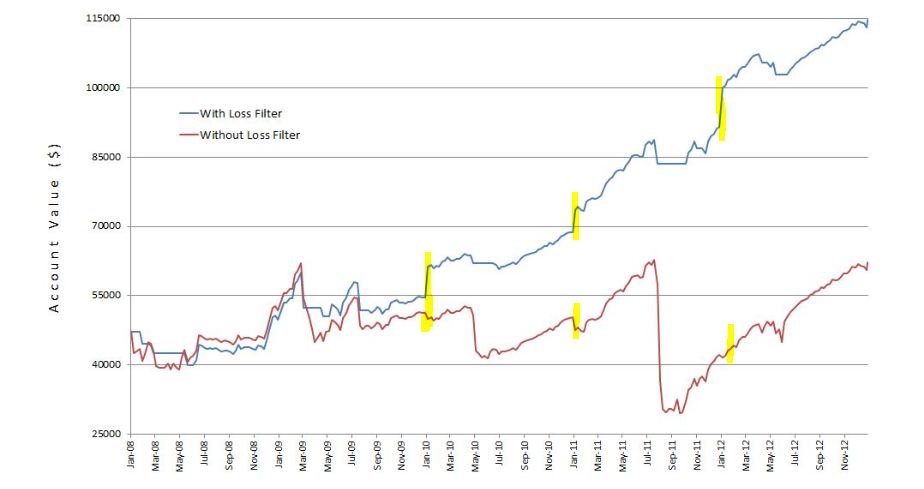
When activated, the LF keeps me out of the market, which results in a flat equity curve. The red line should always be gaining when the blue line is gaining because the red line is always in the market (no LF). Highlighted in yellow above are three occurrences where the blue line was gaining and the red line either gained much less or lost.
As it turns out, I made a mistake in the spreadsheet at year-end 2009, 2010, and 2011!
I will continue this analysis in my next post.
Categories: Accountability | | Permalink